Exam and Test Anxiety
A worksheet for identifying the catastrophic predictions behind exam and test anxiety, weighing them against the evidence, and planning a behavioural experiment or a preparation and exam-day approach that reduces anxiety rather than feeding it.
About this resource
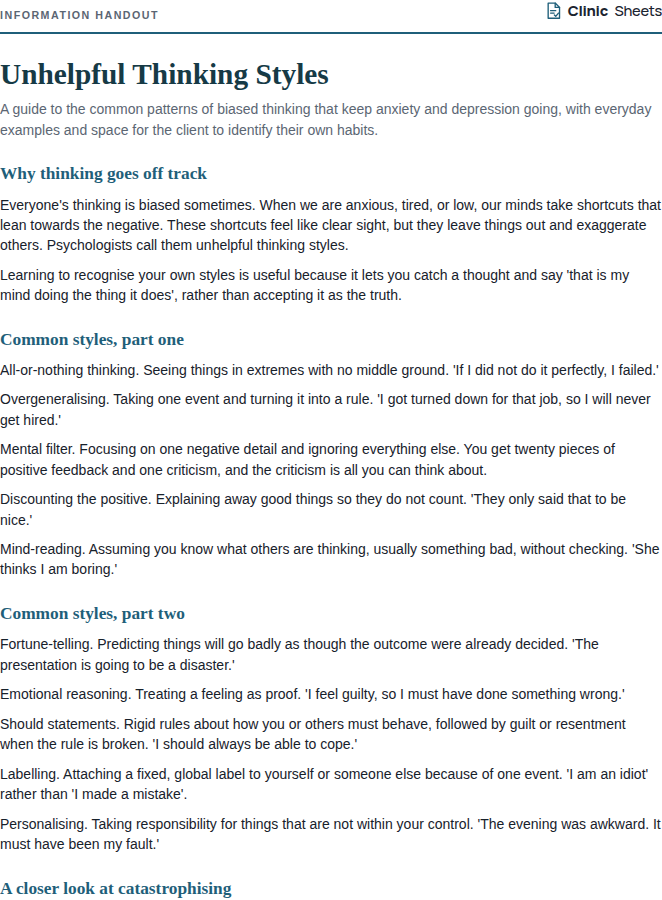
Test anxiety combines anticipatory worry, physiological arousal and, for many students, perfectionistic standards in which anything short of an excellent result is experienced as failure. The worry component is particularly disruptive: catastrophic predictions about the consequences of a poor result consume working memory during preparation and during the exam itself, so the anxiety produces some of the very underperformance it fears. Avoidance in the form of procrastination, over-preparation or last-minute cramming completes the cycle.
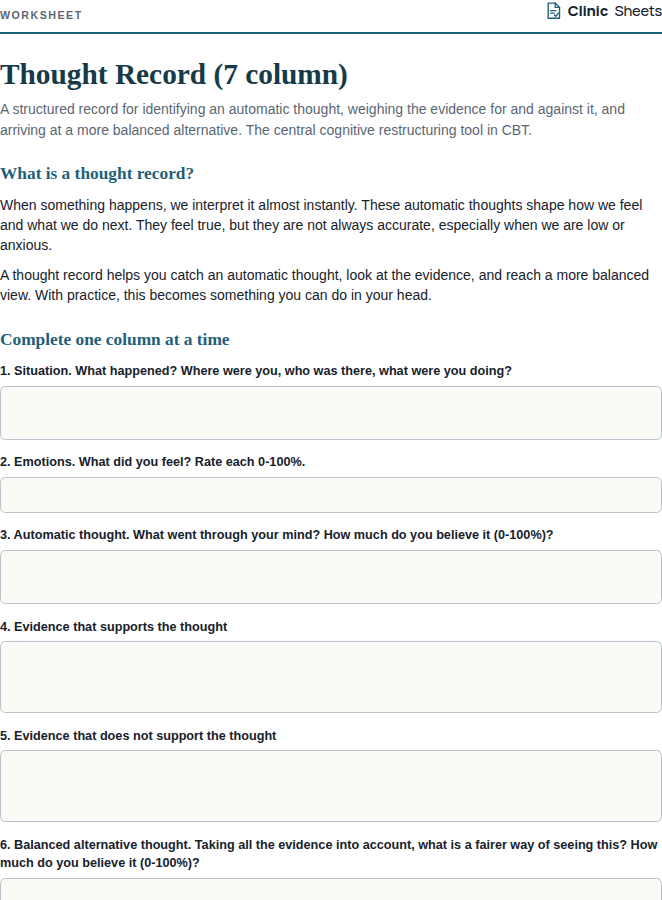
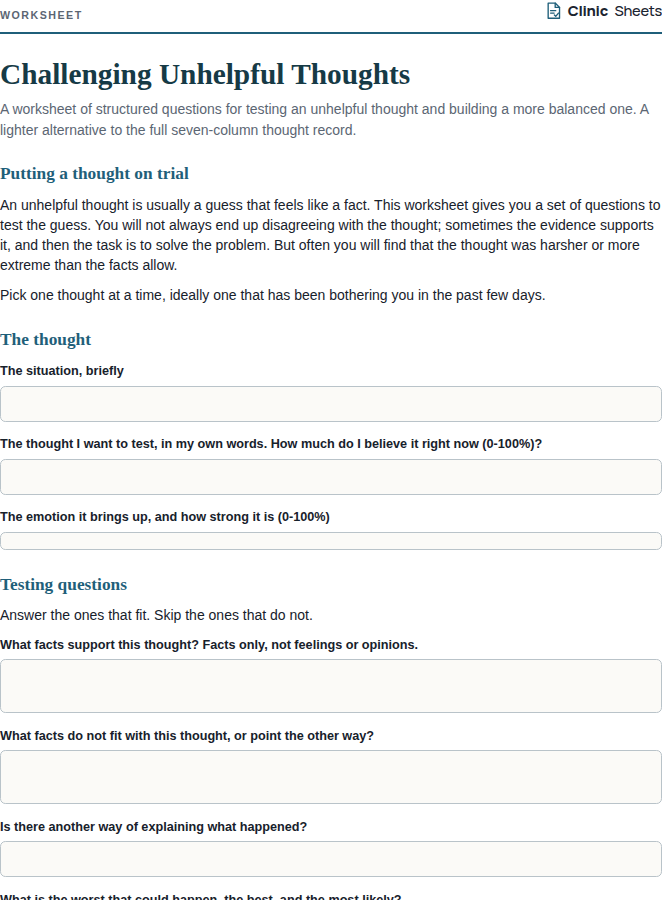
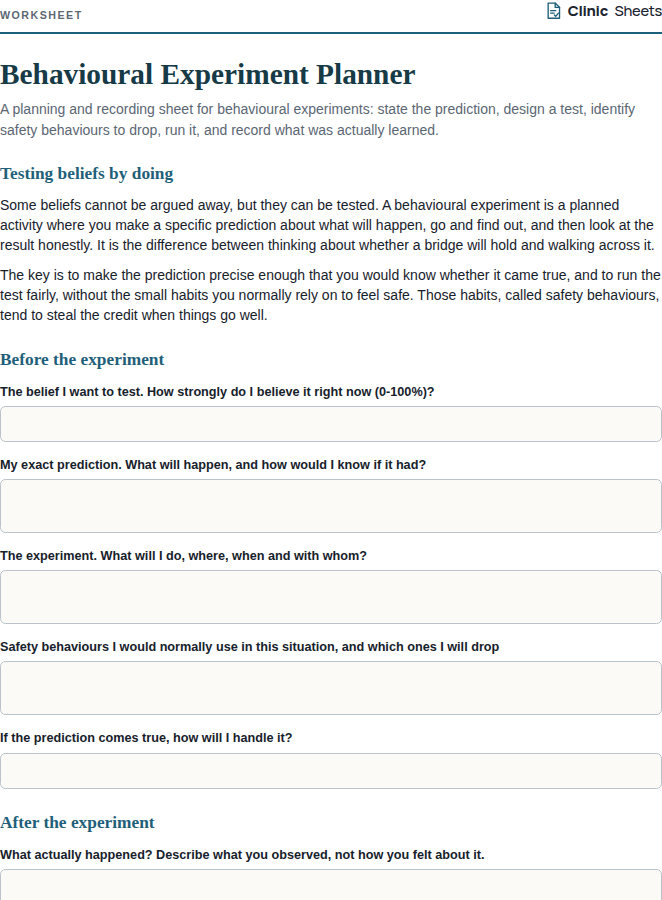
This worksheet takes the student through the CBT sequence: identifying the specific feared outcome and the chain of consequences behind it, rating belief and anxiety, examining the evidence, and generating a balanced prediction. It then asks for a concrete behavioural experiment, such as stopping revision at a set time or sitting a practice paper under timed conditions, so the balanced prediction can be tested rather than simply argued for. A final section turns the work into a practical exam-day plan.
The professional version adds guidance on distinguishing test anxiety from under-preparation or a learning difference, on working with perfectionism as the driver, and on liaising with schools about accommodations where appropriate.
How to use it
- Assess first whether the difficulty is anxiety, preparation or an underlying learning or attention difficulty. This worksheet targets the anxiety component; the others need their own plan.
- Complete the first section together using an upcoming or recent exam. Push past 'I'll fail' to the feared chain of consequences, since that is where the catastrophising lives.
- Work through the evidence and balanced prediction in session. Past results, recovery from previous setbacks and the actual consequences of an imperfect mark are usually the most persuasive evidence.
- Design one behavioural experiment that can be run before the next session. Keep it specific and measurable.
- Review the experiment and complete the exam-day plan together. Share the plan with parents or the school if the student agrees.
References
- Zeidner, M. (1998). Test Anxiety: The State of the Art. Plenum Press.
- Egan, S. J., Wade, T. D., Shafran, R., & Antony, M. M. (2014). Cognitive-Behavioral Treatment of Perfectionism. Guilford Press.
- Bennett-Levy, J., Butler, G., Fennell, M., Hackmann, A., Mueller, M., & Westbrook, D. (Eds.). (2004). Oxford Guide to Behavioural Experiments in Cognitive Therapy. Oxford University Press.