Selective Mutism: A Guide for Parents
A parent handout explaining what selective mutism is, why a child who talks freely at home may be unable to speak at school, and how gradual, low-pressure practice helps. Written to support the parent's role in a behavioural treatment plan.
About this resource
Selective mutism is an anxiety disorder in which a child consistently fails to speak in specific social situations, most often school, despite speaking comfortably in others, usually at home with close family. It is not defiance, shyness that will pass on its own, or a language problem, although it can co-occur with speech and language difficulties. Most children with selective mutism meet criteria for social anxiety disorder, and the condition is best understood as an extreme form of anxious avoidance: not speaking removes the child from the feared situation, so the fear is never disconfirmed and the silence becomes the habit.
Behavioural treatment works by reversing that cycle. Speaking is broken down into very small steps (from non-verbal participation, through whispering or speaking to a parent while a new person is nearby, to speaking directly to the new person) and the child moves up the ladder at a pace that keeps anxiety manageable. Techniques such as stimulus fading, shaping and contingency management have the strongest support. Parents are essential to this work because they are the people the child already speaks to, which makes them the bridge to new speaking partners.
This handout gives parents an accurate model of the problem, explains why rescuing and pressuring both backfire, and describes what their part in treatment will look like. The professional version notes the typical age of onset and presentation, the importance of school liaison and a shared plan across settings, and the value of screening for co-occurring language difficulties before attributing all non-speaking to anxiety.
How to use it
- Give this handout after assessment, once selective mutism has been identified and before you introduce the treatment plan. Ask the parents to read it and note anything that does not fit their child.
- Use the section on rescuing and pressuring to open a non-blaming discussion about what happens at home and school when the child does not speak. Most families are doing what any caring adult would do; the point is to show why it maintains the problem.
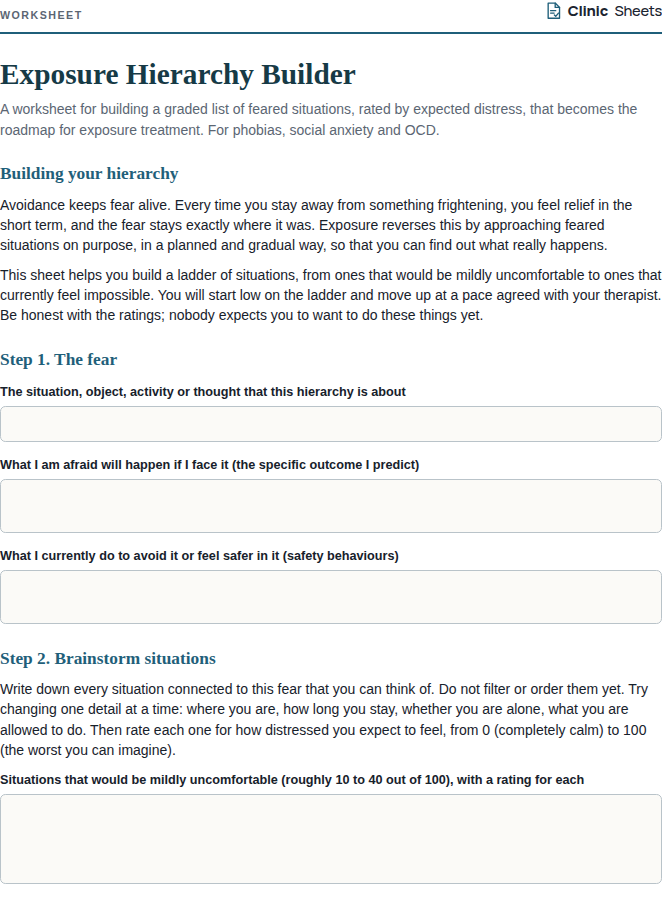
- Introduce the idea of a speaking ladder and build the first few steps together. Start with steps the child can already do reliably, so early practice is a success.
- Agree how school will be involved. A consistent plan across home and school, with one identified adult at school, is far more effective than home practice alone.
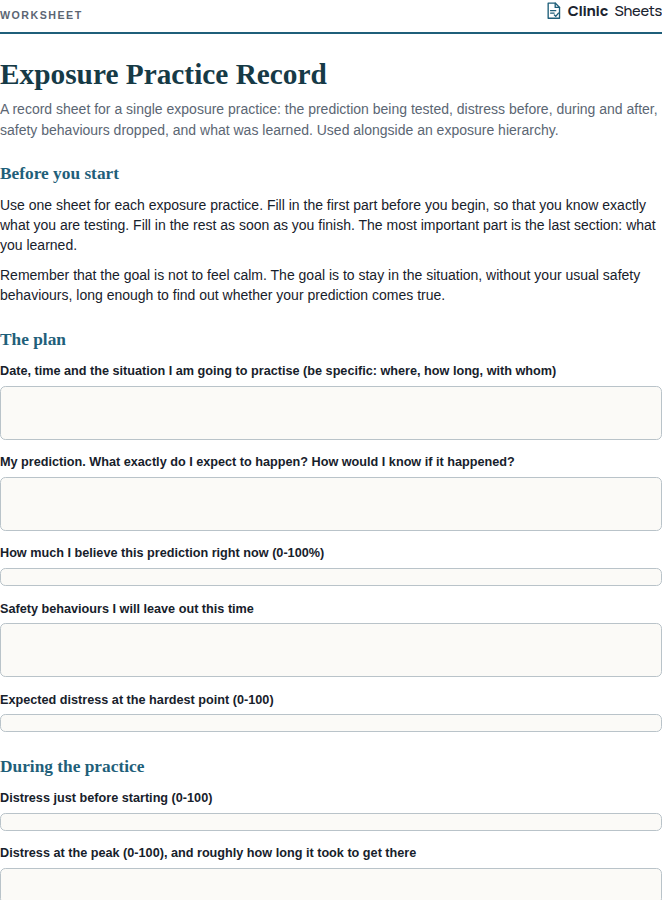
- Review the parent reflection fields in the next session and use them to shape the first exposure tasks.
References
- Bergman, R. L. (2013). Treatment for Children with Selective Mutism: An Integrative Behavioral Approach. Oxford University Press.
- Kearney, C. A. (2010). Helping Children with Selective Mutism and Their Parents: A Guide for School-Based Professionals. Oxford University Press.
- Muris, P., & Ollendick, T. H. (2015). Children who are anxious in silence: A review on selective mutism, the new anxiety disorder in DSM-5. Clinical Child and Family Psychology Review, 18(2), 151-169.