Safety Behaviours
A client handout explaining what safety behaviours are, why they feel helpful in the moment, and how they quietly keep anxiety going. Psychoeducation to prepare clients for dropping safety behaviours during exposure.
About this resource
Safety behaviours are the things people do, or avoid doing, to prevent a feared outcome or to feel less anxious when they cannot escape a situation. They range from the obvious (carrying medication 'just in case', sitting near the exit) to the subtle (rehearsing sentences before speaking, gripping a shopping trolley, monitoring one's own heartbeat). Salkovskis proposed that these behaviours are central to the persistence of anxiety disorders because they prevent disconfirmation: when the feared catastrophe does not happen, the person attributes the non-event to the safety behaviour rather than to the fact that the danger was overestimated.
This handout introduces the concept in plain language, distinguishes safety behaviours from genuine coping, and explains the three ways they maintain anxiety: blocking new learning, keeping attention on threat, and sometimes producing the very symptoms the person fears. It closes with a reflection section in which the client lists their own safety behaviours and what each one is 'protecting' them from.
Use it early in treatment for panic, social anxiety, health anxiety or specific phobia, before exposure or behavioural experiments begin. Clients who understand why safety behaviours are a problem are far more willing to drop them, and far less likely to smuggle them back in during exposure. The professional version adds a list of commonly missed subtle safety behaviours by disorder, and guidance on distinguishing safety behaviours from adaptive coping in clients who protest that a behaviour is 'just sensible'.
How to use it
- Introduce after the client has described their anxiety and the situations they find difficult, and once you have a shared formulation of the feared catastrophe.
- Read the handout together. As you go, ask the client to notice which examples sound familiar. Most clients recognise the obvious ones and are surprised by the subtle ones.
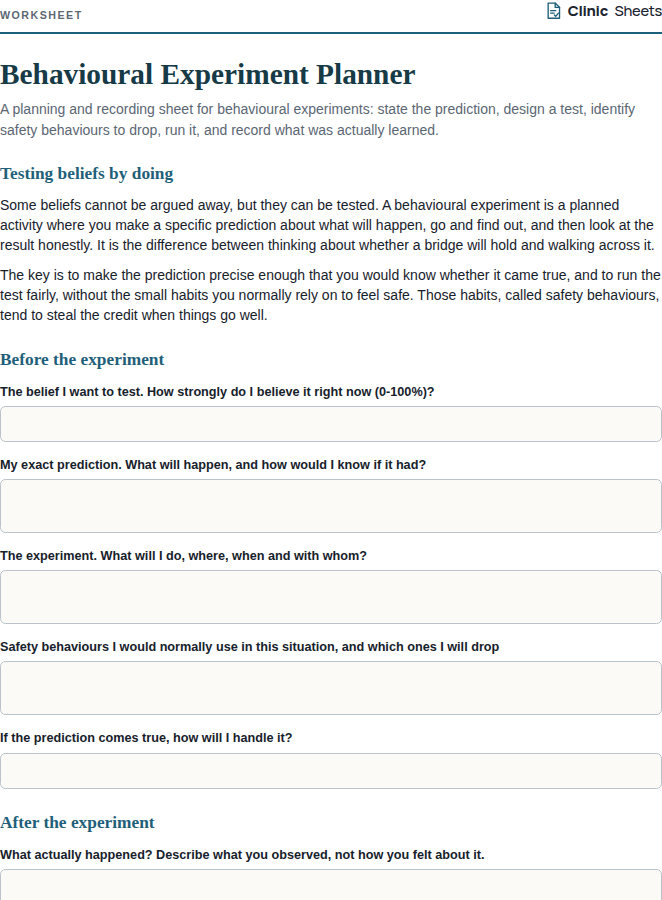
- Complete the reflection section in session. For each behaviour ask: What do you think would happen if you did not do this? That answer is the prediction you will test later.
- Look together for hidden safety behaviours: things the client does so automatically they do not register as choices. Ask what they would notice if they were forbidden from doing it.
- Link directly to the next step: exposure hierarchy building or a behavioural experiment in which one safety behaviour is deliberately dropped and the feared outcome is checked.
References
- Salkovskis, P. M. (1991). The importance of behaviour in the maintenance of anxiety and panic: A cognitive account. Behavioural Psychotherapy, 19(1), 6-19.
- Salkovskis, P. M., Clark, D. M., Hackmann, A., Wells, A., & Gelder, M. G. (1999). An experimental investigation of the role of safety-seeking behaviours in the maintenance of panic disorder with agoraphobia. Behaviour Research and Therapy, 37(6), 559-574.
- Helbig-Lang, S., & Petermann, F. (2010). Tolerate or eliminate? A systematic review on the effects of safety behavior across anxiety disorders. Clinical Psychology: Science and Practice, 17(3), 218-233.
- Clark, D. M., & Wells, A. (1995). A cognitive model of social phobia. In R. G. Heimberg et al. (Eds.), Social Phobia: Diagnosis, Assessment, and Treatment (pp. 69-93). Guilford Press.