Body Clues: Where Do I Feel My Feelings?
A worksheet that helps a child notice where different feelings show up in their body, name the feeling from the clues, and rate how big it is, building the first step of emotion regulation: knowing what you feel.
About this resource
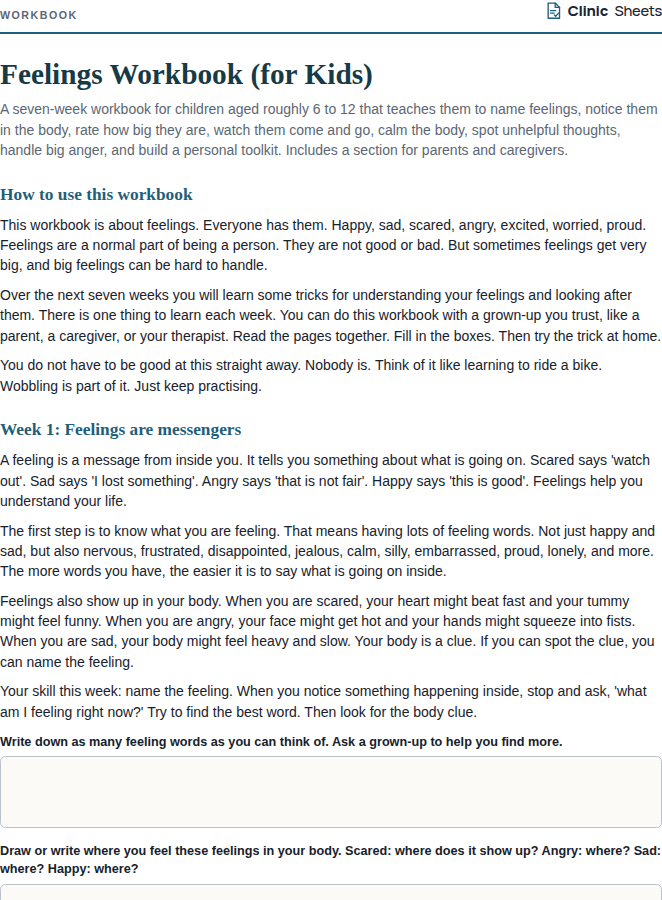
You cannot manage a feeling you have not noticed. Children who struggle with anxiety or big emotions often go from calm to overwhelmed with no awareness of the stages in between, and by the time they (and their parents) realise what is happening, the feeling is too big to reason with. Both CBT and DBT for young people start emotion work with observing and describing: noticing the body sensations that go with each feeling, naming the feeling, and rating its size. In DBT this is part of the mindfulness 'what' skills and the emotion regulation module; in child CBT it is usually taught early through a feelings thermometer and body maps.
This worksheet teaches the child that feelings leave clues in the body. Worry might be a wobbly tummy, fast breathing and hot cheeks; anger might be tight fists, a hot face and a loud voice; sadness might be heavy arms and a lump in the throat. The child works through a few feelings, records their own body clues for each, and then learns to use a feelings thermometer to rate the size. The point is early detection: catching a feeling at a three or four, when calming tools still work, rather than at a nine.
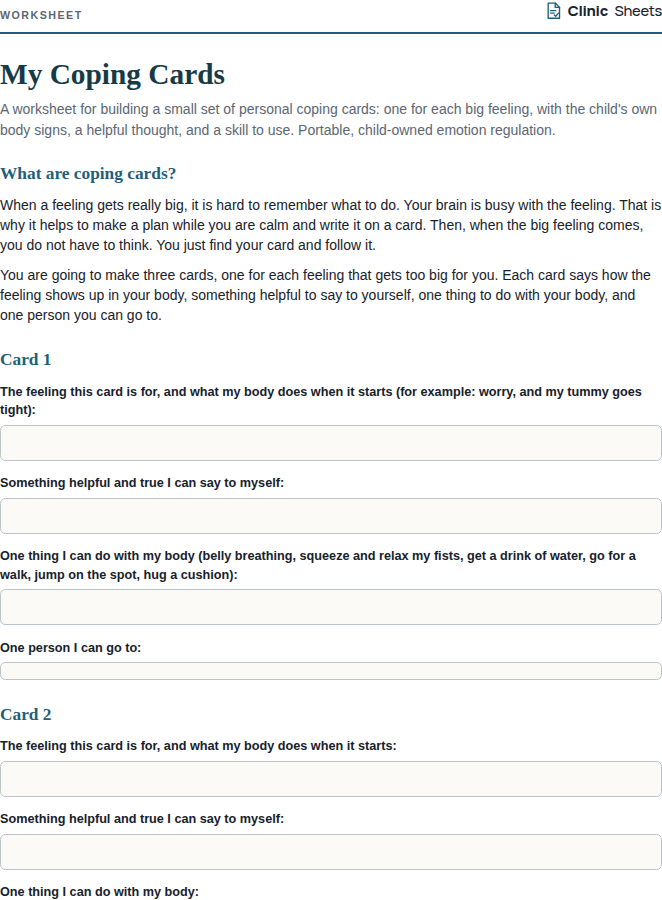
The professional version notes that children's body clues are individual and that the examples on the page are prompts, not answers. It also suggests using the completed worksheet as the basis for a personalised early-warning plan, and linking it to whichever calming skills the child is learning (see Calm Corner Plan).
How to use it
- Introduce the idea that feelings live in the body as well as the head. Ask the child to remember a time they were very excited or very scared and to describe what their body did.
- Work through each feeling. Ask where the child feels it, what it feels like, and what their body wants to do. Use a simple body outline if the child likes to draw.
- Teach the thermometer: 0 is none, 10 is the biggest ever. Rate a few recent feelings together. Identify what the child's body clues are at a three or four, since that is the number to catch.
- Ask the child to notice one feeling each day this week and write down the body clue and the number. A parent can prompt at bedtime.
- Use the completed worksheet to build an early-warning plan: 'when I notice my fists are tight, that is a four, and that means I use my calm tools'.
References
- Linehan, M. M. (2015). DBT Skills Training Manual (2nd ed.). Guilford Press.
- Rathus, J. H., & Miller, A. L. (2015). DBT Skills Manual for Adolescents. Guilford Press.
- Stallard, P. (2019). Think Good, Feel Good: A CBT Workbook for Children and Young People (2nd ed.). Wiley.