Dropping Anchor
A brief grounding exercise from ACT for moments of emotional storm. The client acknowledges what is happening inside, comes back into the body, and engages with the world around them, so that they can act with intention rather than being swept away.
About this resource
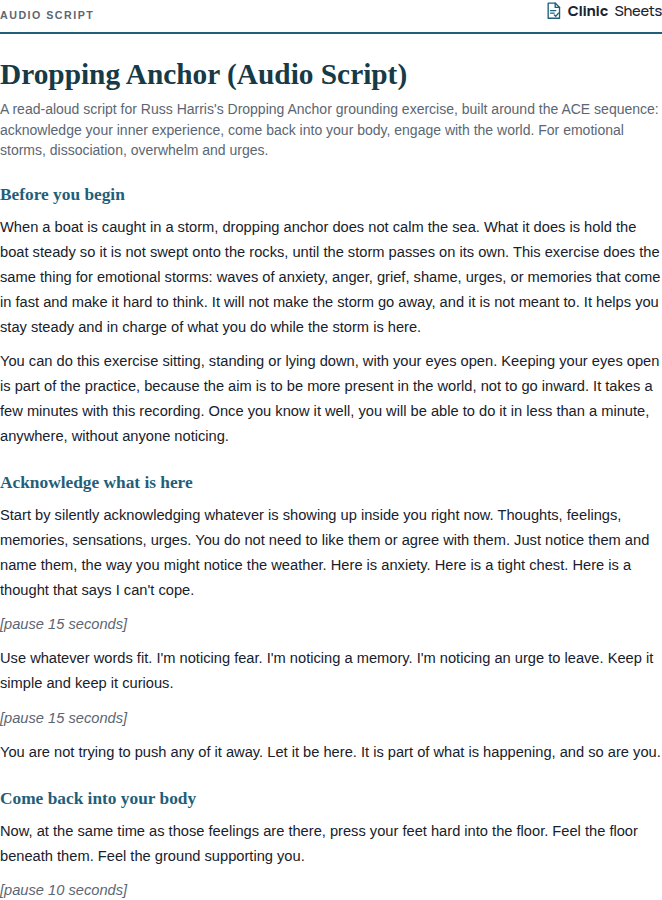
Dropping anchor is a grounding practice developed within Acceptance and Commitment Therapy, most closely associated with Russ Harris. It is designed for moments when a person is caught in intense emotion, overwhelming thoughts, dissociation or an urge to act impulsively. The metaphor is simple: an anchor does not stop the storm, but it holds the boat steady until the storm passes. The exercise does not aim to reduce the emotion. It aims to give the person a stable place to stand while the emotion is present, so that they retain choice over their behaviour.
The practice has three parts, which can be cycled through in under a minute or extended for several. First, acknowledge what is showing up inside: name the thoughts, feelings and sensations without trying to change them. Second, come back into the body: press the feet into the floor, straighten the spine, stretch, notice the physical sense of having control of the body even while the emotion is uncontrollable. Third, engage with the world: notice what can be seen, heard and touched, and bring attention to the present situation and what can be done in it.
Because it is short and portable, dropping anchor is useful across anxiety, panic, anger, trauma-related distress and general emotion dysregulation. It works well early in treatment, before the client has learned more elaborate skills, and it is often the first thing a client uses in a crisis. It is not a relaxation exercise, and clinicians should be careful not to present it as one, since clients who use it to control emotion will conclude it does not work.
The professional version includes a two-minute spoken script, guidance on titrating the exercise for clients with trauma histories who find body awareness activating (emphasising the engagement step and keeping the eyes open), and notes on using it in session when a client becomes flooded.
How to use it
- Introduce the metaphor before the exercise. Ask the client what an anchor does and does not do in a storm, and make explicit that the goal is steadiness, not calm.
- Guide the exercise aloud in session the first time, ideally when the client is experiencing at least mild distress so that the practice is realistic. Keep your voice steady and instructions concrete.
- Emphasise that all three parts happen while the difficult experience is still present. Acknowledging it and coming back into the body are done alongside it, not instead of it.
- Ask the client to practise several times a day at first, during ordinary moments, so the sequence is familiar before it is needed in a storm. Then encourage use at the first sign of being pulled under.
- Debrief with process questions: What did you notice? Did you have more choice about what to do next? Do not ask whether they felt better.
References
- Harris, R. (2019). ACT Made Simple: An Easy-to-Read Primer on Acceptance and Commitment Therapy (2nd ed.). New Harbinger.
- Harris, R. (2021). Trauma-Focused ACT: A Practitioner's Guide to Working with Mind, Body, and Emotion Using Acceptance and Commitment Therapy. New Harbinger.
- Hayes, S. C., Strosahl, K. D., & Wilson, K. G. (2012). Acceptance and Commitment Therapy: The Process and Practice of Mindful Change (2nd ed.). Guilford Press.