Feelings Workbook (for Kids)
A seven-week workbook for children aged roughly 6 to 12 that teaches them to name feelings, notice them in the body, rate how big they are, watch them come and go, calm the body, spot unhelpful thoughts, handle big anger, and build a personal toolkit. Includes a section for parents and caregivers.
About this resource
Difficulty recognising, tolerating and managing emotion underlies many childhood presentations, including anxiety, anger outbursts and low mood. Cognitive behavioural programmes for children, such as Kendall's Coping Cat and Stallard's Think Good, Feel Good, begin with emotion recognition and body awareness before moving to thoughts and behaviour, because a child who cannot name or rate a feeling cannot yet do much with it. Dialectical behaviour therapy contributes the skills of observing emotions without acting on them, reducing bodily arousal in the moment, and acting opposite to an unhelpful urge.
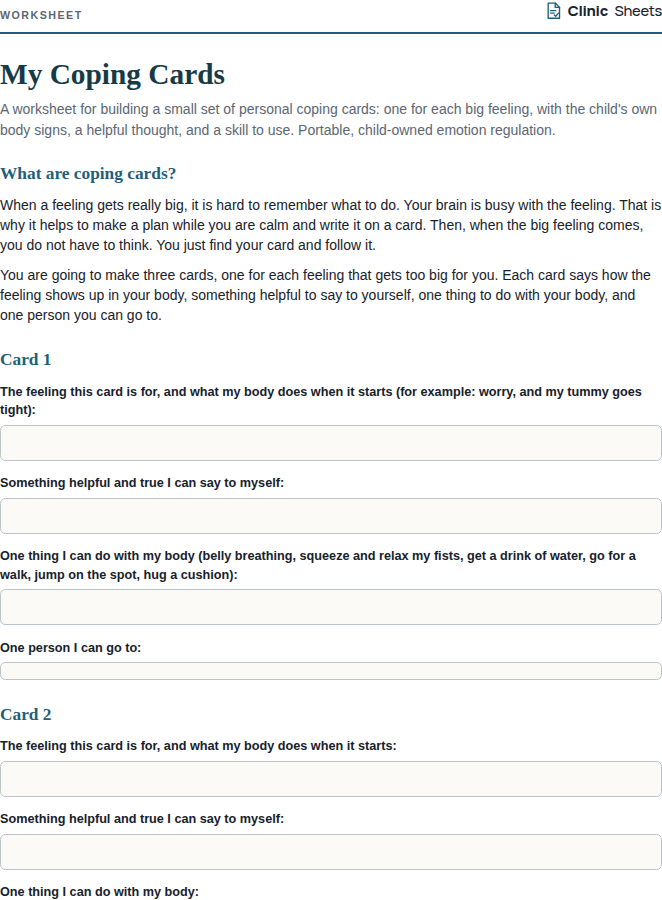
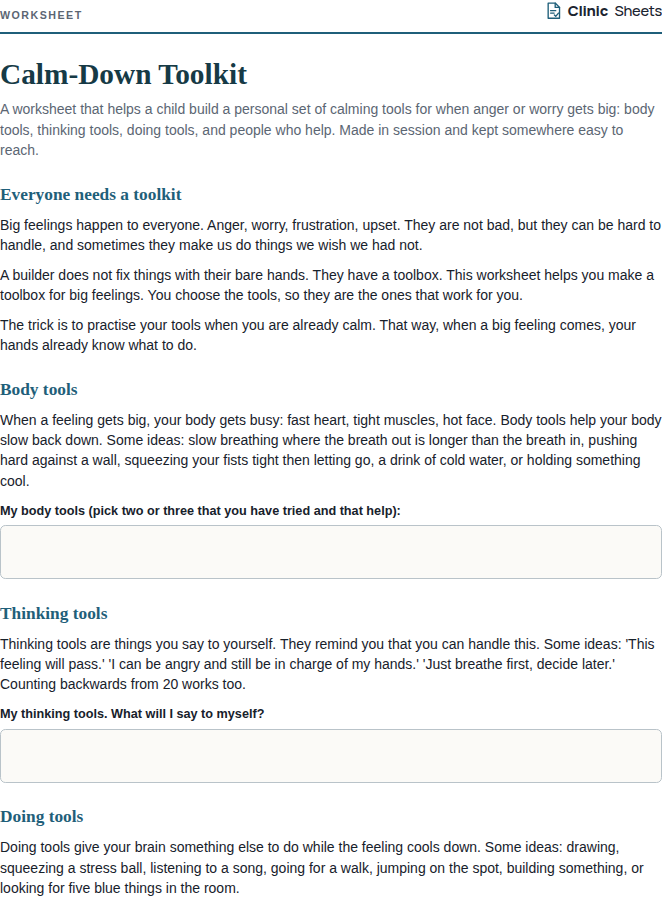
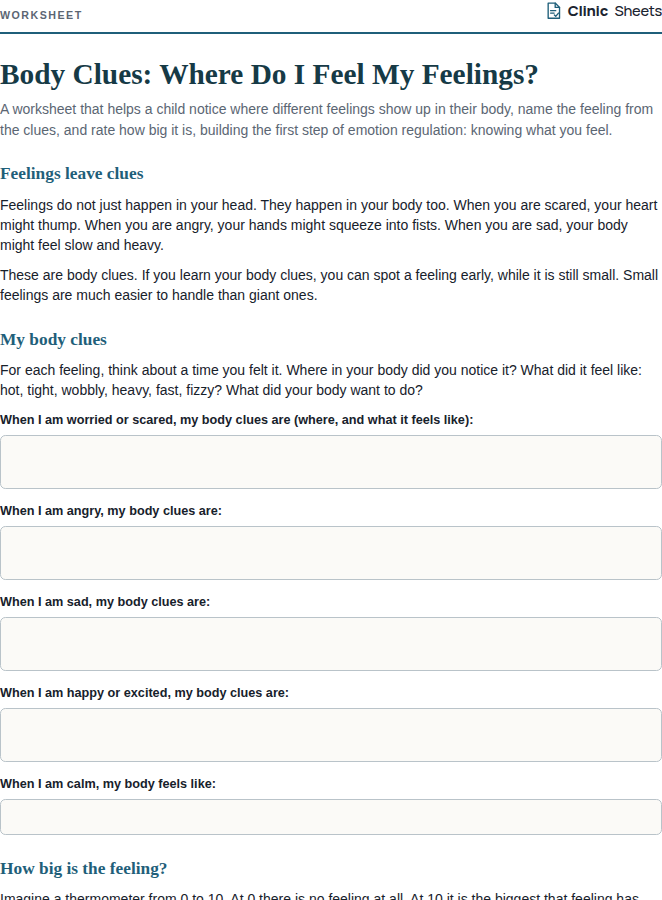
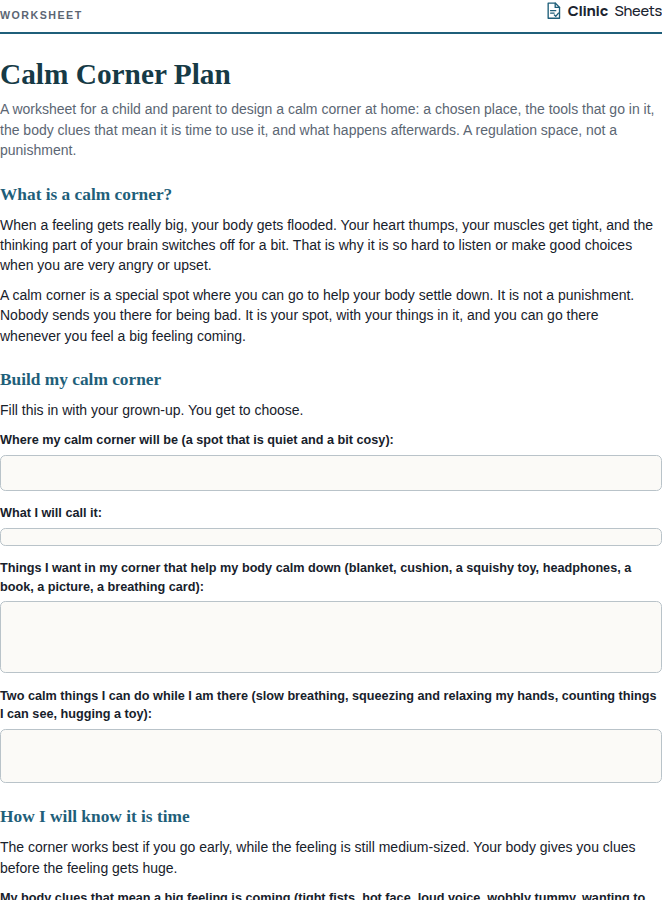
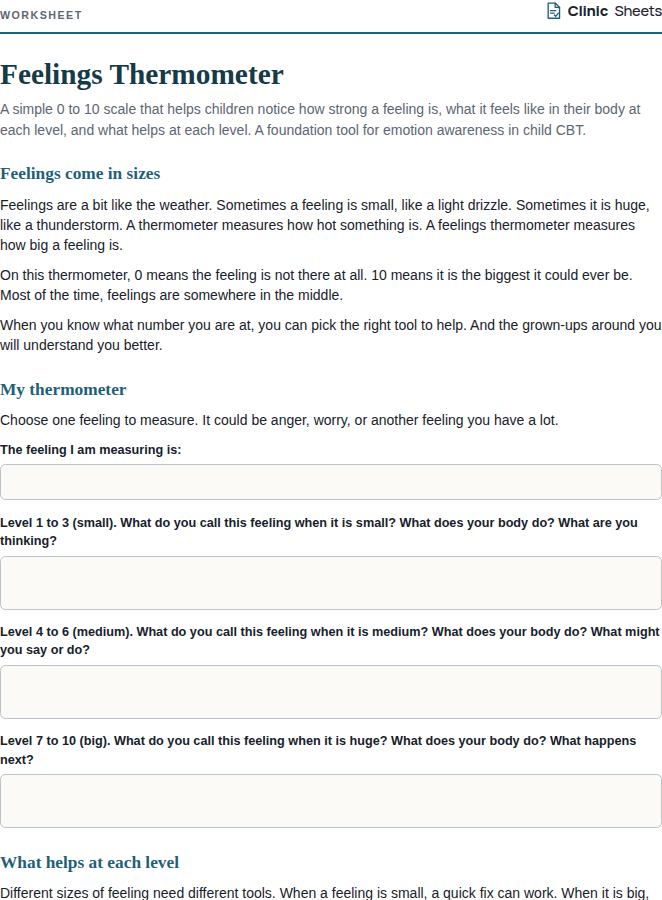
This workbook draws those elements into a seven-week sequence written for the child, with short sentences and one idea per paragraph. Each week has a brief explanation, one skill, and practice fields the child can complete with an adult. The sequence runs from naming feelings and finding them in the body, through a feelings thermometer, watching feelings like waves, calming the body, spotting unhelpful thoughts, managing anger with a pause plan, and finally assembling a toolkit. It closes with a review and a section for parents and caregivers on how to support the skills at home.
The professional version includes guidance on pacing (one week per session is typical but not required), on adapting the language for younger and older children, on involving parents in practice, and on when emotion dysregulation warrants broader assessment.
How to use it
- Use one week per session, or slower if the child needs more time. Read each week's explanation together and do the practice fields in session before asking the child to try the skill at home.
- Involve a parent or caregiver from the start. Ask them to read the final section, to help with the home practice, and to model the skills, especially naming their own feelings and using the pause plan.
- Keep it playful. Use the child's own examples, draw the feelings thermometer together, practise belly breathing with a toy on the stomach. Children learn these skills through doing, not through being told.
- Do not rush past Weeks 1 and 2. Naming and rating feelings is the foundation for everything that follows. If the child struggles to find feeling words, spend extra time here.
- Review the practice fields at the start of each session and praise effort, not just success. A child who tried the pause plan and still shouted has done the homework.
- If a child shows persistent, severe dysregulation, aggression that endangers others, or signs of trauma, use the workbook as part of a fuller assessment and treatment plan rather than as a stand-alone intervention.
References
- Stallard, P. (2019). Think Good, Feel Good: A CBT Workbook for Children and Young People (2nd ed.). Wiley-Blackwell.
- Kendall, P. C., & Hedtke, K. A. (2006). Cognitive-Behavioral Therapy for Anxious Children: Therapist Manual (3rd ed.). Workbook Publishing.
- Linehan, M. M. (2015). DBT Skills Training Manual (2nd ed.). Guilford Press.
- Southam-Gerow, M. A. (2013). Emotion Regulation in Children and Adolescents: A Practitioner's Guide. Guilford Press.