Calm-Down Toolkit
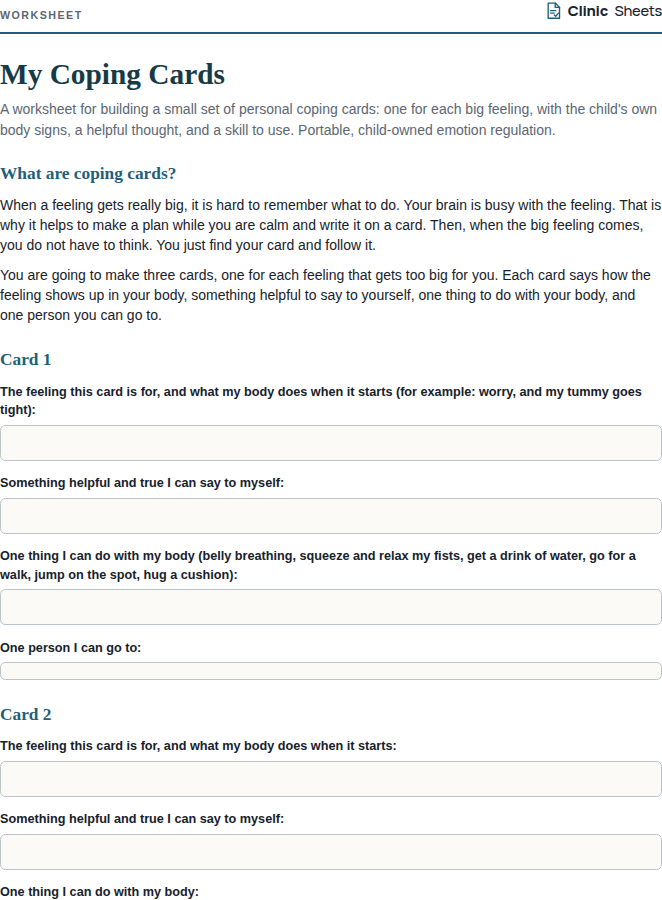
A worksheet that helps a child build a personal set of calming tools for when anger or worry gets big: body tools, thinking tools, doing tools, and people who help. Made in session and kept somewhere easy to reach.
About this resource
Children with anger or anxiety difficulties often know a few calming strategies in the abstract but cannot access them in the moment, because a flooded nervous system does not search memory for coping skills. A calm-down toolkit solves part of this problem by making the strategies concrete, personal and visible before they are needed. The child chooses tools that have worked for them, writes them down in their own words, and keeps the list (and sometimes a physical box of objects) where they can reach it. Adults can then point to the toolkit rather than lecture.
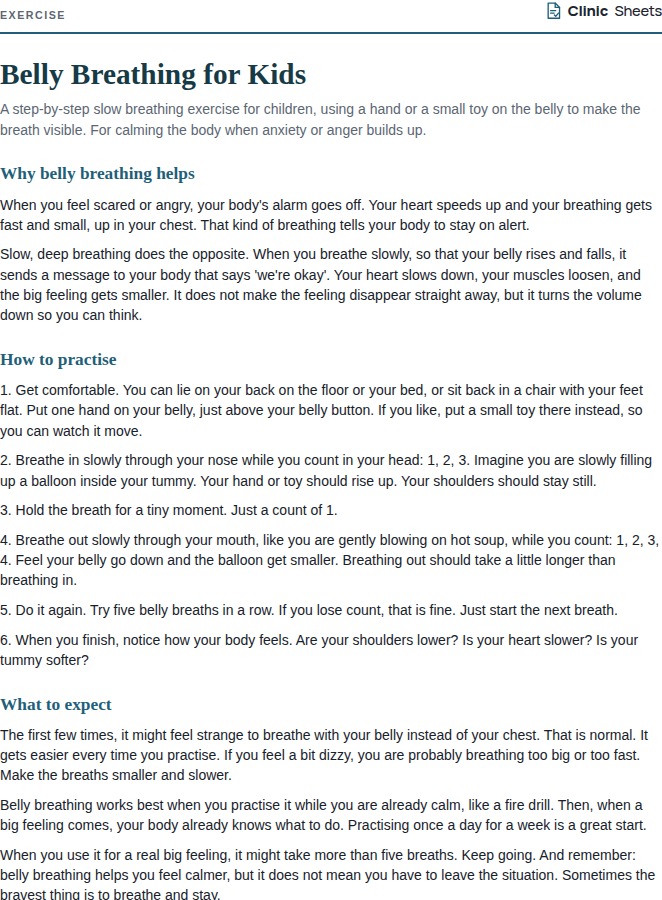
This worksheet organises tools into four kinds. Body tools settle physiological arousal (slow breathing, pushing against a wall, a cold drink, squeezing and releasing fists). Thinking tools change what the child says to themselves (a coping phrase, remembering it will pass, counting). Doing tools redirect attention (drawing, a fidget object, music, a walk). People tools identify who to go to and what to say. The structure draws on emotion regulation skills from child CBT and on the distress tolerance and self-soothing skills of DBT, adapted for children.
The professional version adds guidance on trialling tools in session while the child is calm, on pairing the toolkit with a feelings thermometer so the child learns which tools fit which intensity, on building a physical calm-down box, and on coaching parents to prompt the toolkit early rather than at the peak. It notes that tools should be practised when calm, since a strategy tried for the first time at a 9 rarely works.
How to use it
- Introduce the idea that everyone needs tools for big feelings, just as a builder needs a toolbox. Explain that tools work best when you have practised them while calm.
- Go through each of the four categories and try two or three options in session. Let the child rate each one: does it help a little, a lot, or not at all? Only tools the child rates as helpful go in the kit.
- Complete the worksheet in the child's own words. If the child wants to, help them assemble a physical box with a few objects (a stress ball, a photo, a small bottle of bubbles for slow breathing, a card with their coping phrase).
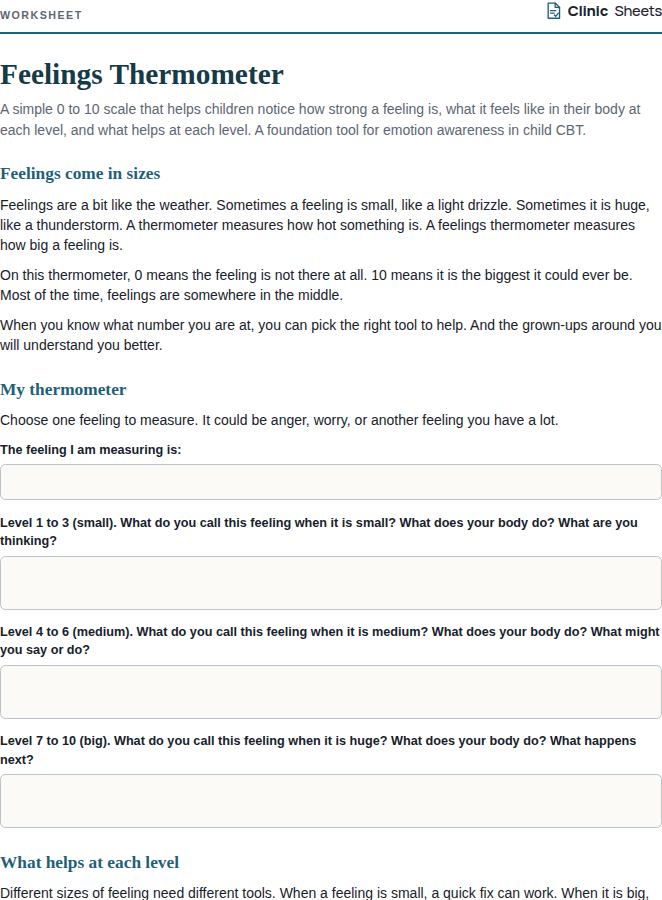
- Link the toolkit to the feelings thermometer if one has been made. Ask which tools are for small feelings and which are for big ones.
- Send a copy home and to school. Agree with the parent on a short prompt ('toolkit?') they can use when they see the feeling starting to rise.
- Review at the next session. Which tools got used, which worked, which need swapping out? Update the kit as the child grows.
References
- Linehan, M. M. (2015). DBT Skills Training Manual (2nd ed.). Guilford Press.
- Stallard, P. (2019). Think Good, Feel Good: A Cognitive Behavioural Therapy Workbook for Children and Young People (2nd ed.). Wiley.
- Lochman, J. E., Wells, K. C., & Lenhart, L. A. (2008). Coping Power: Child Group Program Facilitator Guide. Oxford University Press.