Columbia Suicide Severity Rating Scale Screener: Clinician Guide
A clinician's guide to the Columbia-Suicide Severity Rating Scale (C-SSRS) Screener: what its six questions cover, the skip logic, the low, moderate and high risk categories, and what to do next at each level. Includes Canadian crisis contacts.
About this resource
The Columbia-Suicide Severity Rating Scale was developed by Kelly Posner, Gregory Brown, Barbara Stanley and colleagues at Columbia University, the University of Pennsylvania and the University of Pittsburgh, with support from the US National Institute of Mental Health. The full scale is a structured clinician interview that rates the severity of suicidal ideation and the presence of suicidal behaviour. The Screener is a short version of six questions, drawn from the full scale, that any trained person can ask. It asks about the past month for ideation and about lifetime and the past three months for behaviour, and it sorts the answers into low, moderate and high risk categories with a recommended next step for each.
This resource is a clinician guide. The C-SSRS is free to use, and Columbia asks that the official versions be used without modification, so the questions are described here rather than reproduced; download the Screener from the Columbia Lighthouse Project. The guide explains what each question is establishing (the progression from a passive wish to be dead, through active thoughts, to method, intent and plan, and then behaviour), the skip rule that shortens the interview when active thoughts are absent, the triage categories, and how the Screener fits with risk formulation and safety planning. It is written to be useful to therapists, intake staff and non-clinical team members who may be the first to hear a disclosure.
Two cautions frame everything else. The Screener identifies the presence and level of suicidal ideation and behaviour; it does not replace clinical judgement or a full risk assessment, and a 'low' result in someone whose presentation worries you is a reason to ask more, not less. And asking about suicide does not plant the idea: the evidence is consistent that direct, calm questions are protective, and the C-SSRS is designed to make those questions easy to ask.
How to use it
- Complete the free online training from the Columbia Lighthouse Project before using the Screener, and download the official Screener (the 'recent' version asks about the past month).
- Ask the questions in order, in a calm and matter-of-fact way, using the wording on the form. Explain that these are routine questions you ask everyone. If the answer to the second question (active thoughts of killing oneself) is no, skip to the sixth question about behaviour.
- Record yes or no for each question asked. For the behaviour question, record whether any behaviour occurred in the person's lifetime and, if so, whether it occurred within the past three months.
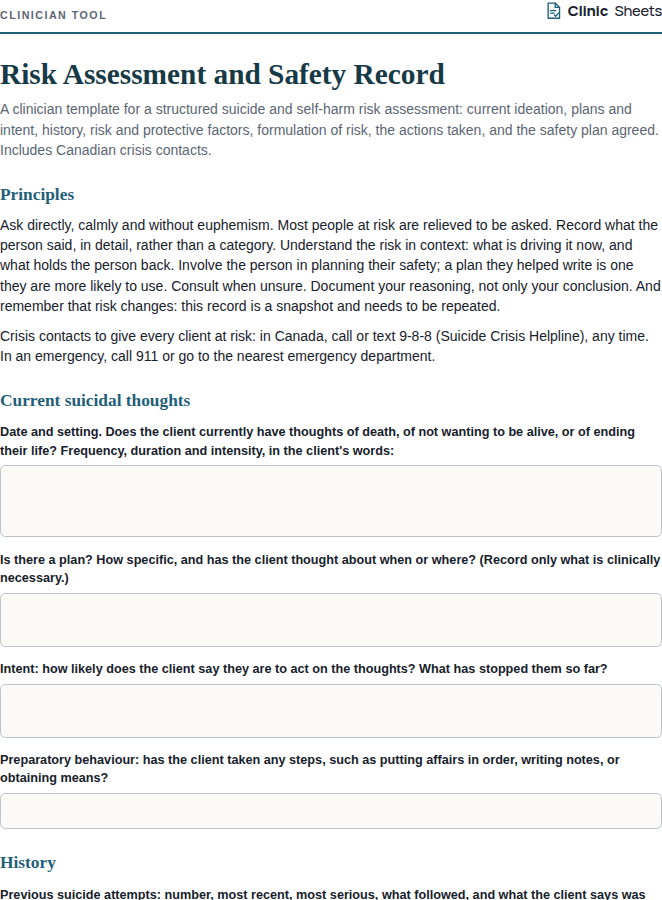
- Assign the risk category using the table in this guide. High risk means a yes to intent (question 4), plan with intent (question 5) or behaviour in the past three months. Moderate means a yes to method without intent (question 3) or behaviour more than three months ago. Low means a yes only to the wish to be dead or non-specific thoughts.
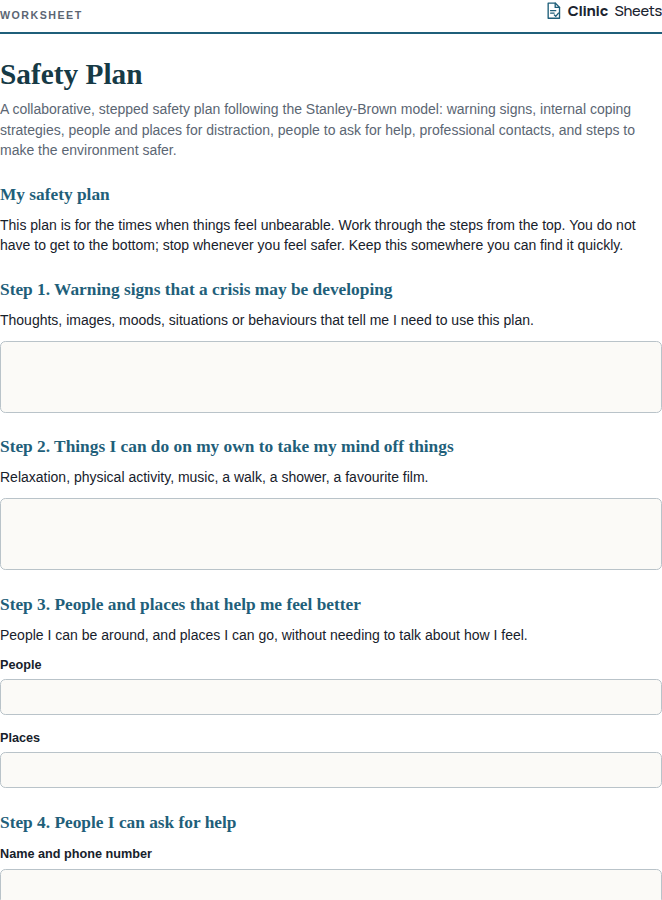
- Act on the category the same day. At high risk, do not leave the person alone; arrange emergency assessment (911 or the nearest emergency department in Canada). At moderate risk, complete a fuller assessment and a safety plan, and consider urgent referral. At low risk, complete a safety plan, share 9-8-8, and follow up. Document what you asked, what was said, and what you did.
References
- Posner, K., Brown, G. K., Stanley, B., Brent, D. A., Yershova, K. V., Oquendo, M. A., Currier, G. W., Melvin, G. A., Greenhill, L., Shen, S., & Mann, J. J. (2011). The Columbia-Suicide Severity Rating Scale: Initial validity and internal consistency findings from three multisite studies with adolescents and adults. American Journal of Psychiatry, 168(12), 1266-1277.
- Stanley, B., & Brown, G. K. (2012). Safety Planning Intervention: A brief intervention to mitigate suicide risk. Cognitive and Behavioral Practice, 19(2), 256-264.
- Dazzi, T., Gribble, R., Wessely, S., & Fear, N. T. (2014). Does asking about suicide and related behaviours induce suicidal ideation? What is the evidence? Psychological Medicine, 44(16), 3361-3363.