Safety Plan
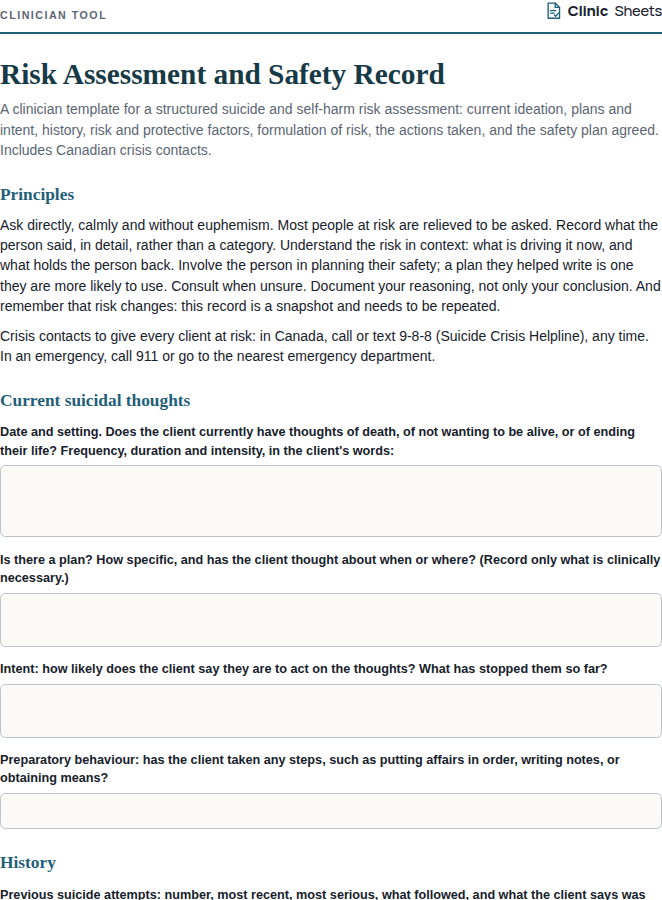
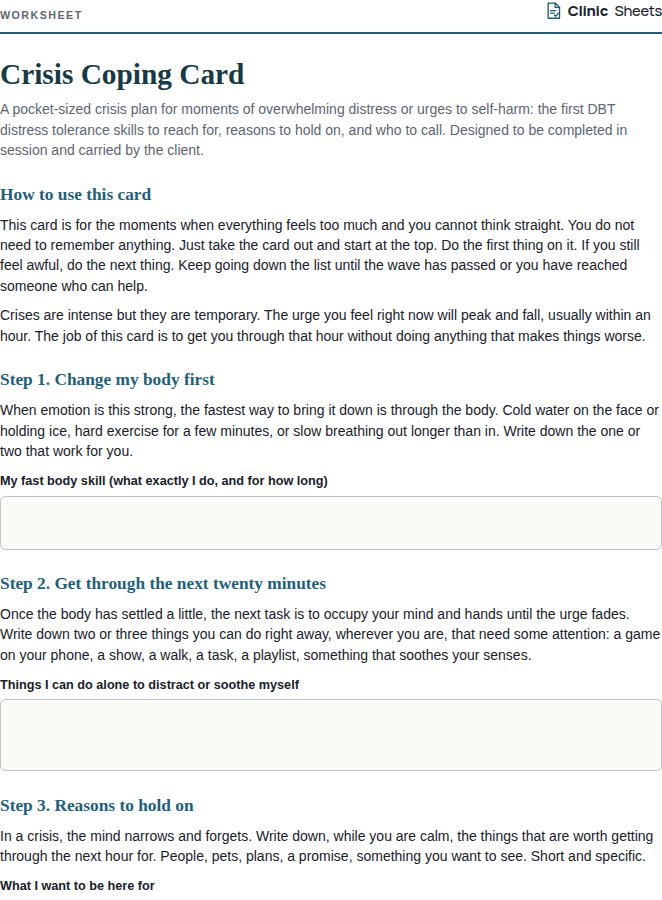
A collaborative, stepped safety plan following the Stanley-Brown model: warning signs, internal coping strategies, people and places for distraction, people to ask for help, professional contacts, and steps to make the environment safer.
About this resource
Safety planning is a brief intervention for people at risk of suicide, developed by Barbara Stanley and Gregory Brown. Rather than a no-suicide contract, it is a prioritised, written list of coping strategies and sources of support that the person can use before or during a crisis. It is completed together with the clinician, in the person's own words.
The plan moves from the least to the most intensive step: recognising warning signs, using internal coping strategies, seeking distraction through people and places, reaching out to people who can help, contacting professionals and crisis services, and making the environment safer. It should be reviewed and updated regularly, and the person should keep a copy somewhere easy to reach.
The professional version includes prompts for each step, guidance on discussing means safety collaboratively, and notes on when to revisit the plan.
How to use it
- Complete the plan collaboratively after a risk assessment, using the client's own words wherever possible.
- Work through the steps in order. For each, ask the client how likely they are to use the item and problem-solve any barriers.
- For the final step, discuss reducing access to means in a collaborative, non-judgemental way. Involve family or supports where appropriate and with consent.
- Give the client a copy (paper and phone photo). Confirm where it will be kept.
- Review the plan at subsequent sessions and after any crisis, and update it as coping strategies and supports change.
References
- Stanley, B., & Brown, G. K. (2012). Safety Planning Intervention: A brief intervention to mitigate suicide risk. Cognitive and Behavioral Practice, 19(2), 256-264.
- Stanley, B., Brown, G. K., et al. (2018). Comparison of the Safety Planning Intervention with follow-up vs usual care of suicidal patients treated in the emergency department. JAMA Psychiatry, 75(9), 894-900.
- Nuij, C., et al. (2021). Safety planning-type interventions for suicide prevention: meta-analysis. British Journal of Psychiatry, 219(2), 419-426.