Risk Assessment and Safety Record
A clinician template for a structured suicide and self-harm risk assessment: current ideation, plans and intent, history, risk and protective factors, formulation of risk, the actions taken, and the safety plan agreed. Includes Canadian crisis contacts.
About this resource
A risk assessment is a clinical conversation with a record, not a checklist that produces a number. Large meta-analyses of suicide risk factors have found that no combination of factors predicts who will die by suicide with useful accuracy, and risk categories such as low, medium and high have poor predictive value. What a good assessment does is establish the current picture in detail, understand it in the context of the person's history and circumstances, involve the person in planning their own safety, and document the reasoning so that colleagues and future clinicians can follow it.
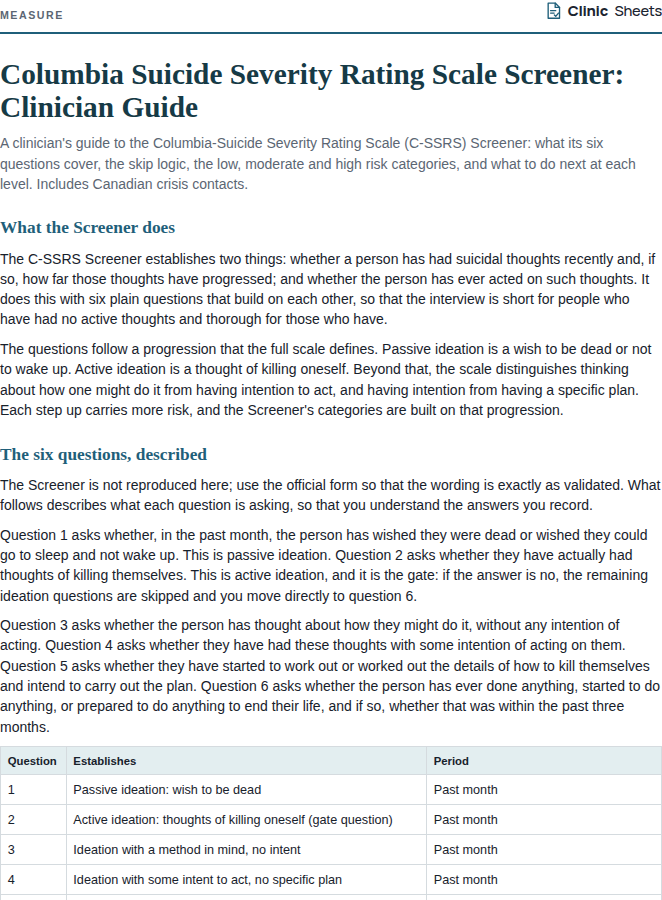
This template supports that process. It is organised around the domains covered in structured tools such as the Columbia-Suicide Severity Rating Scale: current thoughts, their frequency and intensity, plans, intent, preparatory behaviour, past attempts and self-harm, and the factors that increase or reduce risk. It then asks for a brief formulation of risk in prose, the actions taken, the safety plan agreed with the client, and the follow-up arrangements. It is designed to be completed during or immediately after the session and updated at each review.
The professional version includes guidance on asking direct questions in a calm, non-judgemental way, on the difference between assessing and predicting, on collaborative means safety, on consultation and documentation, and on when risk requires immediate action. It does not describe methods of self-harm or suicide, and neither should the completed record beyond what is clinically necessary.
How to use it
- Ask about suicidal thoughts directly and in plain words whenever there is any indication of risk, including a raised score on item 9 of the PHQ-9 or item 10 of the EPDS. Asking does not increase risk. Move from thoughts to plans, intent and preparation in sequence.
- Record what the client actually said rather than a summary category. 'Thinks about it most evenings, no plan, says they would never act because of the children' is more useful than 'moderate risk'.
- Ask about past attempts and self-harm, including the most recent and the most serious, and what happened afterwards. A history of previous attempts is one of the strongest known risk factors.
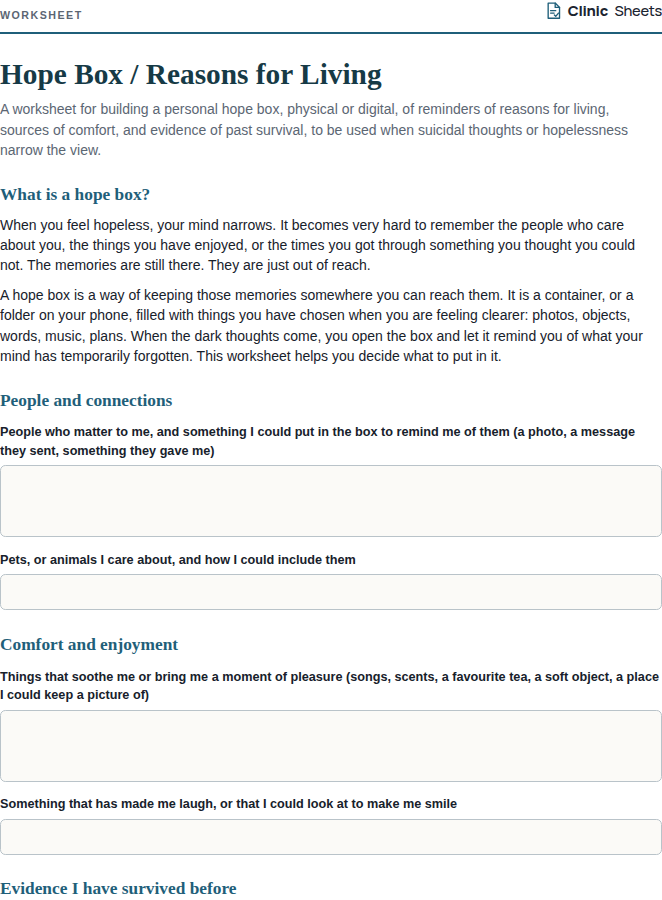
- Assess protective factors and reasons for living as carefully as risk factors. They form the basis of the safety plan and of the client's own sense of what keeps them going.
- Write a short risk formulation: what the risk is, what is driving it now, what would make it worse, and what reduces it. State your clinical judgement and the reasons for it.
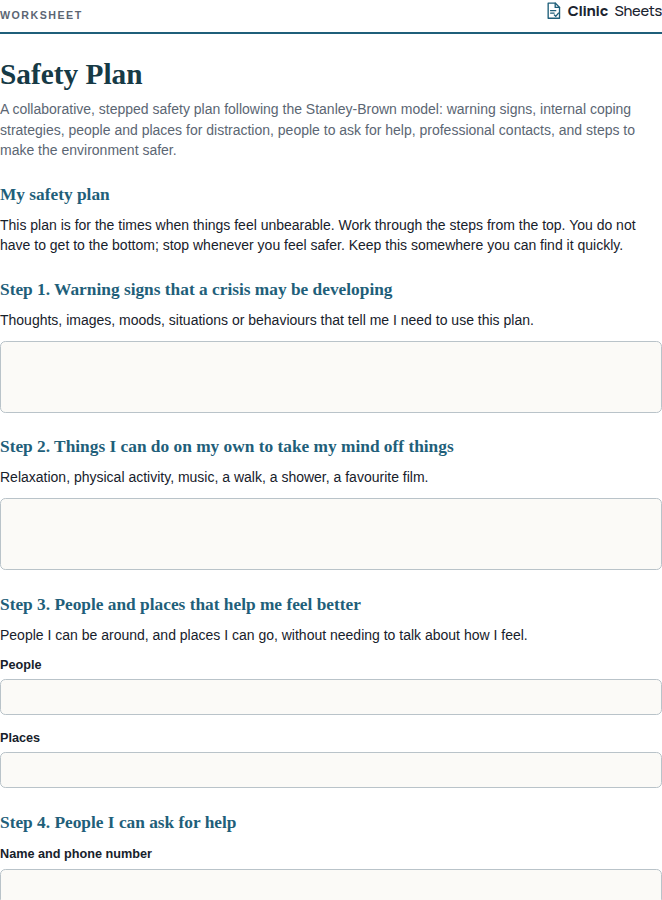
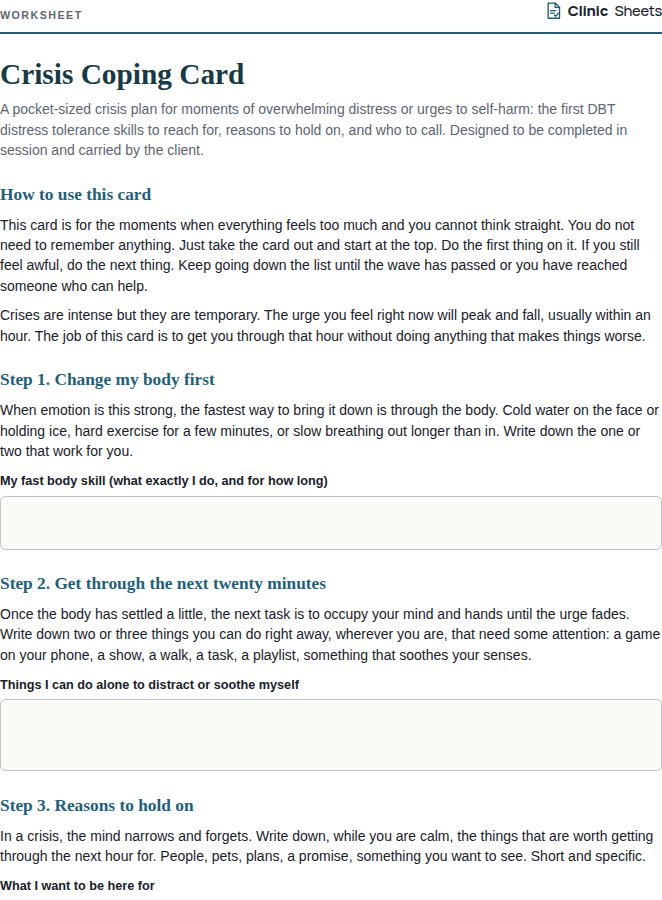
- Complete a safety plan collaboratively (see Safety Plan), discuss reducing access to means, give the client the crisis numbers, arrange follow-up, and consult a colleague or supervisor where the picture is unclear or the risk is high. Document all of this.
- If the client is at immediate risk and cannot be kept safe with the plan, act: in Canada, call 911 or arrange emergency assessment. Anyone can call or text 9-8-8 at any time. Record the actions taken and the reasons.
References
- Posner, K., Brown, G. K., Stanley, B., Brent, D. A., Yershova, K. V., Oquendo, M. A., Currier, G. W., Melvin, G. A., Greenhill, L., Shen, S., & Mann, J. J. (2011). The Columbia-Suicide Severity Rating Scale: Initial validity and internal consistency findings from three multisite studies with adolescents and adults. American Journal of Psychiatry, 168(12), 1266-1277.
- Franklin, J. C., Ribeiro, J. D., Fox, K. R., Bentley, K. H., Kleiman, E. M., Huang, X., Musacchio, K. M., Jaroszewski, A. C., Chang, B. P., & Nock, M. K. (2017). Risk factors for suicidal thoughts and behaviors: A meta-analysis of 50 years of research. Psychological Bulletin, 143(2), 187-232.
- Stanley, B., & Brown, G. K. (2012). Safety Planning Intervention: A brief intervention to mitigate suicide risk. Cognitive and Behavioral Practice, 19(2), 256-264.