Decisional Balance
A four-quadrant worksheet for exploring ambivalence about a behaviour: the benefits and costs of staying the same, and the benefits and costs of changing. A core motivational interviewing tool for clients who are weighing up change.
About this resource
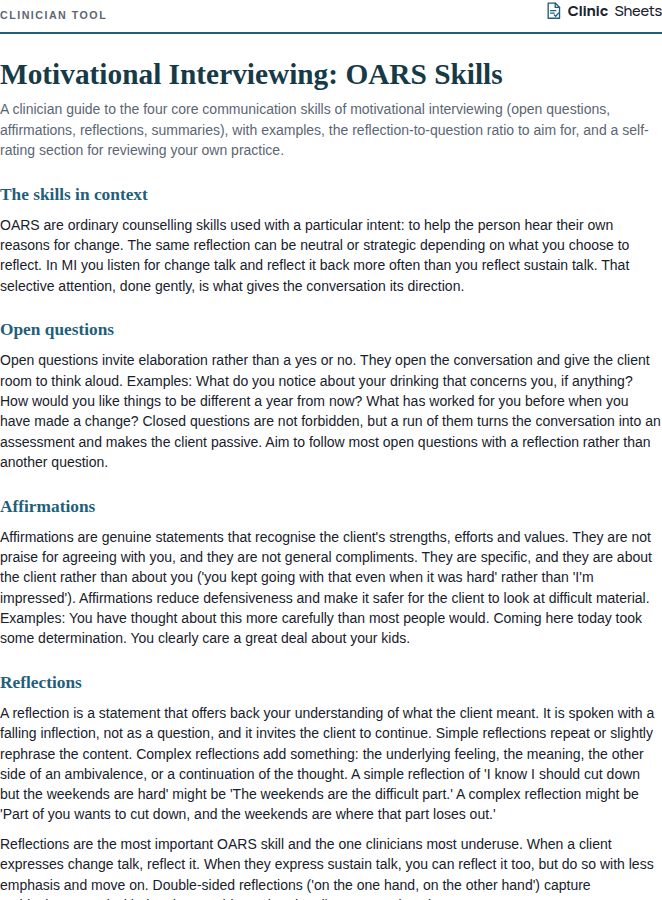
Ambivalence is the normal state of a person considering change. They want to change and they want things to stay as they are, both at once. Motivational interviewing treats this not as resistance to be overcome but as the material of the work. A decisional balance makes the ambivalence visible by laying out all four sides: what the behaviour gives the client, what it costs them, what they would gain by changing, and what they would lose or find hard.
The tool comes from Janis and Mann's work on decision making and was adopted into the transtheoretical model, where it is most useful in the contemplation stage. It is deliberately even-handed. Asking a client to list only the harms of drinking invites them to argue the other side. Asking them to list the good things first, and taking those seriously, allows them to voice the costs themselves, which is far more persuasive than hearing it from the clinician.
The professional version includes guidance on eliciting and reflecting change talk from the completed grid, on avoiding the trap of tallying the quadrants as though the longer list wins, and on when a decisional balance is contraindicated (for example, with a client who has already committed to change, where revisiting the benefits of the behaviour can undermine resolve).
How to use it
- Use with clients in contemplation, when they are unsure whether they want to change. Do not use it with clients who have already decided; move to planning instead.
- Start with the good things about the current behaviour and take them seriously. This builds trust and reduces the pull to defend the behaviour.
- Move through the remaining quadrants in order. Use open questions and reflective listening; do not add items the client has not raised.
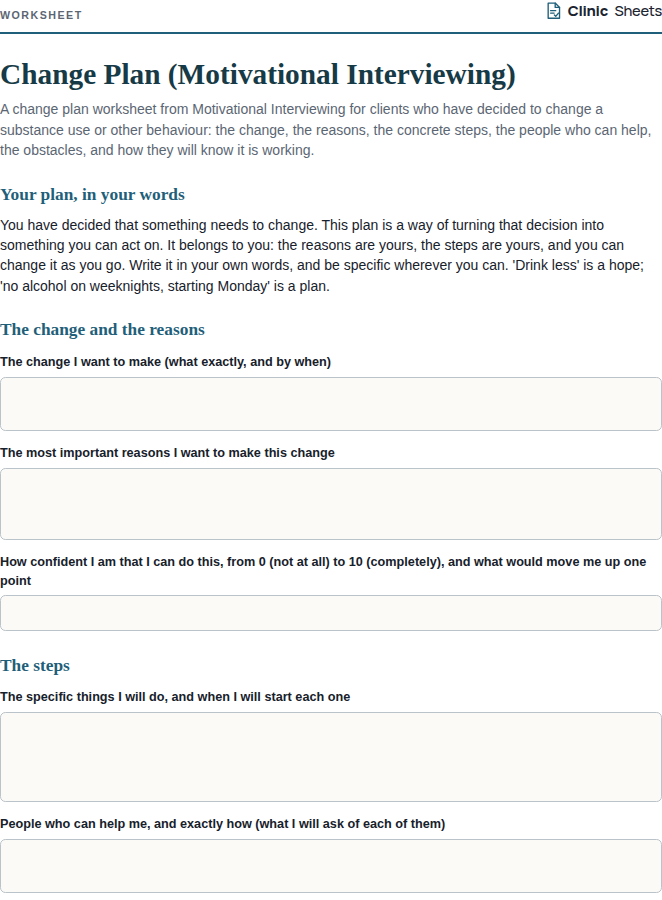
- Ask the client to weight the items rather than count them. One important reason often outweighs several minor ones.
- Close by summarising both sides in the client's own words and asking, 'Where does that leave you?' Let the client draw the conclusion.
- Revisit the worksheet later in treatment if motivation dips; the client's own reasons for change are the most durable ones.
References
- Miller, W. R., & Rollnick, S. (2013). Motivational Interviewing: Helping People Change (3rd ed.). Guilford Press.
- Janis, I. L., & Mann, L. (1977). Decision Making: A Psychological Analysis of Conflict, Choice, and Commitment. Free Press.
- Prochaska, J. O., & DiClemente, C. C. (1983). Stages and processes of self-change of smoking: Toward an integrative model of change. Journal of Consulting and Clinical Psychology, 51(3), 390-395.