Motivational Interviewing: OARS Skills
A clinician guide to the four core communication skills of motivational interviewing (open questions, affirmations, reflections, summaries), with examples, the reflection-to-question ratio to aim for, and a self-rating section for reviewing your own practice.
About this resource
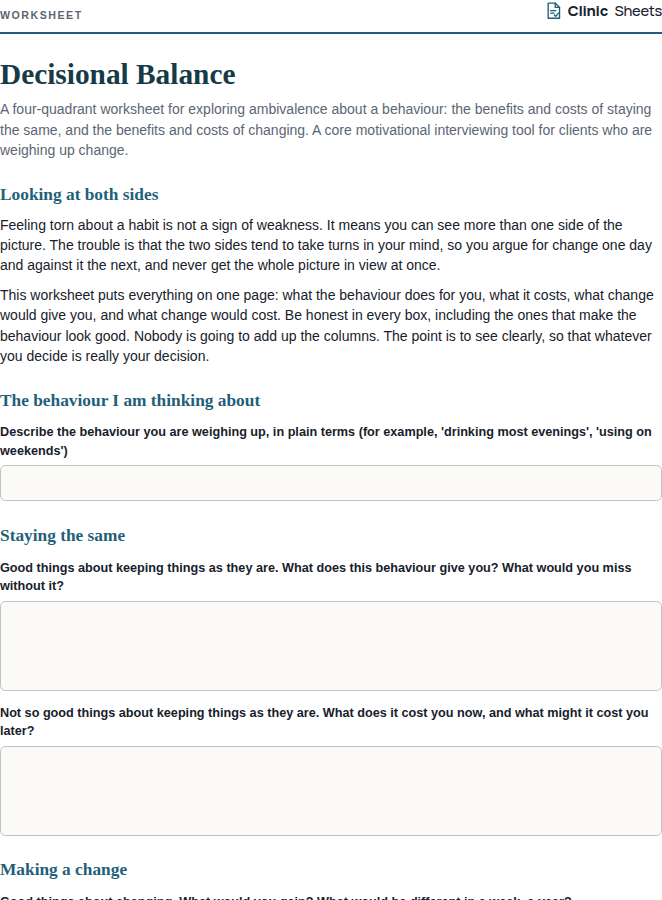
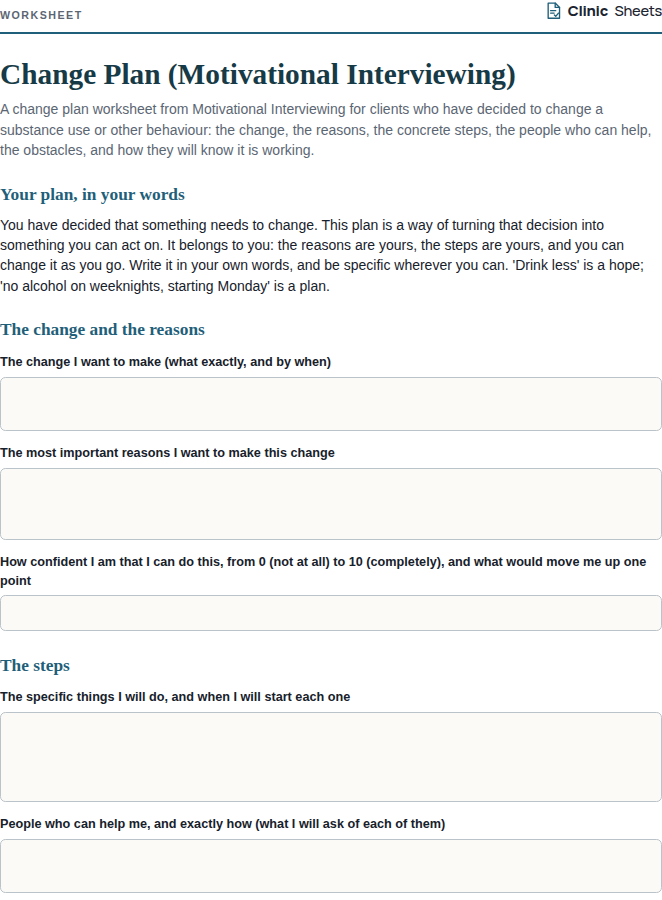
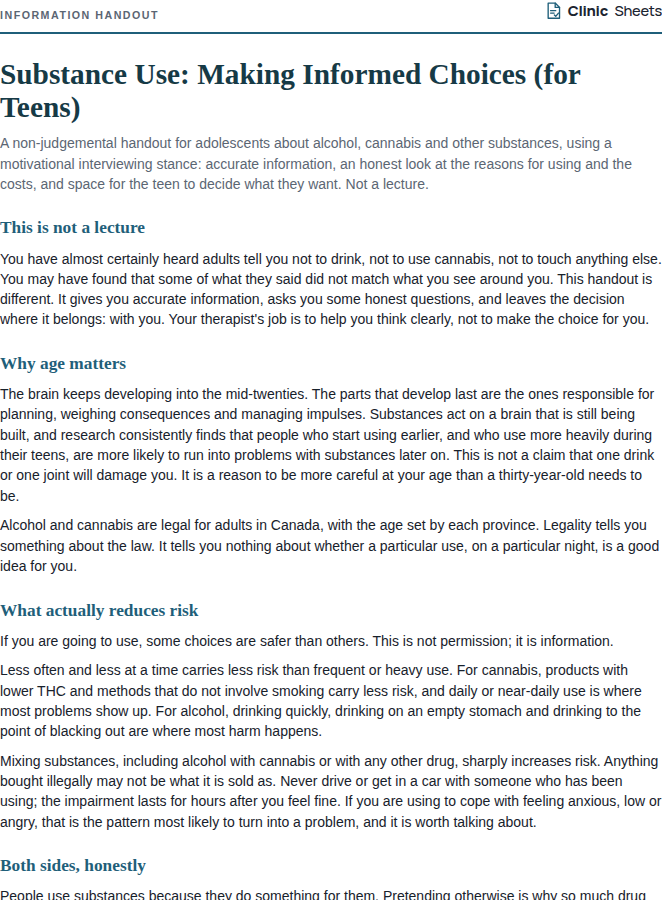
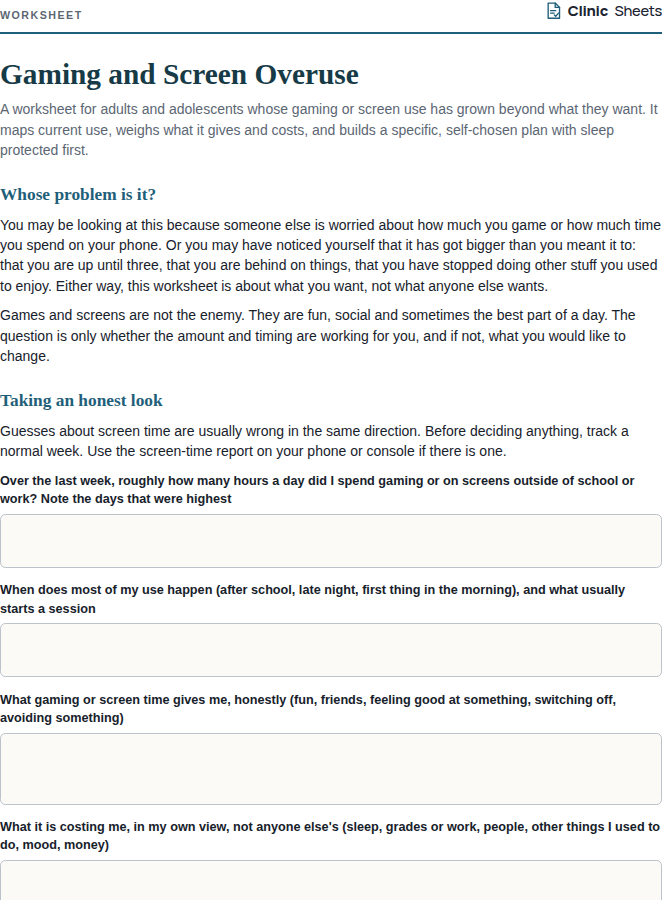
Motivational interviewing (MI) is a collaborative conversational style for strengthening a person's own motivation and commitment to change. Developed by Miller and Rollnick, it has its strongest evidence base in substance use, and is now widely used wherever ambivalence about change is the obstacle. The spirit of MI (partnership, acceptance, compassion and evocation) is carried by four micro-skills, usually taught by the acronym OARS: open questions, affirmations, reflective listening, and summaries.
The OARS skills are the engine of the method. Open questions invite the client to explore; affirmations recognise strengths and effort, and reduce defensiveness; reflections communicate understanding and, when used selectively, steer the conversation toward the client's own reasons for change (change talk); summaries collect what has been said, highlight change talk, and offer a transition. In MI the ratio of reflections to questions, and the proportion of complex to simple reflections, are markers of skill, and both are coded in the standard fidelity measure for MI.
This guide describes each skill with examples relevant to substance use, explains simple versus complex reflections, and offers targets for practice. It ends with a self-rating template that you can use after listening to a recording of your own session. It is a skills guide rather than a full account of MI; the four processes (engaging, focusing, evoking, planning) and the handling of sustain talk and discord are covered in the references.
How to use it
- Read the descriptions of the four skills and the examples. If you are new to MI, work on one skill at a time for a week each, starting with reflections.
- Record a session with consent and count: the number of open and closed questions, the number of simple and complex reflections, and the number of affirmations and summaries. Calculate the reflection-to-question ratio.
- Compare against the practice targets in the guide. Do not worry about hitting them at first; the point is to notice your habits.
- Listen again for the client's change talk (desire, ability, reasons, need, commitment) and check whether your reflections and summaries picked it up or passed over it.
- Use the self-rating section after each reviewed session. Bring the ratings to supervision or a peer learning group; MI skills improve with coaching and feedback, not with reading alone.
- Keep the skills in their context. OARS in the service of the MI spirit builds motivation; the same skills used to manoeuvre a client toward your goal produce resistance.
References
- Miller, W. R., & Rollnick, S. (2023). Motivational Interviewing: Helping People Change and Grow (4th ed.). Guilford Press.
- Moyers, T. B., Rowell, L. N., Manuel, J. K., Ernst, D., & Houck, J. M. (2016). The Motivational Interviewing Treatment Integrity code (MITI 4): Rationale, preliminary reliability and validity. Journal of Substance Abuse Treatment, 65, 36-42.
- Rollnick, S., Miller, W. R., & Butler, C. C. (2008). Motivational Interviewing in Health Care: Helping Patients Change Behavior. Guilford Press.