Cost-Benefit Analysis of a Belief or Behaviour
A worksheet for weighing the advantages and disadvantages of holding a belief or continuing a behaviour, in the short term and the long term, so that a client can decide whether it is worth keeping and identify what a better alternative would need to offer.
About this resource
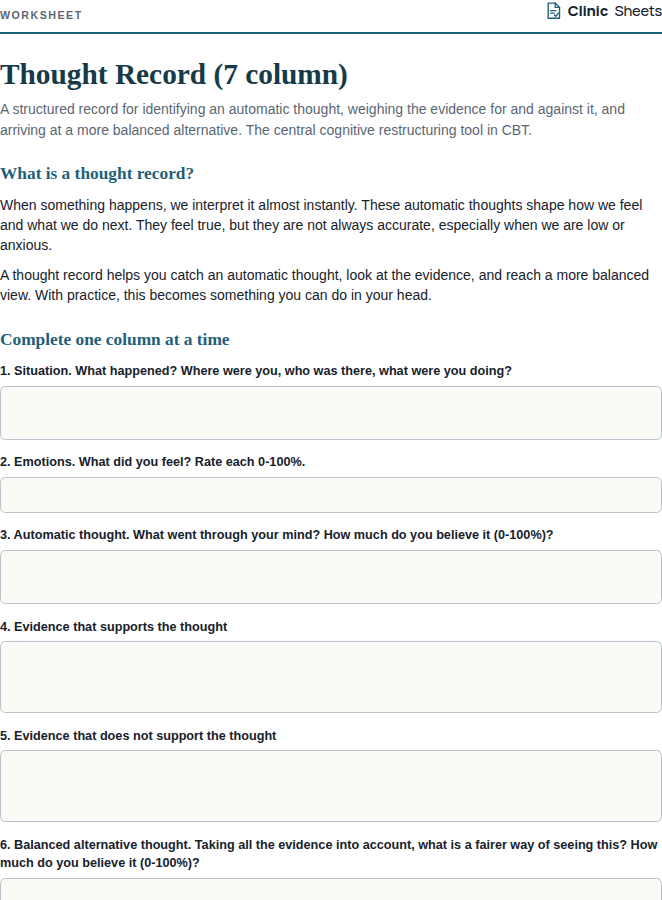
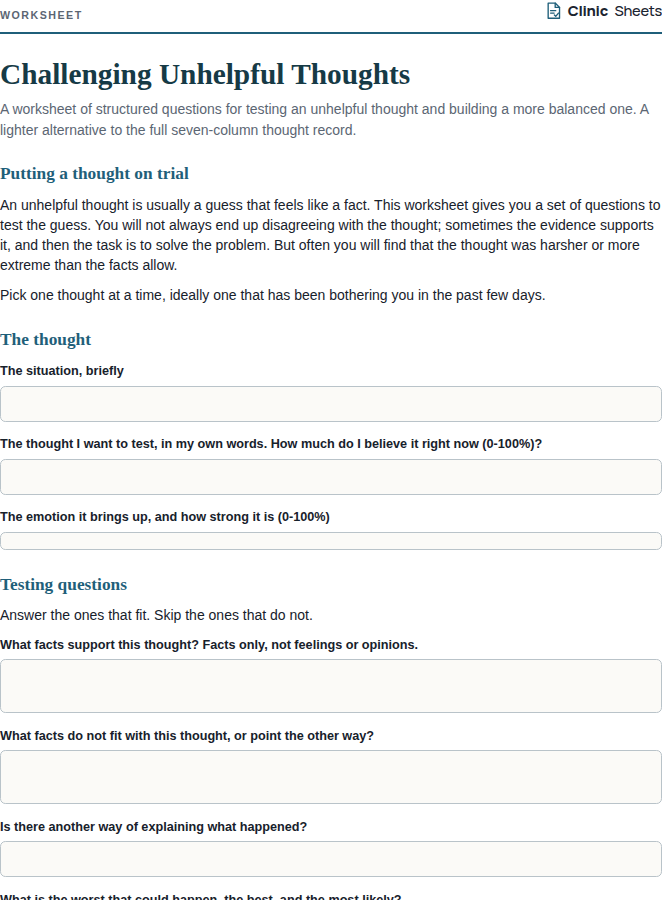
Cost-benefit analysis is a cognitive method popularised by Burns and closely related to the decisional balance used in motivational interviewing. Rather than asking whether a belief is true, it asks whether it is useful: what does believing 'I must never make a mistake', or continuing to drink every evening, actually do for the person, and what does it cost them? Many beliefs and behaviours persist because they carry real short-term benefits (relief, safety, pleasure, a sense of control) even while they cause long-term harm. Making both sides explicit reduces the sense of being stuck and clarifies what any alternative would have to provide.
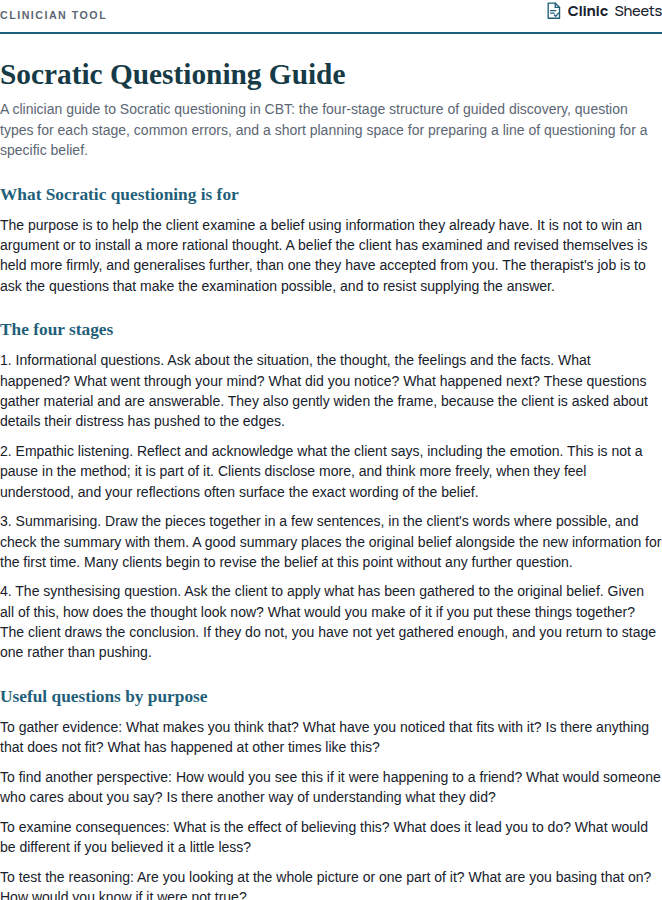
The method suits beliefs that resist evidence-based challenge, such as perfectionist rules that the client half-recognises as unreasonable but feels are keeping them safe, and behaviours where ambivalence is the main obstacle, including substance use, avoidance, reassurance seeking and procrastination. Separating short-term from long-term consequences is important: the short-term column usually explains why the behaviour continues, and the long-term column usually explains why the client is in therapy.
The professional version includes guidance on staying neutral while the client fills in the benefits (arguing against them strengthens resistance), on using the completed analysis to build a revised belief or a change plan, and on revisiting the worksheet when motivation dips.
How to use it
- Identify one clearly stated belief or behaviour. 'Being hard on myself' is too vague; 'the rule that I must check my work three times before sending it' or 'drinking four beers most evenings' can be analysed.
- Invite the client to fill in the benefits first and take them seriously. A behaviour that has no benefits would already have stopped. Ask what the belief or behaviour protects them from and what it gives them.
- Fill in the costs, prompting for effects on mood, relationships, health, work, time, money, self-respect and the things the client values most. Separate what happens in the moment from what happens over months and years.
- Ask the client to weigh the two sides, either with a percentage split or by rating the overall balance. Discuss what they notice. Avoid steering; the client's own conclusion carries far more weight than yours.
- If the balance favours change, move to what a revised belief or alternative behaviour would need to offer to replace the benefits, and plan the first small step. If it favours the status quo, accept that honestly and keep the door open.
- Keep the completed sheet and return to it when motivation wavers. The long-term costs column is often what the client needs to see again.
References
- Burns, D. D. (1999). The Feeling Good Handbook (Rev. ed.). Plume.
- Miller, W. R., & Rollnick, S. (2013). Motivational Interviewing: Helping People Change (3rd ed.). Guilford Press.
- Beck, J. S. (2020). Cognitive Behavior Therapy: Basics and Beyond (3rd ed.). Guilford Press.