Change Plan (Motivational Interviewing)
A change plan worksheet from Motivational Interviewing for clients who have decided to change a substance use or other behaviour: the change, the reasons, the concrete steps, the people who can help, the obstacles, and how they will know it is working.
About this resource
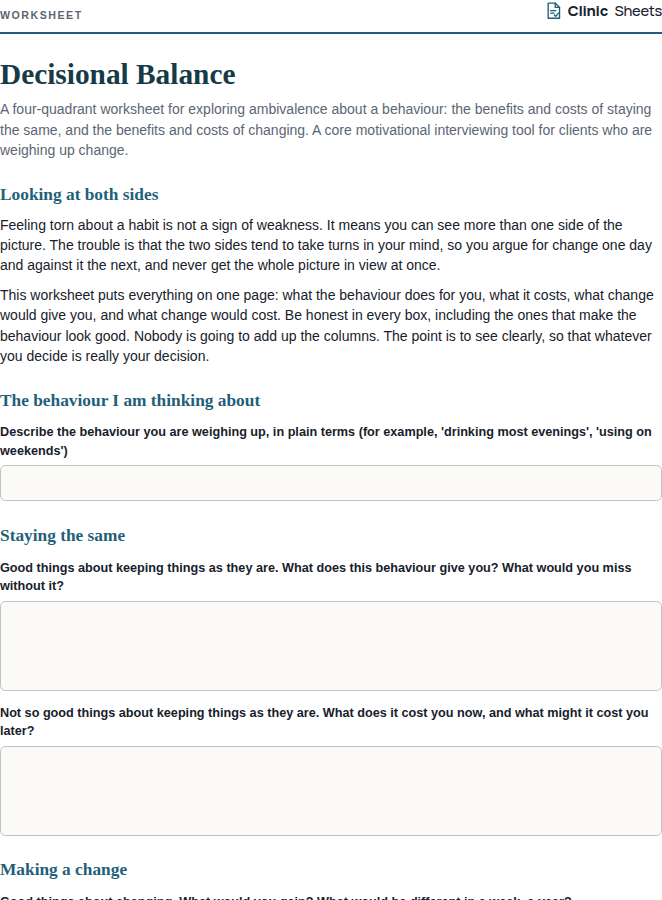
In Motivational Interviewing, the change plan belongs to the planning process, which follows engaging, focusing and evoking. It is only appropriate once the client has expressed commitment to change in their own words; introduced too early, it invites resistance and pushes the clinician into the role of persuader. The plan captures, in the client's language, what they intend to do and why, and it turns a general intention into specific, timed actions with anticipated obstacles and named supports.
This worksheet follows the elements Miller and Rollnick describe: the change the person wants to make, their most important reasons, the specific steps they plan to take and when, the people who can help and how, the things that could get in the way and how they will handle them, and the signs that the plan is working. A confidence rating and a short section on what to do after a slip are included, because most behaviour change involves setbacks and planning for them reduces the chance that a lapse becomes a full return to the old pattern.
The professional version adds guidance on recognising readiness for planning (increasing change talk, decreasing sustain talk, questions about how rather than whether), on keeping the plan in the client's words rather than the clinician's, and on using the confidence ruler to surface remaining ambivalence before the plan is finalised.
How to use it
- Offer the plan only when the client is signalling readiness: talking about how and when to change rather than whether, expressing commitment, or asking what they should do. If in doubt, ask permission: 'Would it be useful to put some of this down on paper?'
- Let the client fill in the words. Reflect and summarise, but avoid supplying reasons or steps. A plan the client has written is far more likely to be followed than one written for them.
- Use the confidence ruler. If confidence is low, ask what would raise it by one point, and adjust the plan rather than pushing forward.
- Spend real time on obstacles. Ask the client to picture the first difficult moment in detail and what they will do in it.
- Give the client the plan and revisit it at each session. When a slip occurs, use the last section and the client's original reasons to re-engage rather than starting from the beginning.
References
- Miller, W. R., & Rollnick, S. (2013). Motivational Interviewing: Helping People Change (3rd ed.). Guilford Press.
- Prochaska, J. O., & DiClemente, C. C. (1983). Stages and processes of self-change of smoking: Toward an integrative model of change. Journal of Consulting and Clinical Psychology, 51(3), 390-395.
- Rollnick, S., Miller, W. R., & Butler, C. C. (2008). Motivational Interviewing in Health Care: Helping Patients Change Behavior. Guilford Press.