Challenging Unhelpful Thoughts
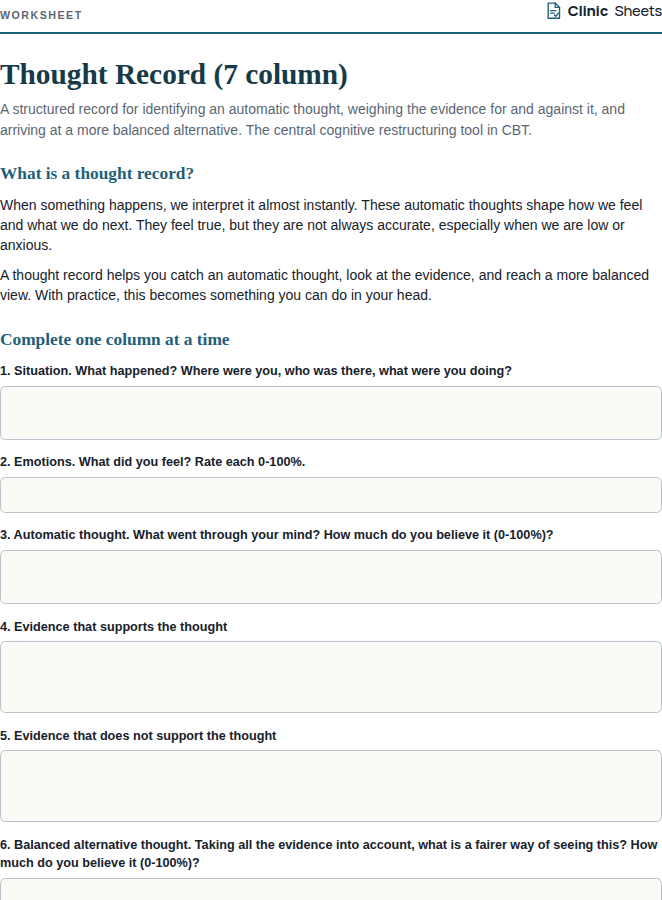
A worksheet of structured questions for testing an unhelpful thought and building a more balanced one. A lighter alternative to the full seven-column thought record.
About this resource
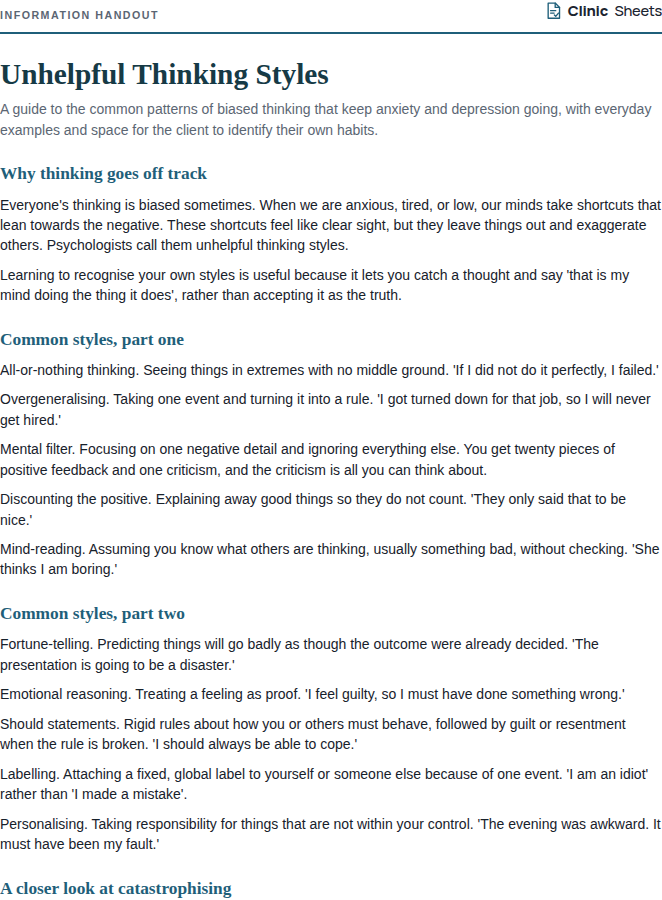
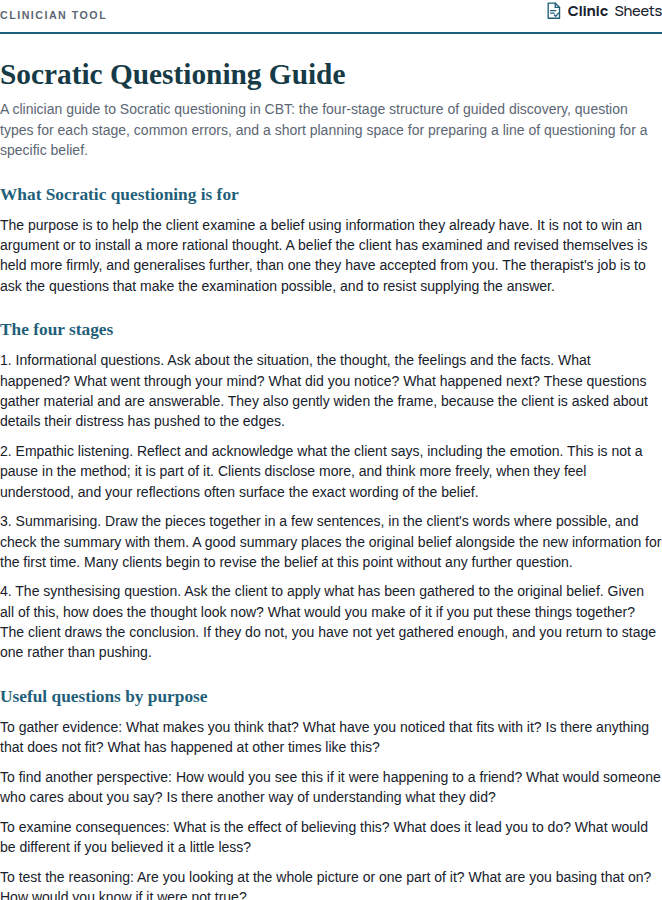
Cognitive restructuring works by helping the client step outside a thought and examine it as a hypothesis rather than a fact. The questions used to do this are well established: What is the evidence? Is there another explanation? What is the worst, best and most realistic outcome? What would I tell a friend? What is the effect of believing this? This worksheet gathers those questions into a single guided sequence that a client can work through on their own.
It is designed for clients who understand the cognitive model and have practised catching thoughts, but who find the seven-column record heavy or who want a portable version for use in the moment. The structure moves from identifying the thought and its emotional impact, through a set of testing questions, to a balanced alternative and a re-rating.
Restructuring is most effective on specific, situational hot thoughts rather than global beliefs. If a client repeatedly targets thoughts like 'I am worthless', it is usually a sign that core-belief work or behavioural methods are needed alongside this one.
The professional version includes a worked example, guidance on choosing which question fits which thinking style, and notes on the common trap of producing a balanced thought the client does not actually believe.
How to use it
- Use after the client can identify hot thoughts reliably. Complete the first one together in session.
- Choose a thought that is specific and believed at least 50%. Vague or weakly held thoughts do not give the method a fair test.
- Work through the testing questions in order. Not every question fits every thought; skip those that do not apply rather than forcing an answer.
- Make sure the balanced thought is believable to the client. A thought that sounds good but is rated at 10% belief will not shift the emotion.
- Review completed worksheets at the next session and note which questions the client finds most useful. They can carry those into everyday use.
References
- Beck, J. S. (2020). Cognitive Behavior Therapy: Basics and Beyond (3rd ed.). Guilford Press.
- Greenberger, D., & Padesky, C. A. (2015). Mind Over Mood (2nd ed.). Guilford Press.
- Leahy, R. L. (2017). Cognitive Therapy Techniques: A Practitioner's Guide (2nd ed.). Guilford Press.