Socratic Questioning Guide
A clinician guide to Socratic questioning in CBT: the four-stage structure of guided discovery, question types for each stage, common errors, and a short planning space for preparing a line of questioning for a specific belief.
About this resource
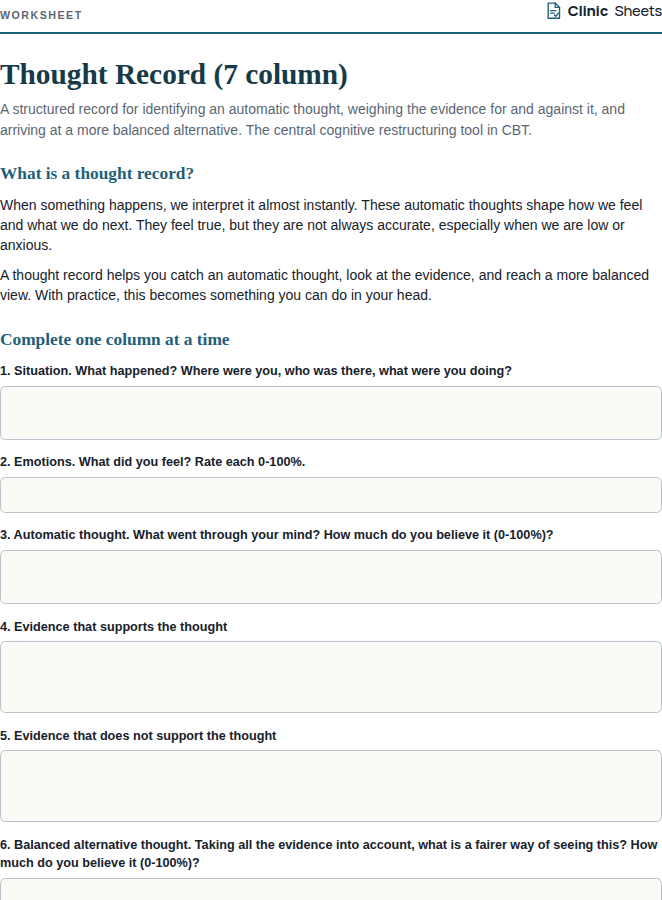
Socratic questioning is the conversational method at the centre of cognitive therapy. Rather than telling the client that a thought is distorted, the therapist asks questions that draw out information the client already has but has not connected to the thought, and then invites the client to draw their own conclusion. Padesky's description of guided discovery gives it a four-stage structure: informational questions, empathic listening, summarising, and a synthesising or analytical question that asks the client to apply the new information to the original belief.
The method is often taught as a list of questions, but the list matters less than the stance. Questions are asked from genuine curiosity, they are ones the client can answer, they draw attention to information outside the client's current focus, and they lead somewhere the therapist has not already decided. When the questioning turns into a series of leading questions with an answer the therapist has in mind, clients notice, and the collaborative quality that makes the method work is lost.
This guide sets out the structure, gives question examples for each stage, describes the errors that most often undermine the method, and ends with a planning template for preparing a line of questioning about a specific belief before a session. It is written for clinicians at any level, with the more experienced likely to use only the planning template.
How to use it
- Read the four stages and the question examples once, then keep the guide to hand during early practice. Most clinicians find the summarising stage the easiest to skip and the most useful to keep.
- Before a session in which you expect to work on a particular belief, use the planning section to think through what information the client may hold that bears on it, and what synthesising question you might ask at the end.
- In session, ask one question at a time and wait. Let silence do some of the work. If the client cannot answer, the question was probably too large; break it down.
- Notice when you are leading. If you already know the answer you want and the questions are steering the client to it, stop, summarise what has been said, and ask an open question instead.
- Review recordings of your own sessions for the balance of questions to statements and for whether the client, rather than you, drew the conclusion.
- Use the method with children and adolescents in simpler, more concrete form, and with clients in acute distress only after emotion has settled enough for reflection.
References
- Padesky, C. A. (1993). Socratic questioning: Changing minds or guiding discovery? Keynote address, European Congress of Behavioural and Cognitive Therapies, London.
- Beck, J. S. (2020). Cognitive Behavior Therapy: Basics and Beyond (3rd ed.). Guilford Press.
- Kennerley, H., Kirk, J., & Westbrook, D. (2016). An Introduction to Cognitive Behaviour Therapy (3rd ed.). SAGE.