Unhelpful Thinking Styles
A guide to the common patterns of biased thinking that keep anxiety and depression going, with everyday examples and space for the client to identify their own habits.
About this resource
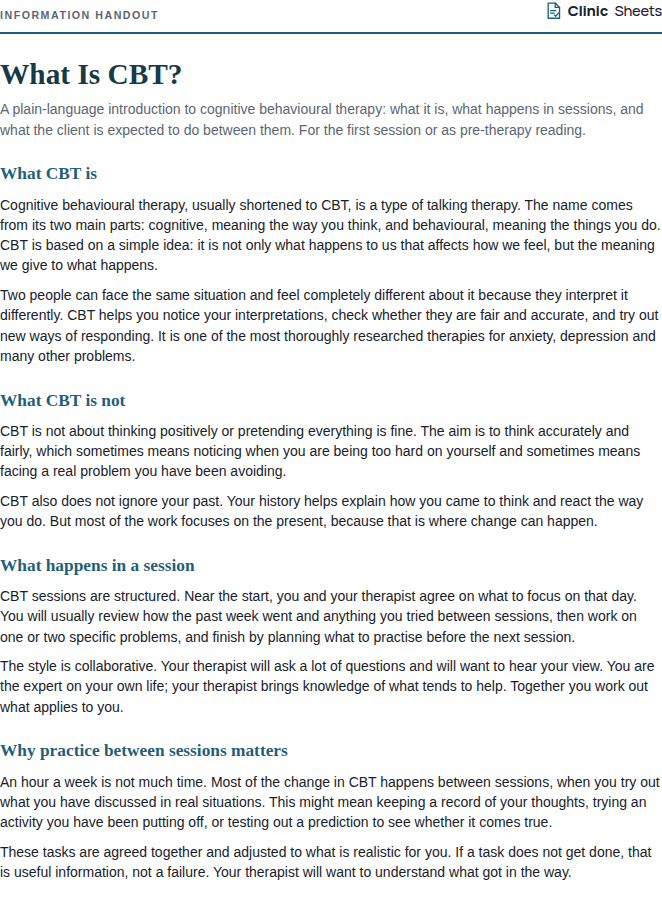
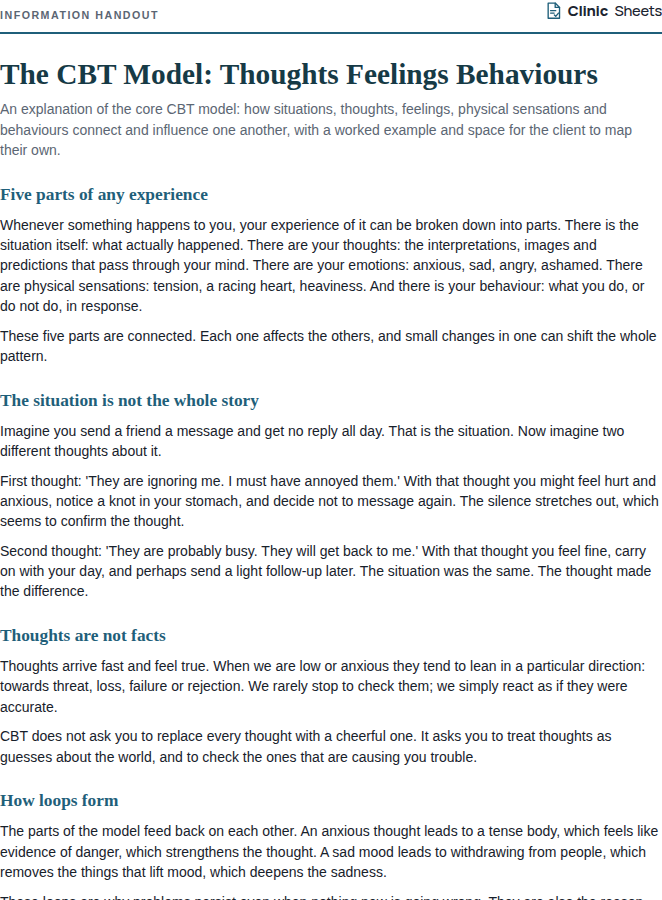
Cognitive distortions, often called unhelpful thinking styles in client-facing material, are systematic biases in the way information is processed when mood is low or anxiety is high. Beck described them as the characteristic errors that follow from underlying negative beliefs; Burns later popularised a list that most clinicians still draw on. Being able to name a thinking style gives the client a quick way to step back from a thought without having to work through a full thought record every time.
This handout presents ten common styles in plain language, each with a short example drawn from ordinary life rather than clinical scenarios. Catastrophising is given slightly more room because it is the pattern most strongly associated with anxiety and is a common target in later work. The handout closes with a reflection section in which the client identifies the two or three styles they recognise most in themselves.
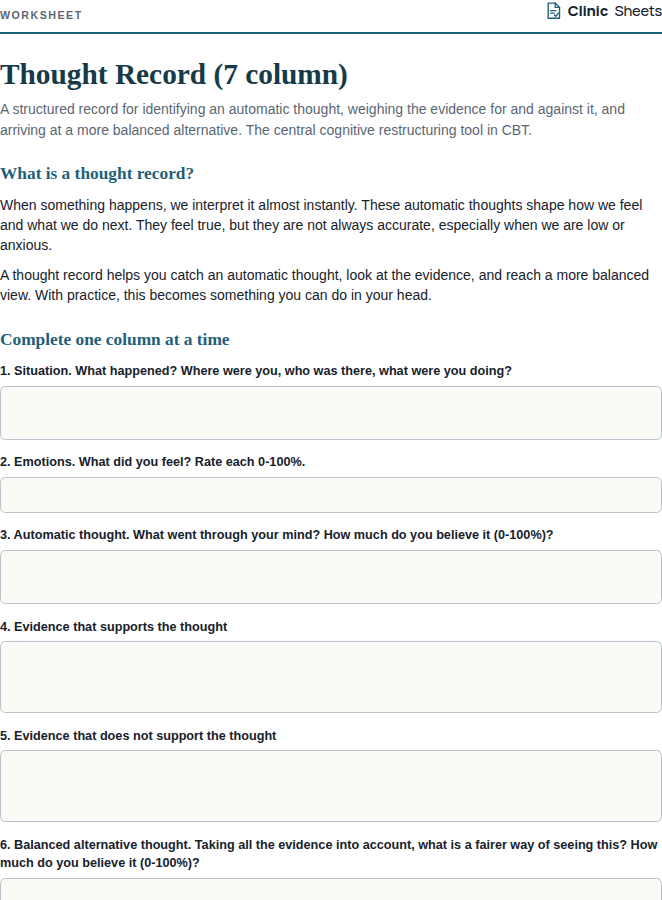
It is most useful once the client has completed a few simple thought records and has real examples to sort. Clients often find that their thoughts cluster around one or two styles, which becomes a useful shorthand in later sessions.
The professional version adds notes on the limits of labelling (styles overlap, and naming a thought is not the same as testing it), suggestions for using the list with clients who over-apply it, and links to the relevant restructuring questions for each style.
How to use it
- Introduce after the client has gathered some automatic thoughts, so the list can be applied to real examples rather than learned in the abstract.
- Read through the styles together. Ask the client to mark any that feel familiar, then go back through their recent thought records and label each thought.
- Ask the client to complete the reflection section, identifying their most common two or three styles and a recent example of each.
- In later sessions, use the style name as shorthand: 'Does that sound like mind-reading again?' This speeds up in-session restructuring.
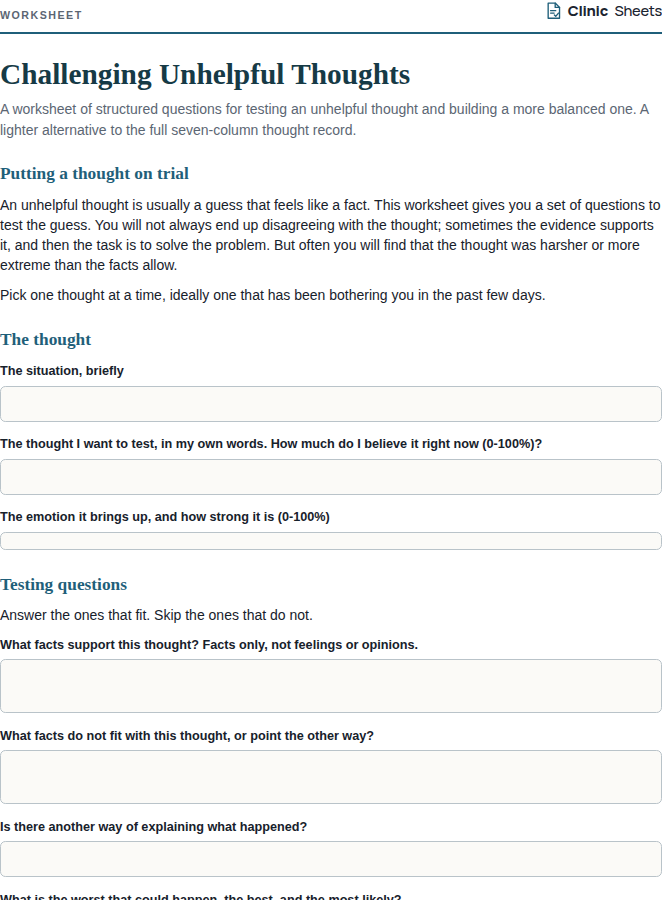
- Follow with Challenging Unhelpful Thoughts, which pairs each style with questions for testing it.
References
- Beck, A. T. (1976). Cognitive Therapy and the Emotional Disorders. International Universities Press.
- Burns, D. D. (1980). Feeling Good: The New Mood Therapy. William Morrow.
- Beck, J. S. (2020). Cognitive Behavior Therapy: Basics and Beyond (3rd ed.). Guilford Press.