Helpful Thoughts vs Unhelpful Thoughts (Kids)
A child-friendly introduction to cognitive restructuring: the child learns to notice thoughts, sort them into helpful and unhelpful, spot 'worst case' thinking, and come up with a helpful thought to try instead.
About this resource
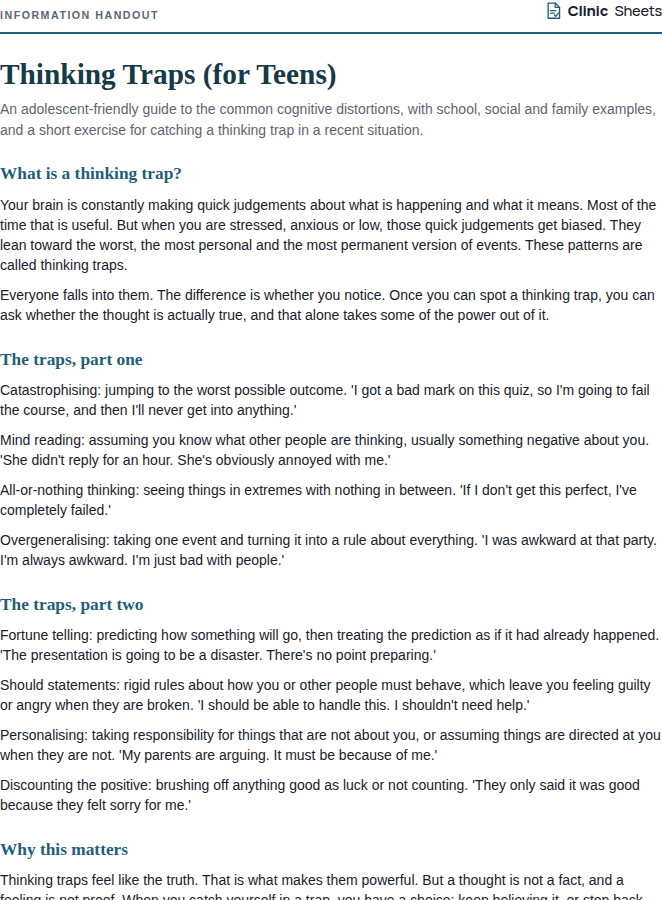
The cognitive model applies to children as well as adults, but children need it delivered concretely. Rather than 'cognitive distortions', children can grasp the idea that thoughts are like words that pop into your head, that some thoughts help you and some make things harder, and that you can choose which ones to listen to. Paul Stallard's work on adapting CBT for young people describes this sort of simplified sorting task as a first step before more formal thought challenging, and Kendall's Coping Cat programme uses the same idea in its 'thoughts and feelings' sessions.
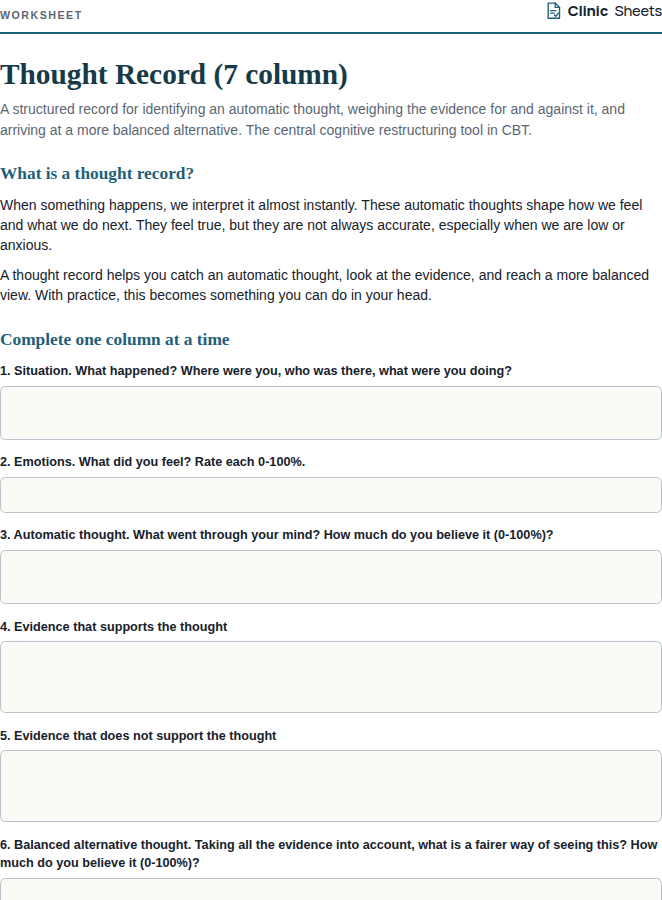
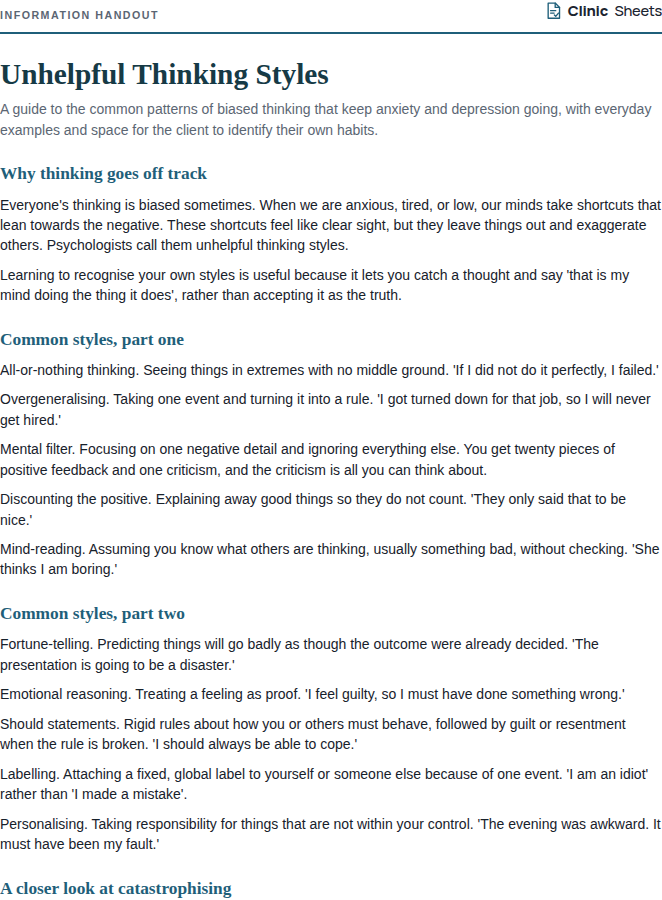
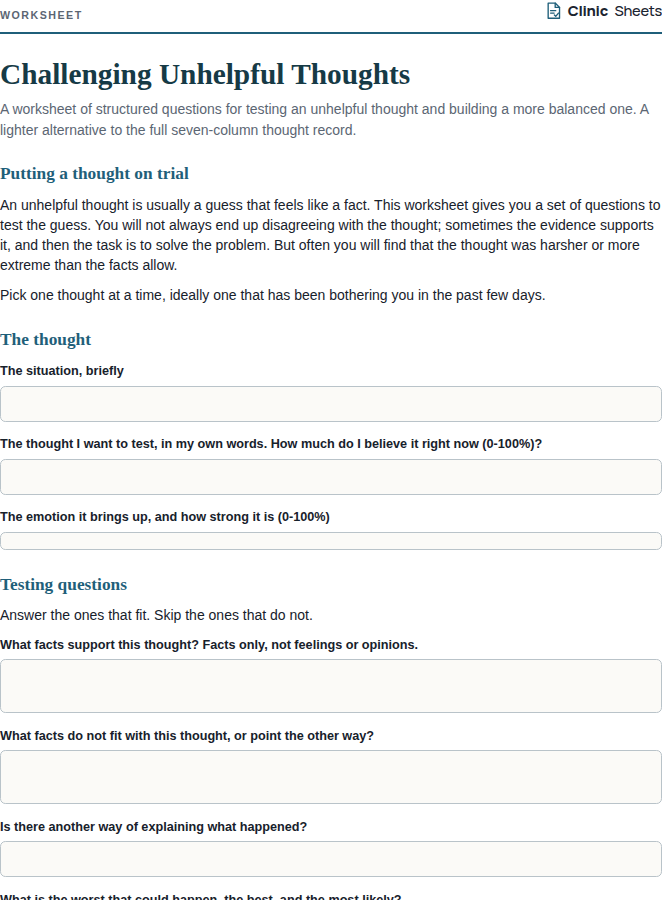
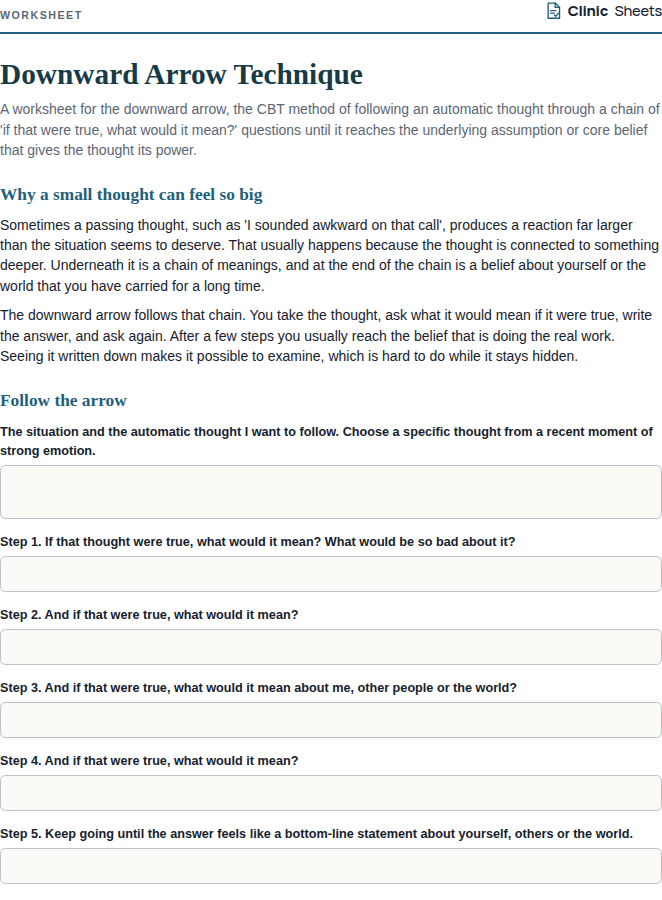
This worksheet introduces three ideas in sequence. First, thoughts are separate from feelings and can be noticed. Second, thoughts can be sorted: helpful thoughts make you feel a bit better and help you do what you need to do; unhelpful thoughts make you feel worse and make you want to give up or hide. Third, one very common unhelpful thought is 'worst case' thinking (catastrophising), where the mind jumps to the most terrible thing that could happen. The child practises catching a worst-case thought and replacing it with a helpful one that is realistic, not simply positive.
The professional version stresses that a helpful thought is not a happy thought: 'it will probably be fine and if it isn't I can ask for help' is helpful; 'nothing bad will ever happen' is not. It also suggests using the child's own recent example rather than the ones on the page, and pairing the worksheet with a feelings thermometer so the child can rate how each thought changes the feeling.
How to use it
- Start with a thought-catching game: ask the child what popped into their head when they walked into the room, or when they saw a picture. Establish that thoughts are words or pictures in the mind and that everyone has them.
- Explain helpful and unhelpful thoughts with an example from the child's life (a test, a sleepover, a game). Ask which thoughts would make the feeling bigger and which would make it smaller.
- Introduce worst-case thinking as a common trap. Have the child give it a name if they like ('the worst-case worrier'). Practise catching one together.
- Work through the fields using the child's own example. Check that the helpful thought is believable to the child; if not, adjust it until it is.
- Ask the child to catch one worst-case thought during the week and write down the helpful thought they tried. Review it next session.
References
- Stallard, P. (2019). Think Good, Feel Good: A CBT Workbook for Children and Young People (2nd ed.). Wiley.
- Kendall, P. C., & Hedtke, K. A. (2006). Cognitive-Behavioral Therapy for Anxious Children: Therapist Manual (3rd ed.). Workbook Publishing.
- Beck, J. S. (2020). Cognitive Behavior Therapy: Basics and Beyond (3rd ed.). Guilford Press.