Driving Anxiety
A worksheet for adults who fear driving or being a passenger, whether after a collision or without one, to map their avoidance and safety behaviours and build a graded driving exposure ladder. Suitable for phobic and post-accident driving anxiety.
About this resource
Driving anxiety takes several forms. Some people develop a specific phobia of driving, often focused on highways, bridges, tunnels, heavy traffic or driving far from home, with fears of losing control, causing a crash, or panicking at the wheel. Others develop driving fear after a motor vehicle collision, where it may be part of a post-traumatic reaction with intrusive memories, hypervigilance to other drivers and a strong sense that the road is now dangerous. In both cases the maintaining factors are the same: catastrophic predictions, avoidance of feared routes and conditions, and safety behaviours such as gripping the wheel, driving only with a passenger, refusing to drive at night or in rain, and constant scanning of mirrors.
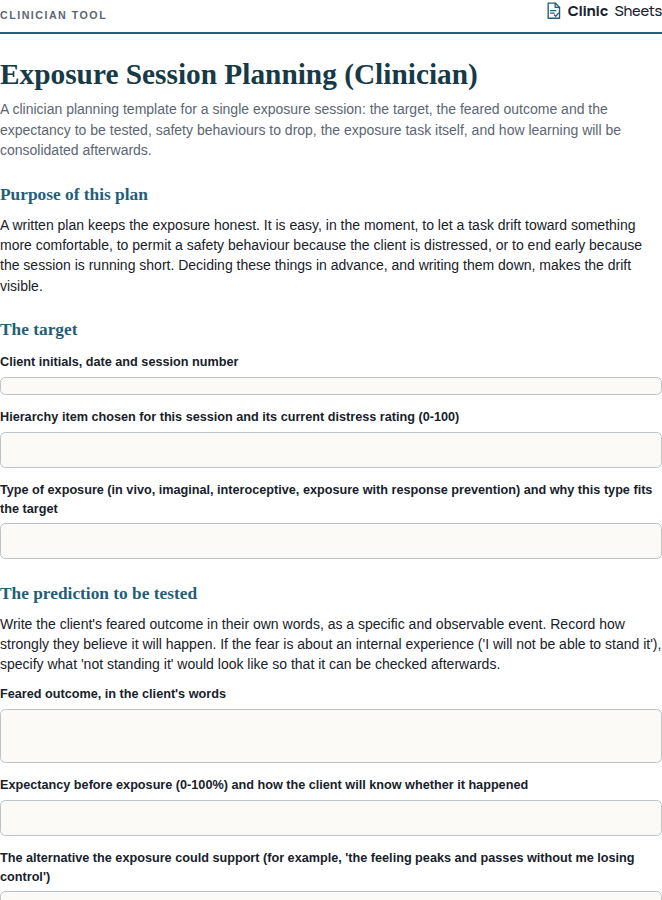
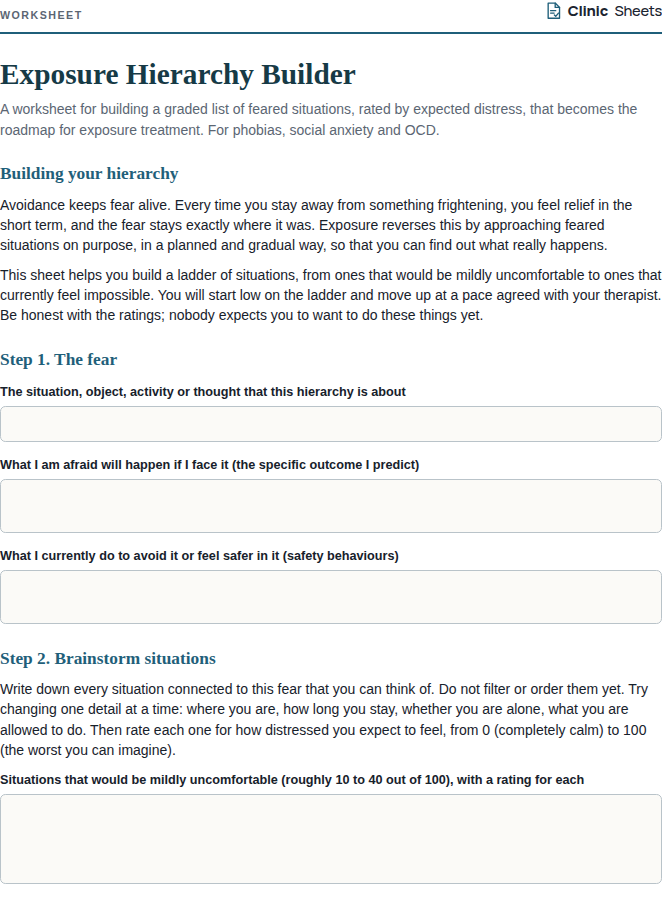
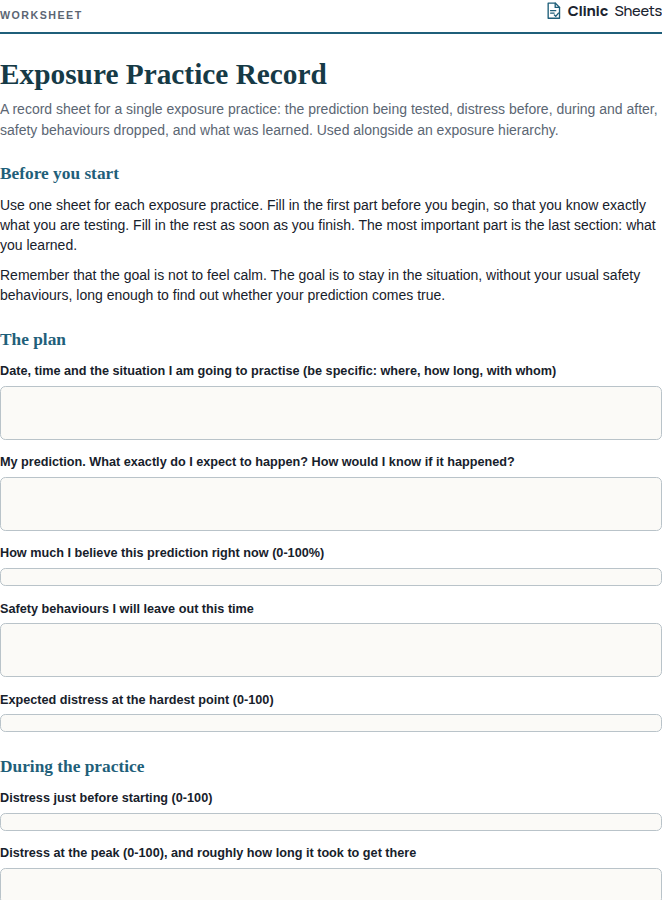
This worksheet helps the client identify the specific situations and predictions that drive their fear, catalogue their avoidance and safety behaviours, and construct a graded exposure hierarchy of driving tasks. Each step is framed as an experiment with a prediction to test, in line with contemporary exposure practice. Where the anxiety follows a collision, the worksheet is used alongside trauma-focused work; the driving exposure addresses the avoidance while the trauma memory is processed in session.
The professional version adds guidance on distinguishing phobic from post-traumatic presentations, on when to involve a driving instructor or a supportive passenger as a temporary aid, and on managing the realistic risk element in driving exposures.
How to use it
- Assess whether the anxiety followed a collision. If so, screen for post-traumatic stress and plan trauma-focused work alongside this worksheet; if the client meets criteria for PTSD, the memory work usually comes first or in parallel.
- Complete Part 1 together in session. Push for specific predictions (I will freeze and cause a crash on the on-ramp) rather than general fear (highways are scary).
- Build the hierarchy in Part 2 from the client's own material. Vary the dimensions: route, traffic, speed, weather, time of day, distance from home, and whether a passenger is present.
- Agree that each step will be repeated until the predicted catastrophe has been clearly tested, and that safety behaviours will be dropped step by step rather than all at once.
- Review the practice log weekly. Where the client has genuine skill deficits (a long gap since driving, a new country), a few lessons with an instructor can be part of the ladder rather than a form of avoidance.
References
- Ehlers, A., Mayou, R. A., & Bryant, B. (1998). Psychological predictors of chronic posttraumatic stress disorder after motor vehicle accidents. Journal of Abnormal Psychology, 107(3), 508-519.
- Blanchard, E. B., & Hickling, E. J. (2004). After the Crash: Psychological Assessment and Treatment of Survivors of Motor Vehicle Accidents (2nd ed.). American Psychological Association.
- Abramowitz, J. S., Deacon, B. J., & Whiteside, S. P. H. (2019). Exposure Therapy for Anxiety: Principles and Practice (2nd ed.). Guilford Press.