ERP Planning Worksheet
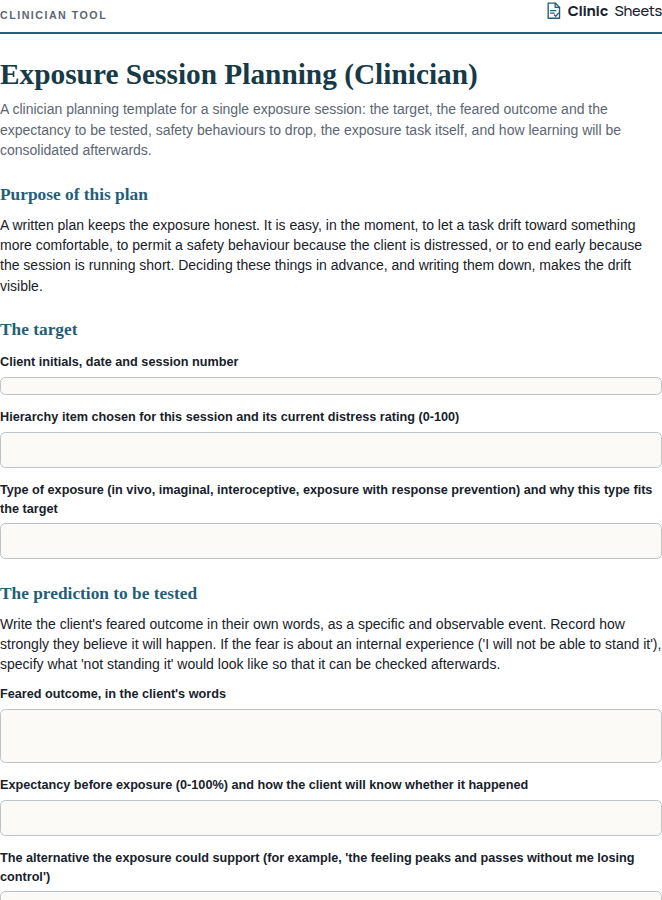
A worksheet for planning a single exposure and response prevention (ERP) task: the trigger, the feared outcome and its believability, the compulsions to be dropped, predicted and actual distress, and what was learned.
About this resource
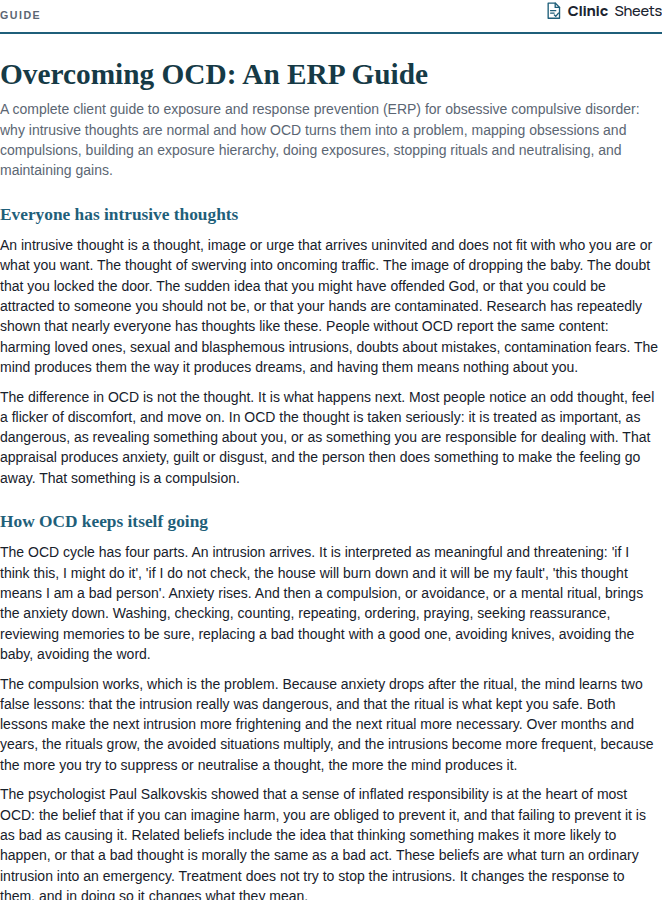
Exposure and response prevention remains the most strongly supported psychological treatment for OCD. The exposure element brings the client into deliberate contact with the situations, objects or thoughts that trigger obsessional fear. The response prevention element, which is at least as important, asks the client to refrain from the compulsions, neutralising and reassurance seeking that would ordinarily follow. Together they allow two things to happen: the client discovers that the feared consequence does not occur, or is tolerable, and they learn that distress rises and falls on its own without needing to be managed.
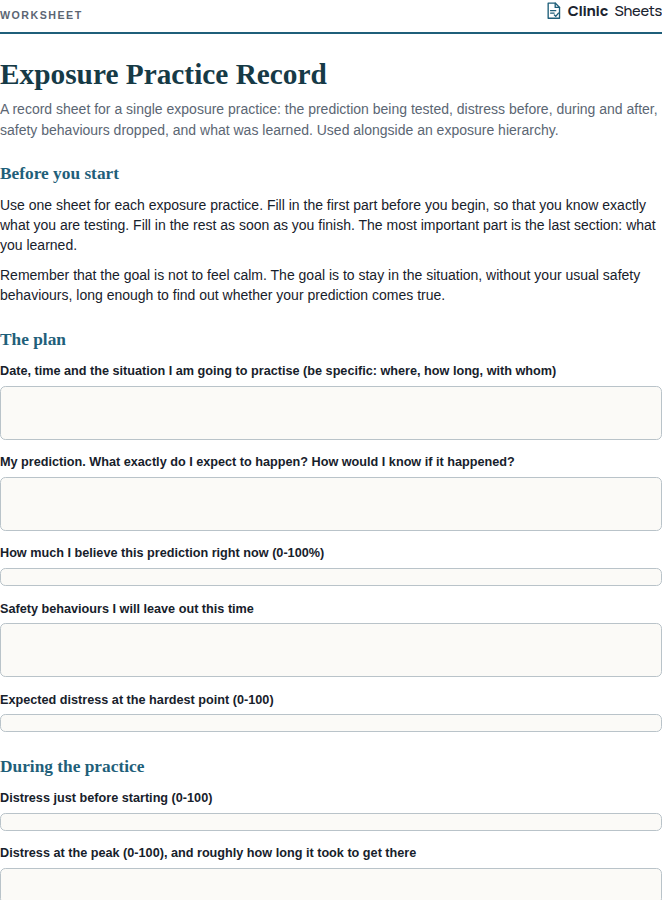
Contemporary accounts of exposure, drawing on inhibitory learning theory, put less emphasis on waiting for anxiety to fall within a session and more on maximising the mismatch between what the client expects and what actually happens. This worksheet is built around that idea. Each task begins with a concrete prediction and ends with a comparison against what occurred. Ratings of distress are still recorded, because they help clients see that anxiety is survivable, but the central question is always 'what did you learn?'
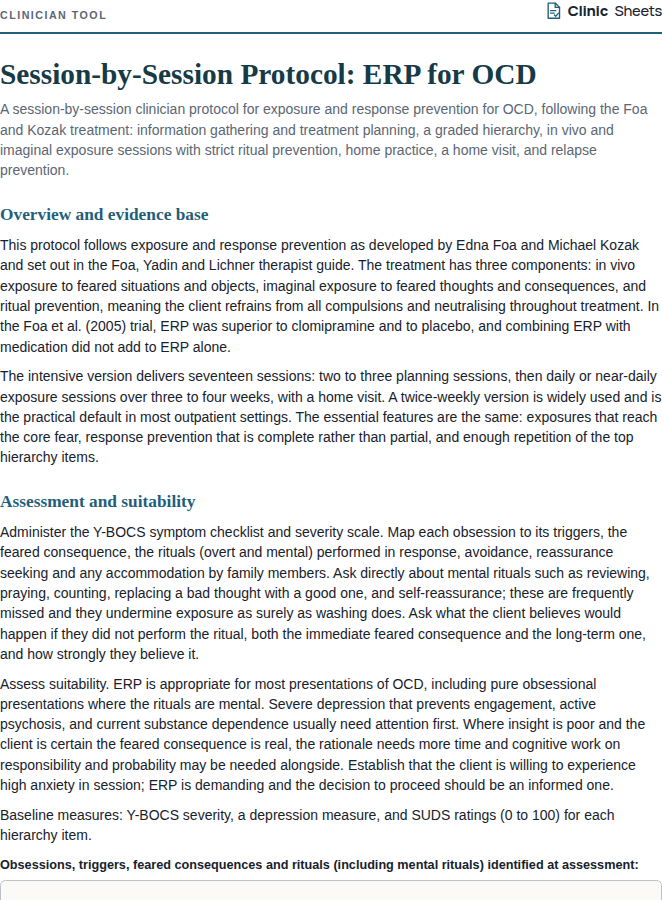
Use one sheet per planned task, whether it is completed in session or set as homework. The professional version includes guidance on designing tasks that block subtle or covert compulsions, on grading difficulty without letting the hierarchy become a source of avoidance, and on responding when a client 'completes' an exposure while secretly neutralising.
How to use it
- Complete the shared formulation first (see OCD Formulation) so the client understands why deliberately facing the fear, without the usual safety measures, is the route to change.
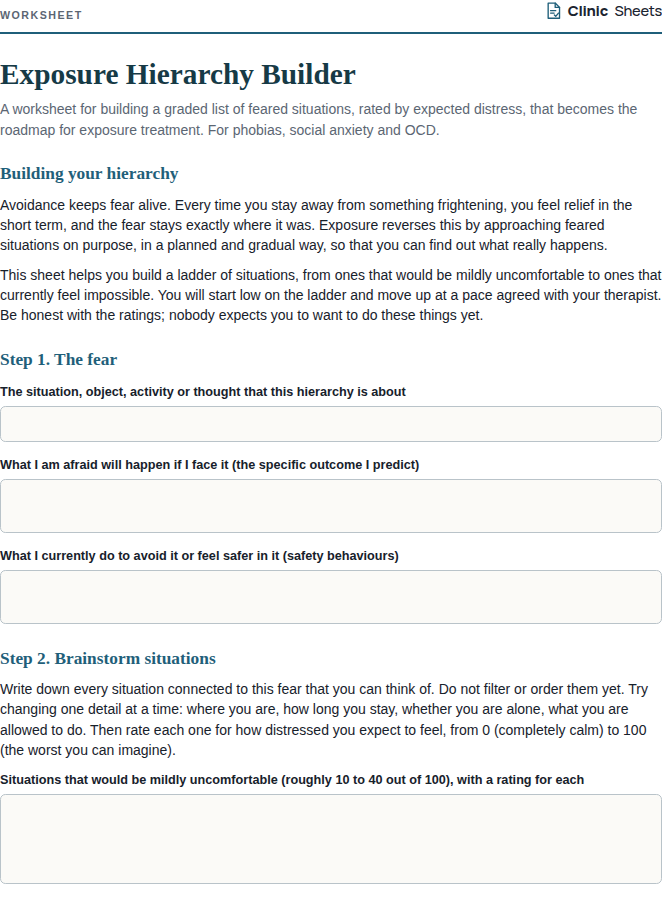
- Choose a task from the client's hierarchy that is challenging but that they agree to attempt. Early success matters more than early ambition.
- Write the feared prediction in specific, testable terms and rate how strongly the client believes it. 'Something bad will happen' is not testable; 'I will be so anxious I cannot go back to work that afternoon' is.
- List every compulsion, mental ritual, reassurance request and avoidance that would normally follow, and agree that all of them will be dropped for the duration of the task and afterwards.
- After the task, complete the lower half together or ask the client to do so at home. Focus the review on the gap between prediction and outcome rather than on how unpleasant it felt.
- Plan the next task while the learning is fresh. Repeat the same task in different contexts before moving up the hierarchy.
References
- Foa, E. B., Yadin, E., & Lichner, T. K. (2012). Exposure and Response (Ritual) Prevention for Obsessive-Compulsive Disorder: Therapist Guide (2nd ed.). Oxford University Press.
- Craske, M. G., Treanor, M., Conway, C. C., Zbozinek, T., & Vervliet, B. (2014). Maximizing exposure therapy: An inhibitory learning approach. Behaviour Research and Therapy, 58, 10-23.
- Abramowitz, J. S., Deacon, B. J., & Whiteside, S. P. H. (2019). Exposure Therapy for Anxiety: Principles and Practice (2nd ed.). Guilford Press.