Family Meeting Guide
A worksheet for running a regular, short family meeting: ground rules, a simple agenda (appreciations, problems, plans, something fun) and a record of decisions, so that issues are handled in a calm forum rather than in the heat of the moment.
About this resource
Family conflict often happens at the worst possible moment: in the car, at bedtime, in the middle of the problem itself, when everyone is tired and nobody can think. A regular family meeting creates a predictable, calm time and place where concerns can be raised, heard and solved. Structured family meetings appear across behavioural parenting programmes and family therapy approaches, and they serve several functions at once: they model the communication and problem-solving skills the family is trying to learn, they give children a legitimate voice and a share in decisions, and they take pressure off the parents to resolve everything in the moment.
This worksheet provides the structure. It begins with ground rules the family agrees together, then a short fixed agenda that starts with appreciations, moves to problems and plans, and ends with something enjoyable so the meeting is not experienced as a complaints session. A decisions record gives the meeting teeth: what was agreed, who is doing what, and when it will be reviewed. The format scales from two people to a large household and is written to be used with children from around school age upward.
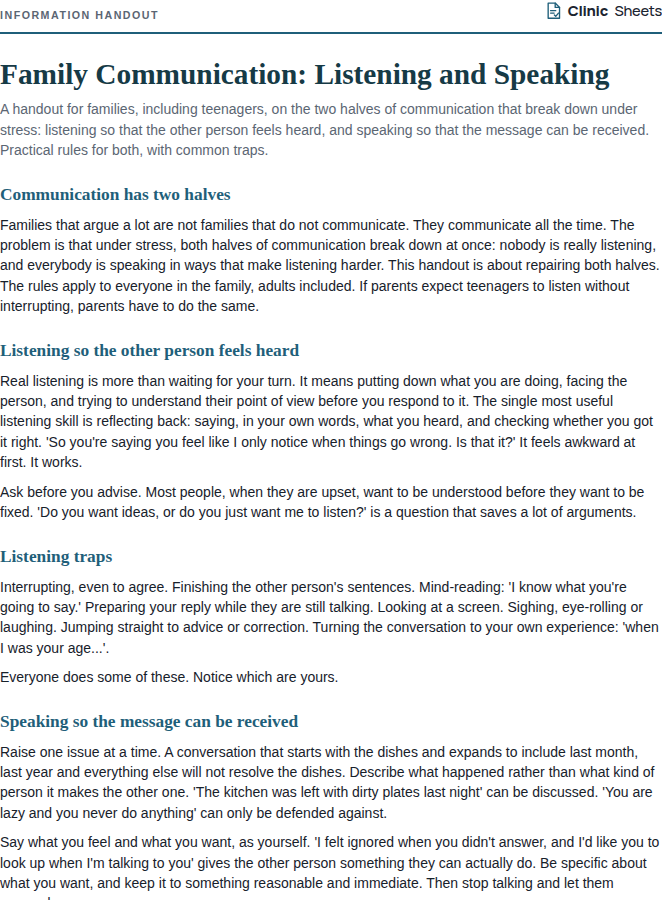
The professional version adds guidance on introducing the meeting to sceptical adolescents, on parents who use the meeting to lecture, on what to do when a child raises a problem about a parent, and on keeping the meeting short enough to survive.
How to use it
- Introduce the meeting to the parents first and make sure both are committed. A meeting that one parent undermines will not last.
- Run the first meeting in session if possible, with you facilitating and the parents watching how the structure works. Keep it to twenty minutes.
- Agree the ground rules with the whole family, including the children. Rules the children helped write are rules they are more likely to keep and to enforce on the adults.
- Coach the parents to hold the structure rather than the content: keep to the agenda, make sure everyone speaks, and write things down. Their job in the meeting is chair, not judge.
- Review the decisions record at each therapy session. It shows you what the family is working on and whether agreements are being kept.
References
- Kazdin, A. E. (2005). Parent Management Training: Treatment for Oppositional, Aggressive, and Antisocial Behavior in Children and Adolescents. Oxford University Press.
- Robin, A. L., & Foster, S. L. (1989). Negotiating Parent-Adolescent Conflict: A Behavioral-Family Systems Approach. Guilford Press.
- Dattilio, F. M. (2010). Cognitive-Behavioral Therapy with Couples and Families: A Comprehensive Guide for Clinicians. Guilford Press.