Four Patterns That Damage Relationships and Their Antidotes
A couples handout describing the four communication patterns that most reliably predict relationship breakdown (criticism, contempt, defensiveness and withdrawal) and the practical antidote to each.
About this resource
Decades of observational research on couples, most notably John Gottman's laboratory studies, identified a small set of interaction patterns that distinguish relationships that endure from those that end. Criticism, contempt, defensiveness and stonewalling (withdrawal) were found to predict later separation with high accuracy, with contempt the single most corrosive of the four. Each pattern is common in distressed couples and each tends to invite the next, so that a small complaint can escalate into a familiar and exhausting fight.
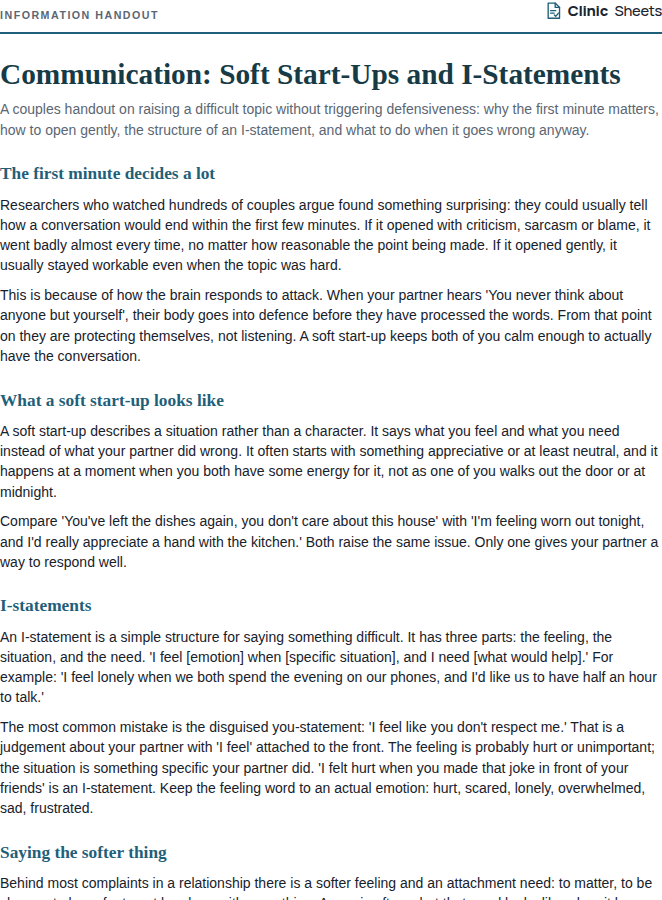
This handout names the four patterns in plain language, shows how they chain together into a negative cycle, and gives each an antidote drawn from the couples literature: a gentle, specific start-up in place of criticism; building appreciation and respect in place of contempt; taking responsibility for even a small part of the problem in place of defensiveness; and agreeing a break with a planned return in place of withdrawal. The emotionally focused view is also present: each pattern is understood as a protest or a protective move within an attachment relationship, which helps partners see the pattern, rather than each other, as the problem.
The professional version adds guidance on introducing the material without shaming either partner, on helping partners recognise their own patterns before their partner's, and on linking the antidotes to the couple's own recent argument so the ideas do not stay abstract.
How to use it
- Introduce the handout after you have observed at least one negative cycle in session, so both partners can recognise the patterns from their own experience.
- Read through the four patterns together. Ask each partner to identify which one they most often do themselves, before asking what they see in their partner. Normalise: almost every couple does all four sometimes.
- Take a recent argument and trace the sequence: who started with which pattern, and how the other responded. Draw it as a loop on paper if helpful.
- Practise one antidote in session. The gentle start-up is usually the easiest place to begin: have the partner who raised the complaint re-state it as 'I feel... about... and I need...'.
- Set a between-session task: each partner watches for their own pattern once during the week and tries the antidote, then reports back on what happened.
References
- Gottman, J. M., & Levenson, R. W. (1992). Marital processes predictive of later dissolution: Behavior, physiology, and health. Journal of Personality and Social Psychology, 63(2), 221-233.
- Gottman, J. M., & Silver, N. (1999). The Seven Principles for Making Marriage Work. Crown.
- Johnson, S. M. (2008). Hold Me Tight: Seven Conversations for a Lifetime of Love. Little, Brown.
- Epstein, N. B., & Baucom, D. H. (2002). Enhanced Cognitive-Behavioral Therapy for Couples: A Contextual Approach. American Psychological Association.