Blended Family Roadmap
A planning worksheet for stepfamilies and blended families: mapping who is in the family, the realistic expectations for each relationship, roles and discipline, the couple's own time, and the practical problems to solve first.
About this resource
Stepfamilies face a set of structural challenges that first families do not: children arrive with a prior history and loyalties, the couple relationship is the newest bond in the household rather than the oldest, a parent outside the home may remain central, and stepparents are frequently expected to love and discipline children who did not choose them. Research and clinical experience, notably Patricia Papernow's work and the earlier contributions of Emily and John Visher, consistently find that the families who adjust best are those who expect the process to take years rather than months, let step-relationships develop at the child's pace, keep discipline initially with the biological parent while the stepparent builds a relationship, and protect time for the couple and for each parent with their own children.
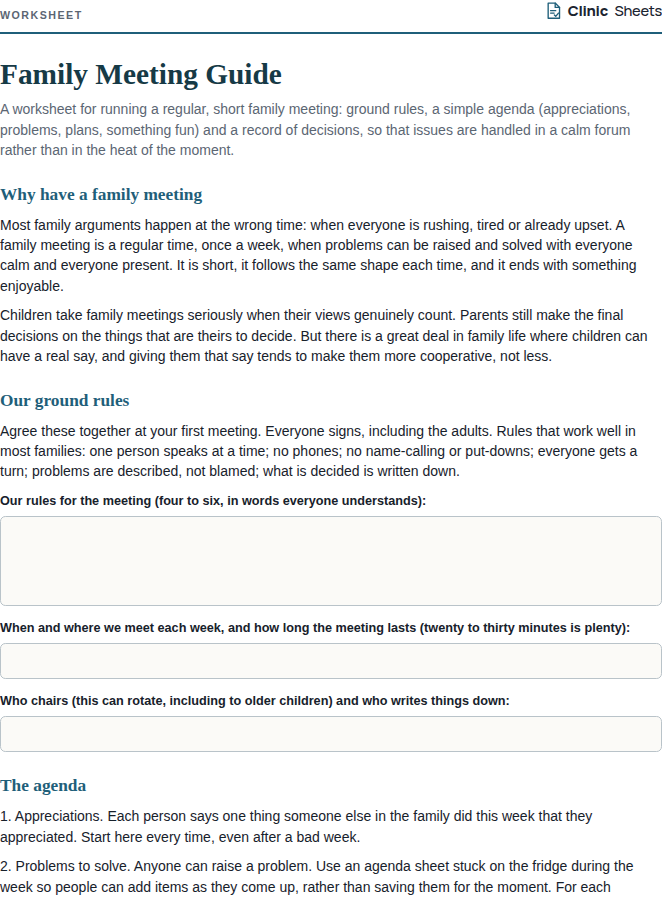
This worksheet organises those findings into a planning document the adults complete together. It starts with a map of everyone involved, including former partners and children who live elsewhere, then asks the couple to set realistic expectations for each step-relationship, agree how roles and discipline will work in the early period, protect the relationships that need protecting, and identify the two or three practical problems most worth solving first. The problem-solving orientation is deliberate: much stepfamily distress comes from treating structural strain as a personal failing, and the worksheet reframes it as a set of problems with known solutions.
The professional version adds guidance on the common early collision (the stepparent pushing for a role the child is not ready to grant, the parent caught in the middle), on the child's likely loyalty binds, and on when the work needs to involve the children or the other household directly.
How to use it
- Use with the adult couple, ideally early in the formation of the stepfamily or at the point they present with conflict about the children. Normalise the difficulty before the worksheet: what they are finding hard is what most stepfamilies find hard.
- Complete the map first. Make sure former partners and non-resident children are on it. Their absence from the map often mirrors their absence from the couple's planning, which is a common source of later trouble.
- Work through expectations one relationship at a time. Challenge timelines that are too fast. A stepparent and a child who have known each other for a year are still early.
- On roles and discipline, help the couple agree a clear early arrangement: the biological parent holds the line, the stepparent supports and builds connection, and the adults present a united front in private disagreements. Revisit as the relationships mature.
- Finish with two or three concrete problems to work on, using a structured problem-solving approach for each. Review the roadmap every few months, since a stepfamily's needs change quickly.
References
- Papernow, P. L. (2013). Surviving and Thriving in Stepfamily Relationships: What Works and What Doesn't. Routledge.
- Visher, E. B., & Visher, J. S. (1996). Therapy with Stepfamilies. Brunner/Mazel.
- D'Zurilla, T. J., & Nezu, A. M. (2007). Problem-Solving Therapy: A Positive Approach to Clinical Intervention (3rd ed.). Springer.