Parenting as a Team
A worksheet for couples who are parenting together, helping both partners name where they pull in different directions, understand the cycle underneath the disagreements, and agree on a small number of shared ground rules.
About this resource
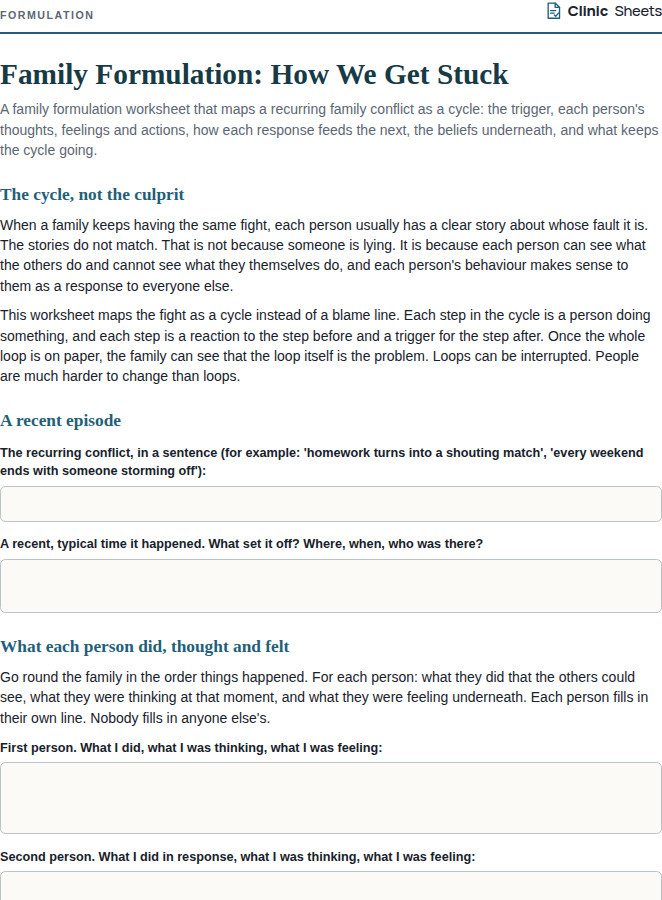
Parenting is one of the most common battlegrounds for couples, and disagreements about discipline, routines, screen time or how much to worry are rarely just about the child. Under most co-parenting conflicts sits the same negative cycle that emotionally focused therapy describes in other areas of a relationship: one partner pushes harder for the child's sake and is experienced as critical or controlling, the other pulls back or gives in and is experienced as absent or undermining, and each partner's move confirms the other's fear. Feinberg's work on co-parenting adds that children do best when parents support each other's authority, keep their disagreements out of the child's hearing and share the load in a way both find fair, which is why the couple's ability to work as a team matters in its own right.
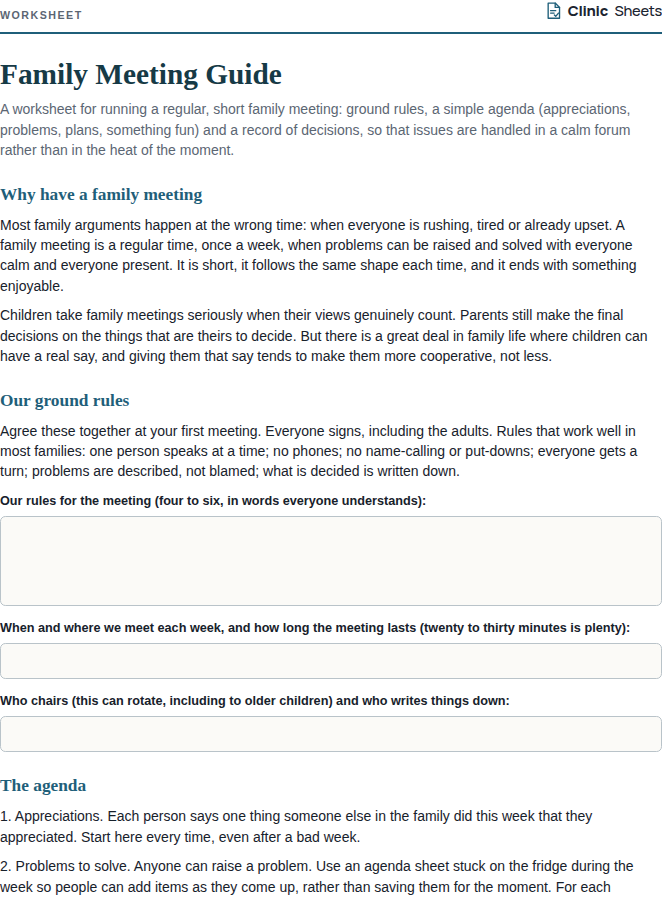
This worksheet takes both partners through the disagreements that come up most often, the position each partner tends to take, the softer feeling and worry under that position, and the effect on the child. It then moves to the practical: what each partner appreciates in the other's parenting, where the two of them already agree, and three ground rules they can hold to. The structure comes from EFT's cycle mapping and from communication skills work in CBT for couples, applied to parenting specifically.
The professional version notes that the sheet is best completed when the couple has already had some help identifying their cycle, so that the 'underneath' questions do not feel like an ambush. It also flags that where one partner has serious concerns about the other's safety with the child, this is not a co-parenting worksheet issue and needs direct assessment.
How to use it
- Use after the couple has been introduced to the idea of a negative cycle, so the questions about what is underneath each partner's position make sense.
- Ask both partners to complete the first section separately, then compare in session. Differences in what each considers the main disagreements are themselves useful information.
- When working through the 'underneath' fields, slow down. Help each partner say the fear or hope beneath their stance (for example, 'I'm scared she'll grow up with no limits' or 'I don't want him to feel about me the way I felt about my father') and help the other partner hear it before moving on.
- Keep the ground rules few and concrete. Three rules a couple actually keeps are worth more than ten they forget. A common first rule is not to contradict each other in front of the child and to raise disagreements later, in private.
- Review the ground rules at the next session and adjust. Treat a broken rule as a chance to look at the cycle, not as evidence that one partner is the problem.
References
- Feinberg, M. E. (2003). The internal structure and ecological context of coparenting: A framework for research and intervention. Parenting: Science and Practice, 3(2), 95-131.
- Johnson, S. M. (2020). The Practice of Emotionally Focused Couple Therapy: Creating Connection (3rd ed.). Routledge.
- Gottman, J. M., & Gottman, J. S. (2007). And Baby Makes Three. Crown.