Feelings Check-In (Kids)
A short daily check-in for children: name the feeling, find it in the body, rate its size, notice what was happening, and decide whether anything is needed. Builds emotional awareness and the habit of noticing feelings without being swept away by them.
About this resource
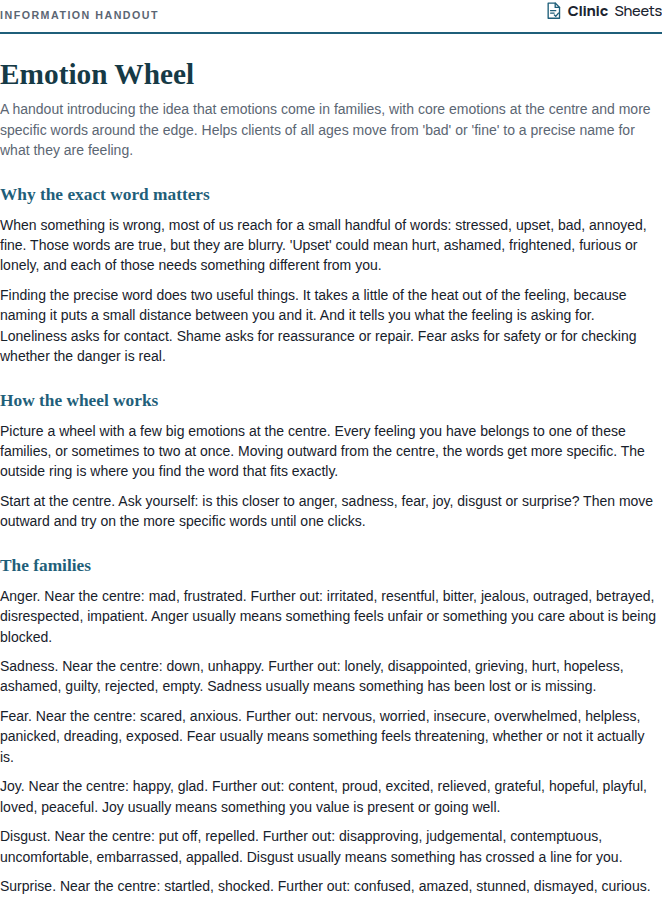
The ability to notice and name an emotion is a foundation skill for almost every child treatment. Emotional awareness develops gradually through childhood and is often limited in children referred for low mood, irritability or emotional outbursts, who may report only 'bad' or 'fine'. Emotion-focused and CBT programs for children, and Southam-Gerow's practitioner guide on emotion regulation, all begin with emotion identification: labelling feelings, locating them in the body, grading their intensity, and linking them to what was happening. Naming a feeling accurately tends to reduce its intensity slightly and creates the pause in which a coping choice can be made.
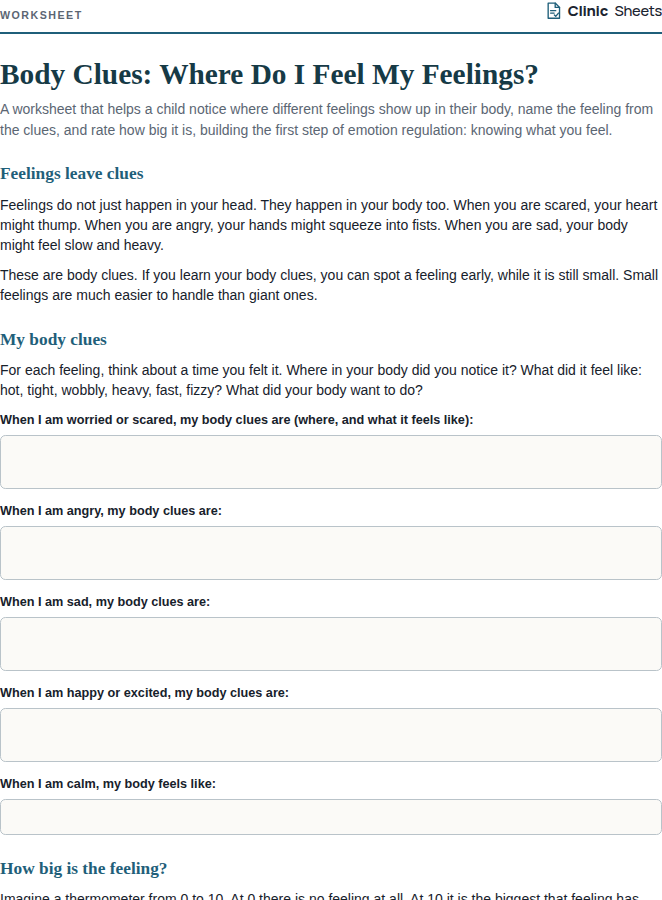
This worksheet is a brief mindful check-in the child can do once a day or when prompted by a parent. It asks: what feeling is here (with a list of feeling words to choose from), where it is in the body, how big it is on a 0 to 10 thermometer, what was happening just before, and whether the feeling needs anything right now. The final question introduces the idea that many feelings simply need to be noticed and allowed to pass, while some are a signal to do something or to tell someone. For children with low mood, it also provides a record for the clinician of how feelings vary across days and situations.
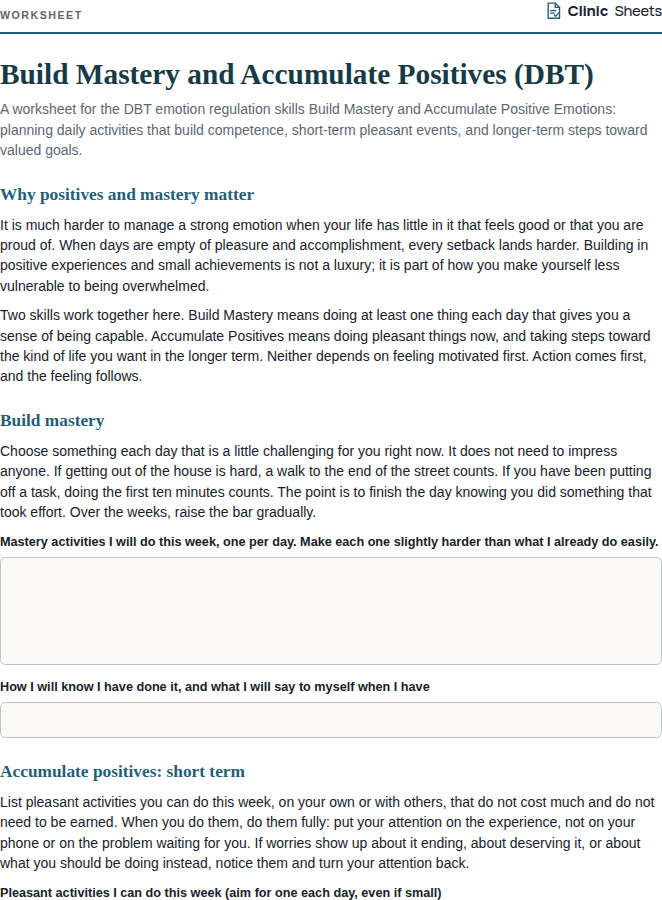
The professional version adds a feeling word list graded by complexity, guidance on children who always report 'fine' or who choose only 'angry', and notes on using the completed check-ins as the raw material for later thought work or behavioural activation. It also advises that the check-in should never be used by a parent as a lead-in to correction ('you said you were angry, so why did you...').
How to use it
- Introduce the check-in in session with a feeling word list and a body outline. Ask the child to complete one for how they feel right now, then one for a moment earlier in the day. Model doing one yourself.
- Teach the thermometer: 0 means the feeling is not there at all, 10 is the biggest it could ever be. Use examples from the child's life to anchor 3, 6 and 9.
- Agree a regular check-in time at home, often at dinner or bedtime, and a rule that parents listen and thank, without fixing or questioning. Two minutes is enough.
- For the last question, help the child sort feelings into three responses: just notice it and let it pass, do something helpful (a coping card skill, an activity), or tell someone. Most feelings fall in the first group.
- Review the week's check-ins together at the next session. Look for patterns in what was happening before low or big feelings, and use these as starting points for activity scheduling or thought work.
References
- Southam-Gerow, M. A. (2013). Emotion Regulation in Children and Adolescents: A Practitioner's Guide. Guilford Press.
- Saarni, C. (1999). The Development of Emotional Competence. Guilford Press.
- Stallard, P. (2019). Think Good, Feel Good: A Cognitive Behavioural Therapy Workbook for Children and Young People (2nd ed.). Wiley.