Food and Mood Diary
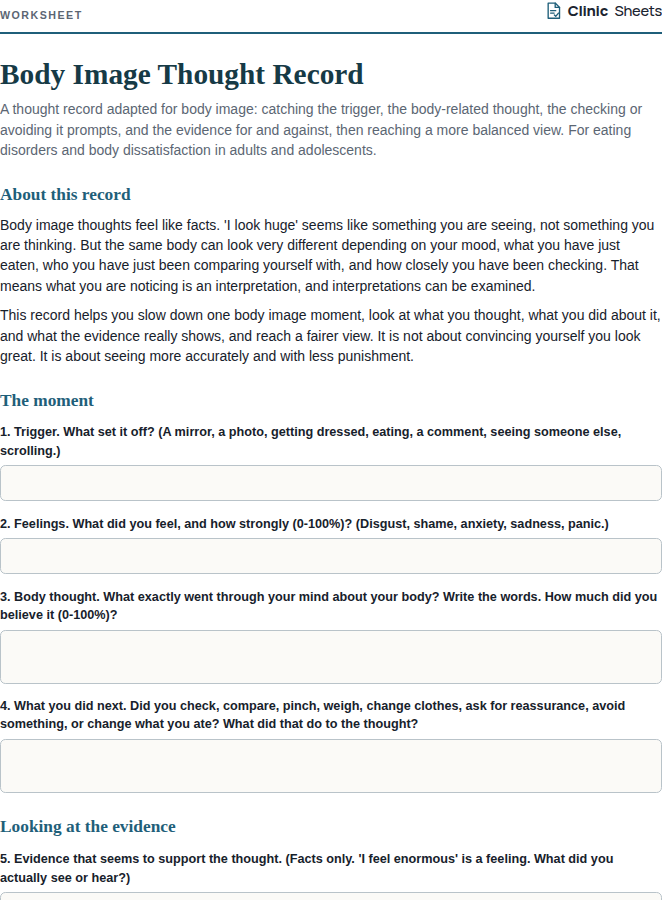
A real-time self-monitoring record for eating disorder treatment: what was eaten and when, the context, whether it felt like a binge or was followed by compensatory behaviour, and the thoughts and feelings around it. The foundation of CBT for eating disorders.
About this resource
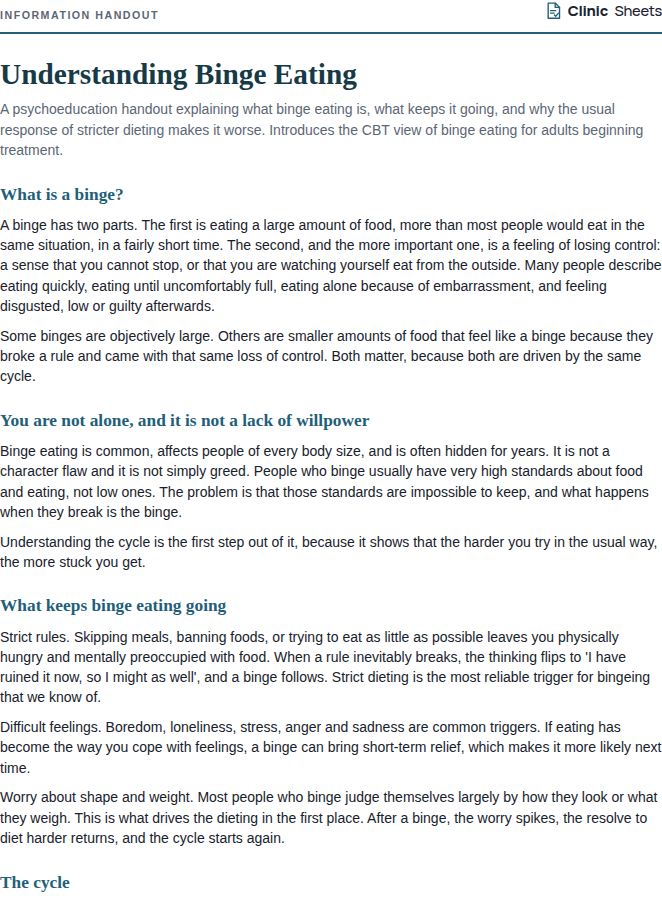
Self-monitoring is the first and most important procedure in cognitive behavioural treatment for eating disorders. Recording eating in real time, rather than from memory at the end of the day, does two things. It gives the clinician and client accurate information about the pattern of eating, which is often very different from the client's summary of it. And it changes the eating itself, because the act of writing interrupts automatic behaviour and makes the moment of choice visible. Fairburn describes it as the engine of the early phase of treatment.
This diary asks for time, what was consumed, where, whether the client considered it excessive, whether any compensatory behaviour followed (recorded as a simple mark rather than described), and a column for the thoughts, feelings and circumstances around the eating. It deliberately does not ask for calories, weights or portion sizes, which would feed the very preoccupation treatment aims to reduce. The mood column links eating to the emotional states that often trigger restriction or bingeing, and lays the groundwork for later cognitive work.
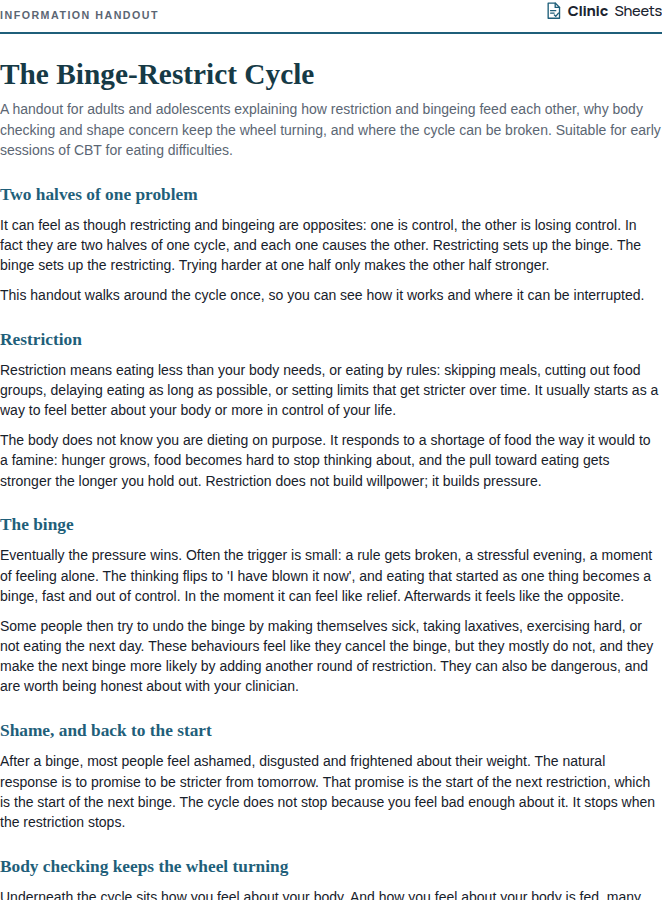
The professional version includes guidance on introducing the diary so that clients complete it (many have kept food diaries for dieting purposes and need to understand that this one is different), on reviewing it at the start of every session, and on the typical patterns it reveals: long gaps between eating that precede binges, rules being applied, and emotional triggers. It also notes what to do if the client is not completing it, which is itself clinically informative.
How to use it
- Introduce the diary in the first or second session, explaining that it is a tool for understanding rather than for judging or controlling intake.
- Emphasise real-time recording. Ask the client to carry the diary and write within a few minutes of eating.
- Make clear that nothing is to be measured or counted. What matters is the pattern, the context and the feelings.
- Review the diary at the start of every session, together, before anything else. Look at gaps between eating, the events preceding any binges, and the emotions recorded.
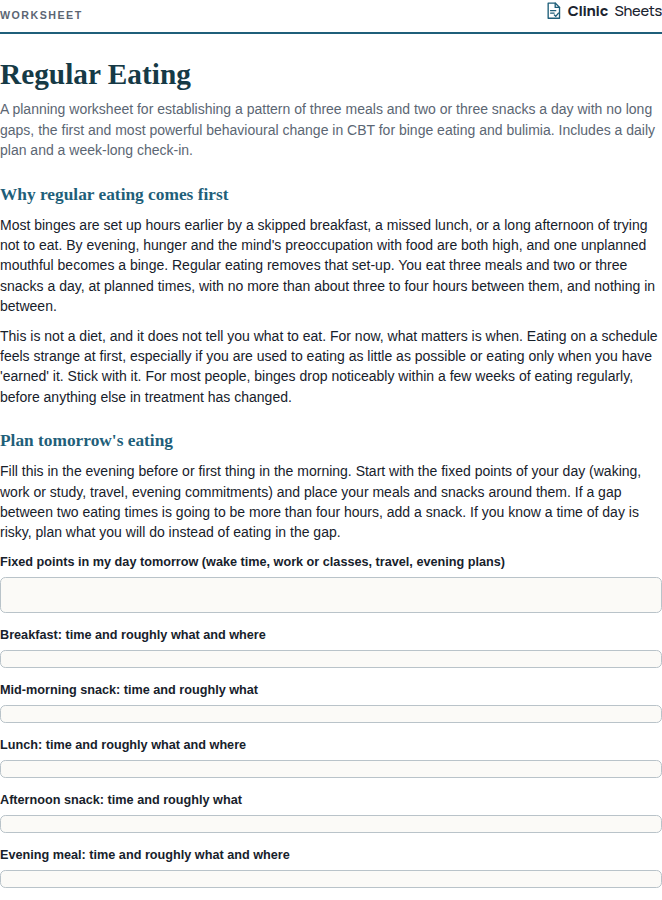
- Use what emerges to plan the next step, usually establishing regular eating. Return to the diary throughout treatment as the record of change.
- If the diary is not completed, explore what got in the way without criticism. Shame about what would be written is common and worth naming.
References
- Fairburn, C. G. (2008). Cognitive Behavior Therapy and Eating Disorders. Guilford Press.
- Fairburn, C. G. (2013). Overcoming Binge Eating (2nd ed.). Guilford Press.
- Waller, G., et al. (2007). Cognitive Behavioral Therapy for Eating Disorders: A Comprehensive Treatment Guide. Cambridge University Press.