Understanding Eating Disorders
A psychoeducation handout describing what eating disorders are, the shared core of over-evaluating shape and weight, the effects of restriction on mind and body, and how the disorder maintains itself. Based on the transdiagnostic CBT model.
About this resource
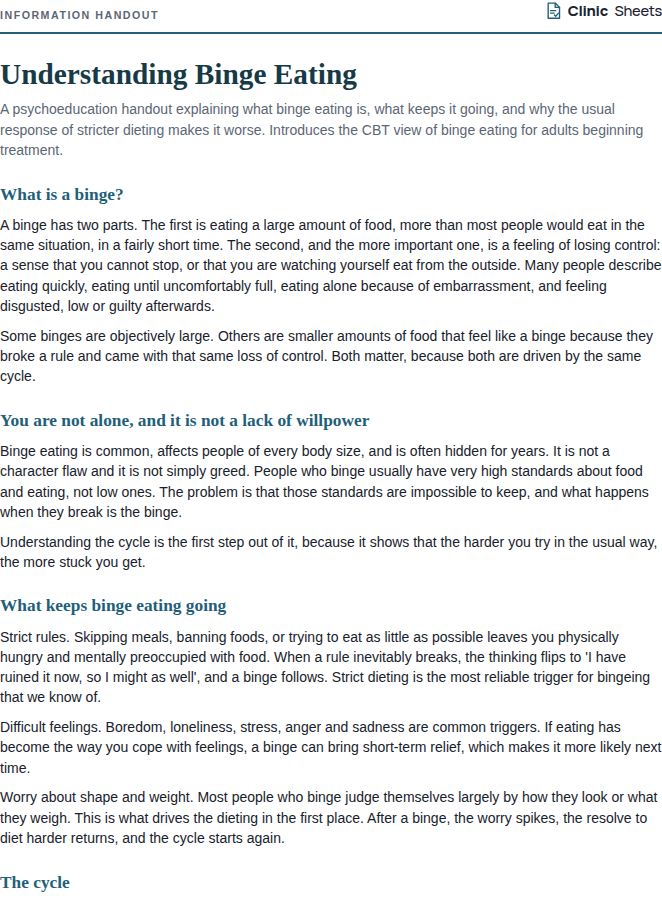
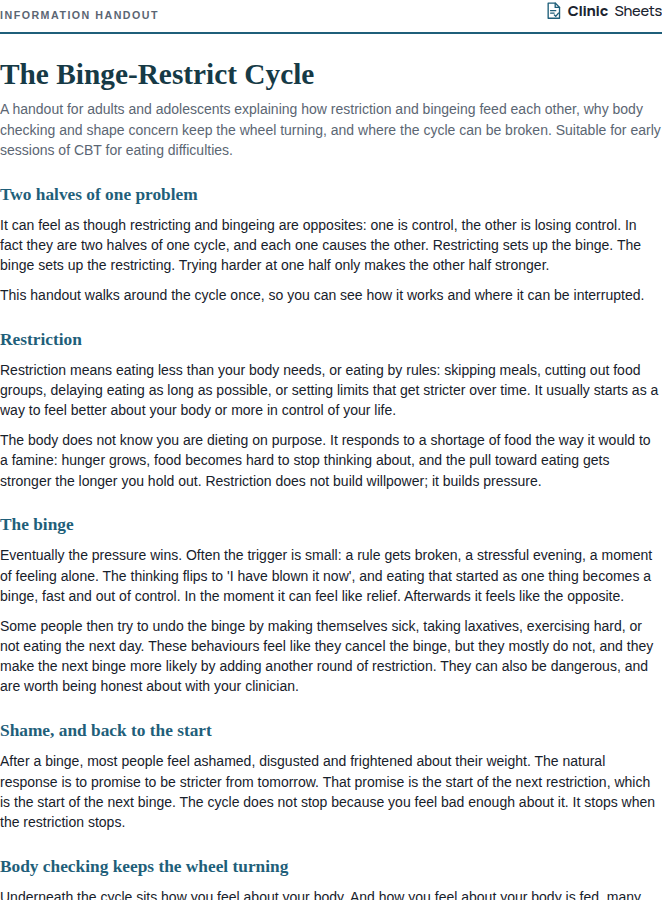
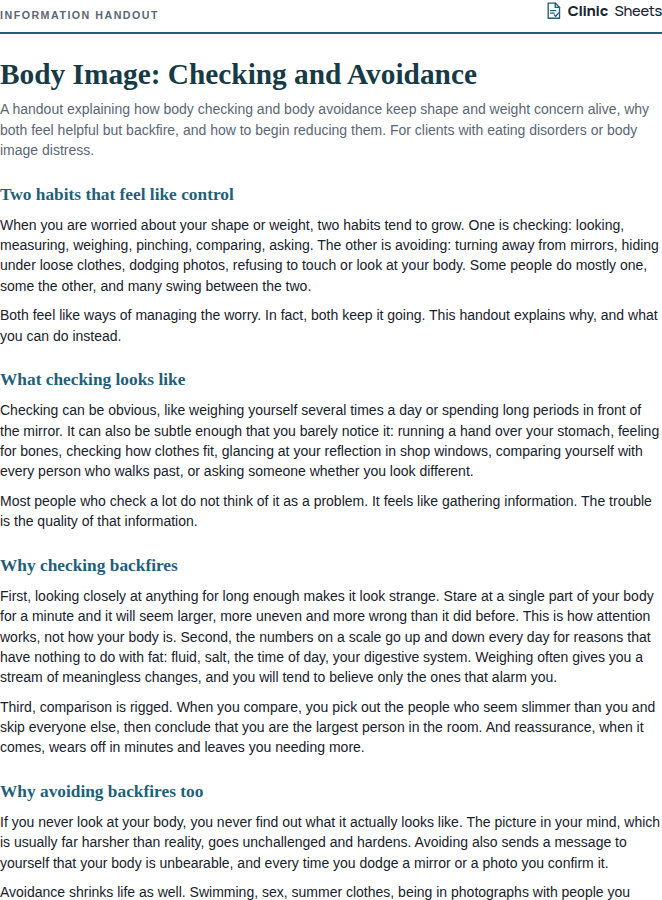
Christopher Fairburn's transdiagnostic cognitive behavioural model proposes that anorexia nervosa, bulimia nervosa and the other eating disorders share a common core: the over-evaluation of shape and weight and their control, such that self-worth is judged largely or entirely in these terms. From this core follow dietary restraint, and from restraint follow the other features, including binge eating, compensatory behaviours, body checking and avoidance, and a preoccupation with food that the client often experiences as the disorder's most exhausting symptom. The model is maintaining rather than causal: it describes what keeps the disorder going now, which is what treatment addresses.
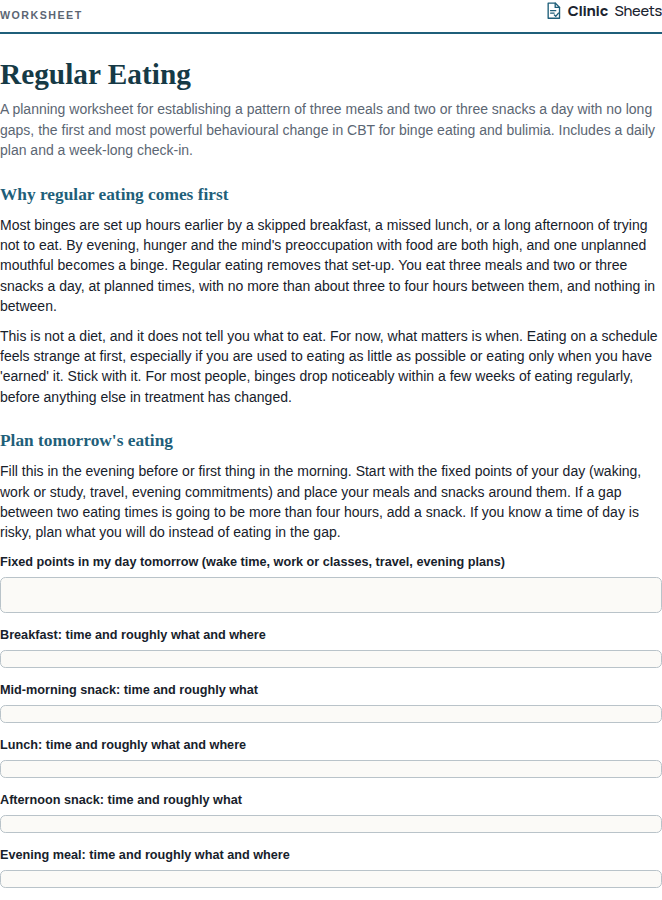
This handout presents that model in client-friendly terms. It describes the common eating disorders without weight thresholds or numbers, explains the effects of restriction on mood, concentration, sleep and the drive to binge (drawing on the Minnesota starvation study), and shows how the pieces link together into a cycle. It is written to reduce shame and to make treatment logic transparent: if restriction drives bingeing, then regular eating is the first target, however counterintuitive that feels.
The professional version includes guidance on introducing the model without triggering defensiveness, on the medical monitoring that should accompany psychological treatment, and on the language to avoid (no numbers, no descriptions of specific behaviours in enough detail to be instructive). It also flags that psychoeducation alone is not treatment and should lead directly into self-monitoring and regular eating.
How to use it
- Use in the first sessions of treatment, after assessment and once medical safety has been established.
- Read the maintaining cycle section together and ask the client to map their own experience onto it. Draw it out if that helps.
- Discuss the effects of restriction openly. Many clients are relieved to learn that preoccupation with food and the urge to binge are predictable consequences of undereating, not personal failings.
- Do not introduce weight or calorie figures. If the client raises them, redirect to patterns and effects.
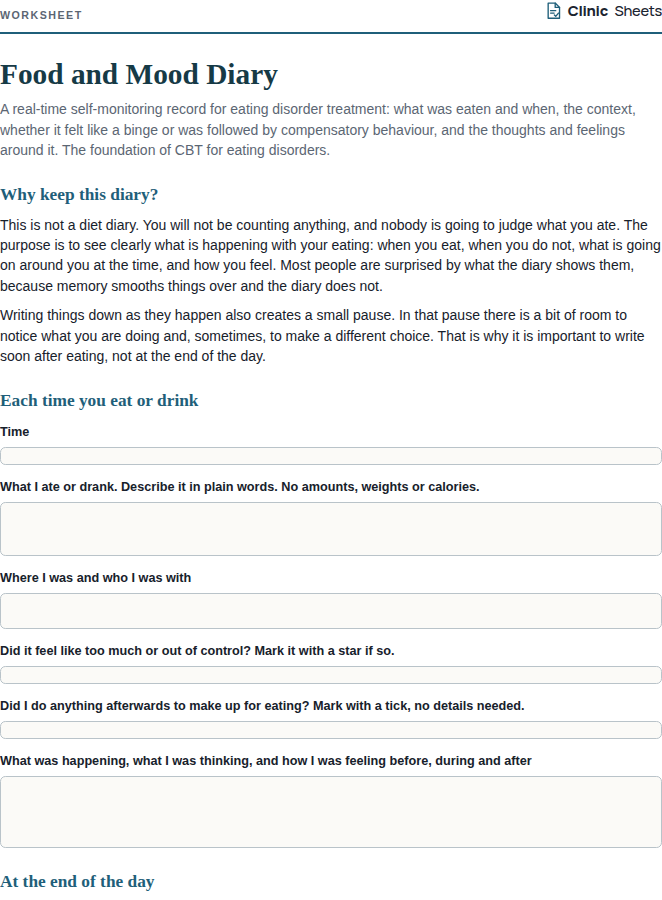
- Follow with a food and mood diary to begin self-monitoring, and with the regular eating plan.
References
- Fairburn, C. G. (2008). Cognitive Behavior Therapy and Eating Disorders. Guilford Press.
- Fairburn, C. G., Cooper, Z., & Shafran, R. (2003). Cognitive behaviour therapy for eating disorders: A 'transdiagnostic' theory and treatment. Behaviour Research and Therapy, 41(5), 509-528.
- Keys, A., Brozek, J., Henschel, A., Mickelsen, O., & Taylor, H. L. (1950). The Biology of Human Starvation. University of Minnesota Press.
- Waller, G., et al. (2007). Cognitive Behavioral Therapy for Eating Disorders: A Comprehensive Treatment Guide. Cambridge University Press.