Body Image Thought Record
A thought record adapted for body image: catching the trigger, the body-related thought, the checking or avoiding it prompts, and the evidence for and against, then reaching a more balanced view. For eating disorders and body dissatisfaction in adults and adolescents.
About this resource
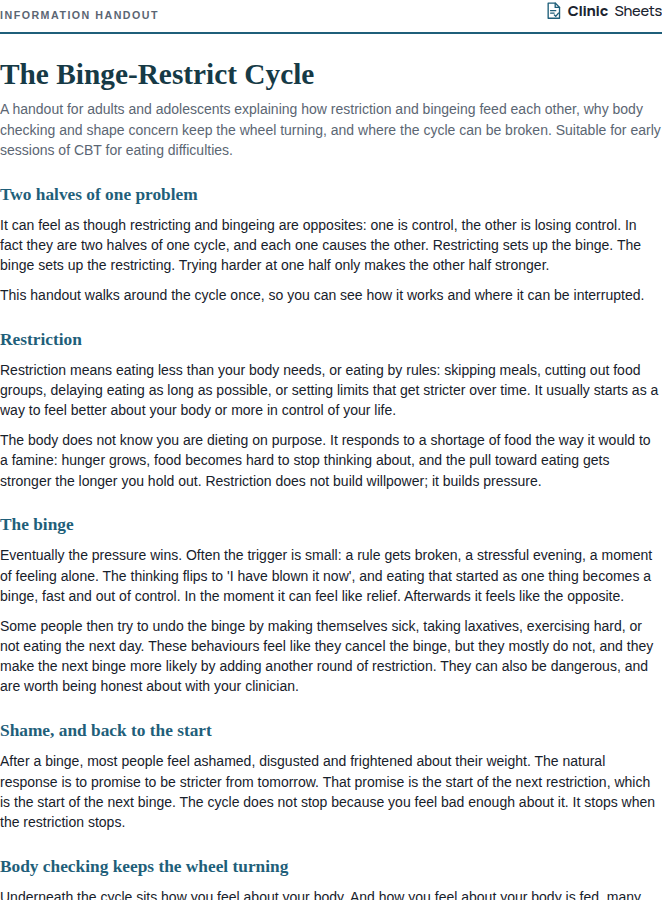
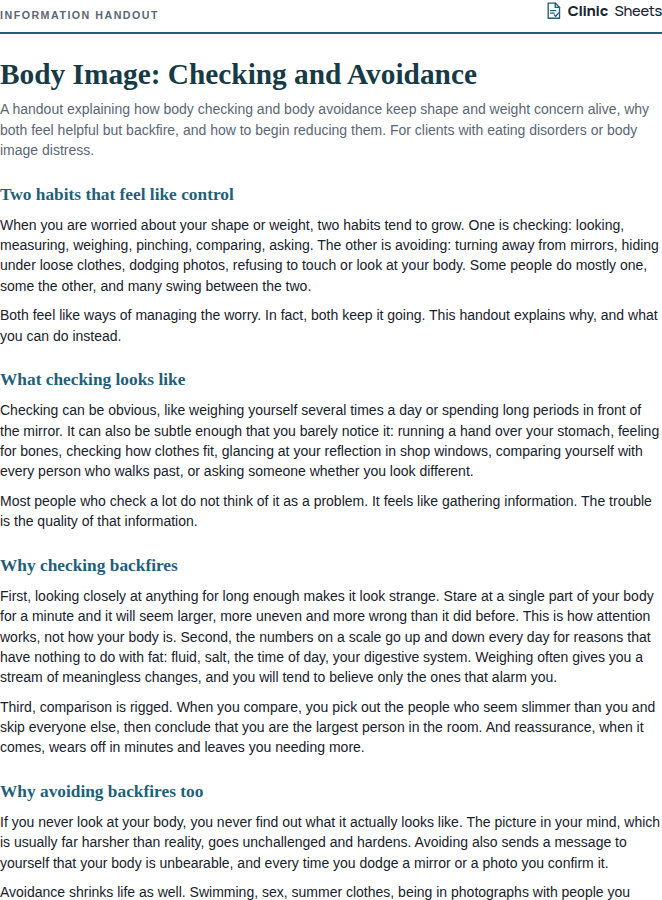
Negative body image is maintained by a characteristic set of thoughts and behaviours. Triggers such as mirrors, photographs, clothing, comments, comparison with others, or eating are followed by rapid appraisals ('I look enormous', 'everyone can see my thighs', 'I'm disgusting'), which drive both distress and body-focused behaviours: checking, comparing, seeking reassurance, avoiding situations where the body is visible, or restricting food. In Fairburn's transdiagnostic model, over-evaluation of shape and weight is the core psychopathology of eating disorders, and Cash's cognitive behavioural model of body image describes a similar cycle of appearance-related schemas, triggering events, automatic appearance thoughts, and adjustive behaviours. In both models, identifying and testing the thoughts, and stopping the behaviours that keep them alive, is central to treatment.
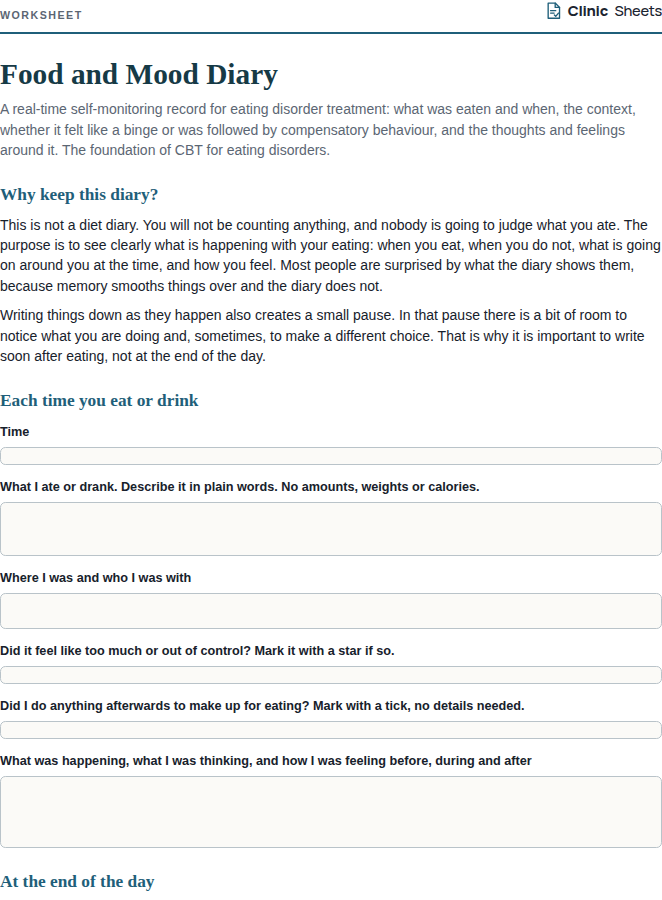
This worksheet adapts the standard seven-column thought record to that cycle. It adds two elements to the usual structure. First, it asks about the body-related behaviour the thought led to, because checking and avoidance provide the sense of evidence that keeps the thought going and need to be named. Second, its evidence prompts are tailored to the errors that dominate body image thinking: mind reading (assuming others are judging), magnification (a part becomes the whole), emotional reasoning (feeling fat treated as being fat), and comparison with unrepresentative images. Body image thoughts often feel like perceptions rather than thoughts, and the record helps clients see them as interpretations that can be examined.
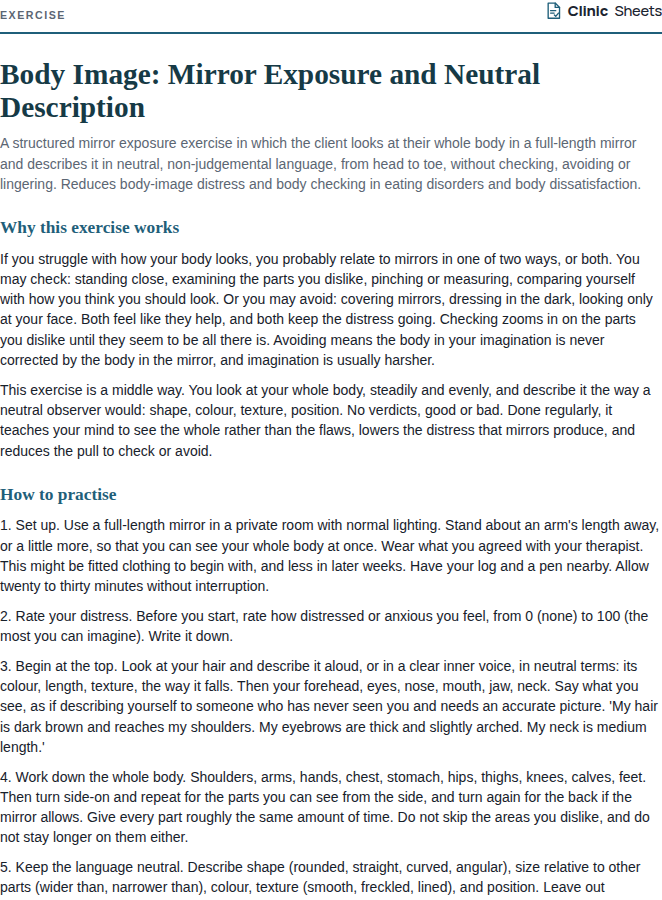
The professional version adds guidance on introducing the record after the client has begun to reduce checking (otherwise checking supplies a constant stream of confirming 'evidence'), on the difference between feelings of fatness and being fat, and on using the record alongside mirror exposure and behavioural experiments rather than as a stand-alone intervention. It also notes that for adolescents the language has been kept plain and that the record should be introduced with a worked example.
How to use it
- Introduce the body image cycle first: trigger, thought, feeling, behaviour, and the way checking and avoiding feed the thought. Use the client's own recent example.
- Complete the first record together in session, ideally about a moderately distressing recent situation. Get a specific hot thought rather than a general theme.
- Pay particular attention to the behaviour column. Ask what the client did next (checked, compared, changed clothes, cancelled plans, skipped a meal) and how that behaviour affected belief in the thought.
- Use the tailored evidence prompts. Body image thoughts are often maintained by mind reading and by treating feelings as facts; the prompts target those directly.
- Assign one record between sessions whenever a body image thought produces a clear shift in mood or a body-focused behaviour. Review together, and follow up with behavioural experiments where the thought makes a testable prediction (for example, that others will stare).
References
- Fairburn, C. G. (2008). Cognitive Behavior Therapy and Eating Disorders. Guilford Press.
- Cash, T. F. (2008). The Body Image Workbook: An Eight-Step Program for Learning to Like Your Looks (2nd ed.). New Harbinger.
- Greenberger, D., & Padesky, C. A. (2015). Mind Over Mood (2nd ed.). Guilford Press.