Regular Eating
A planning worksheet for establishing a pattern of three meals and two or three snacks a day with no long gaps, the first and most powerful behavioural change in CBT for binge eating and bulimia. Includes a daily plan and a week-long check-in.
About this resource
Regular eating is the first intervention in Fairburn's CBT for eating disorders and the one with the largest early effect on binge frequency. The instruction is simple: eat three planned meals and two or three planned snacks each day, at roughly set times, with no more than about three to four hours between them, and do not eat between these planned times. What is eaten is initially left up to the client; the focus is on when, not what. The pattern works by removing the two main behavioural drivers of binges: prolonged hunger from gaps and skipped meals, and the unstructured grazing that slides into loss of control.
This worksheet treats regular eating as a scheduling task, in the same way that activity scheduling treats withdrawal in depression. The client plans tomorrow's eating times in advance, fits them around their actual day, anticipates obstacles, and reviews what happened. Planning ahead is the mechanism: decisions made in the morning are easier than decisions made at 9 p.m. in front of the fridge.
The professional version reminds the clinician that regular eating is introduced with self-monitoring, that no calorie, portion or weight targets are set, that clients who are underweight or purging need medical oversight, and that the two most common obstacles are fear of weight gain (addressed through psychoeducation and, where appropriate, in-session weighing as part of the protocol) and chaotic days without any routine (addressed by planning around fixed points such as work start and finish).
How to use it
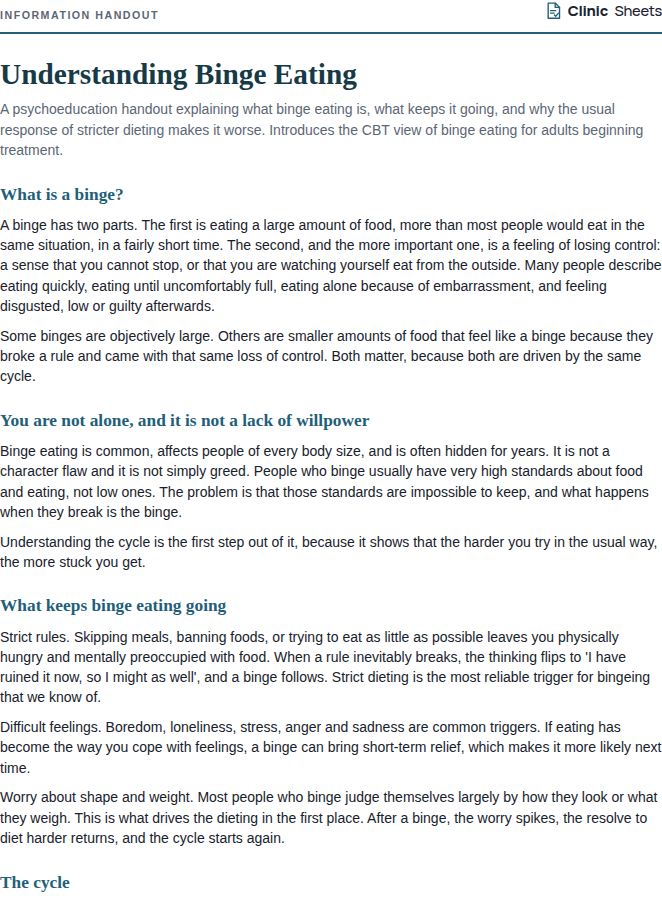
- Introduce regular eating in the first or second treatment session, after the client has read Understanding Binge Eating and started self-monitoring.
- Plan the first day together in session, anchoring meal and snack times to fixed points in the client's day. Aim for gaps of no more than three to four hours.
- Make clear that the content of meals is not being prescribed at this stage, and that the plan is not a diet. Address fear of weight gain directly and factually.
- Ask the client to plan each day the evening before or first thing in the morning, and to note what actually happened. Review the week's plans and records at the next session.
- Treat missed meals and long gaps as the priority problems to solve, ahead of the content of binges. Expect binge frequency to fall as regularity improves.
References
- Fairburn, C. G. (2008). Cognitive Behavior Therapy and Eating Disorders. Guilford Press.
- Fairburn, C. G. (2013). Overcoming Binge Eating (2nd ed.). Guilford Press.
- Waller, G., Cordery, H., Corstorphine, E., Hinrichsen, H., Lawson, R., Mountford, V., & Russell, K. (2007). Cognitive Behavioral Therapy for Eating Disorders: A Comprehensive Treatment Guide. Cambridge University Press.