Repair Conversations
A couples worksheet for having a structured repair conversation after a fight or a hurt: each partner shares their own experience and the softer feeling underneath, hears the other without defending, owns their part, and says what would help next time.
About this resource
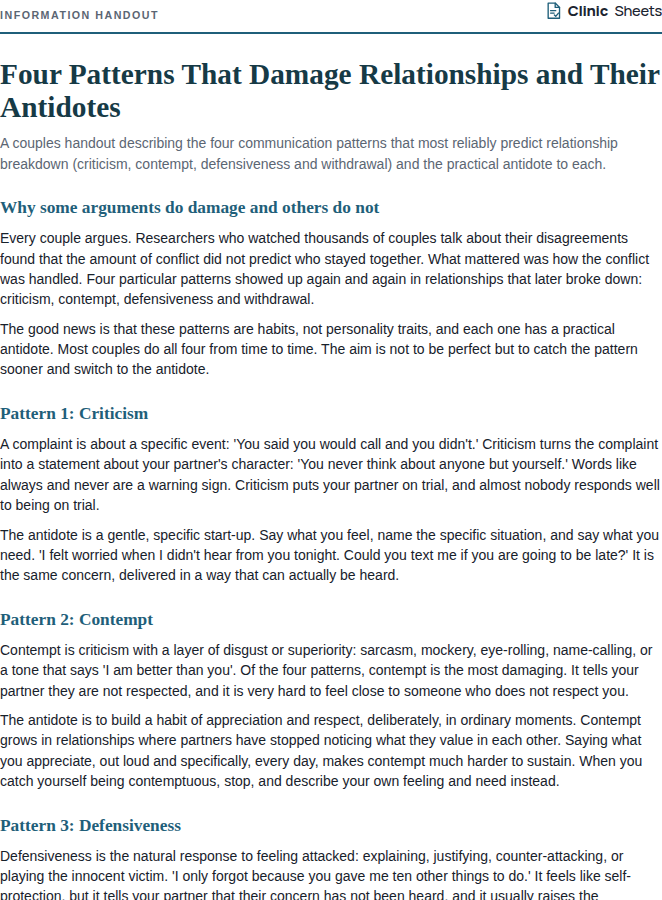
The capacity to repair after conflict is one of the strongest predictors of relationship stability. Gottman's research found that the difference between couples who do well and couples who do not lies less in how often they fight than in whether repair attempts are made and received. In Emotionally Focused Therapy, repair is built on the work of de-escalation: once partners can see their negative cycle, they can return to a rupture, each speak from their own primary emotion rather than their reactive one, and offer the other the kind of response that restores the bond. Johnson's work on attachment injuries and forgiveness describes a sequence in which the hurt partner articulates the injury and its attachment significance, the other partner acknowledges it and expresses remorse, and the hurt partner is able to reach for comfort.
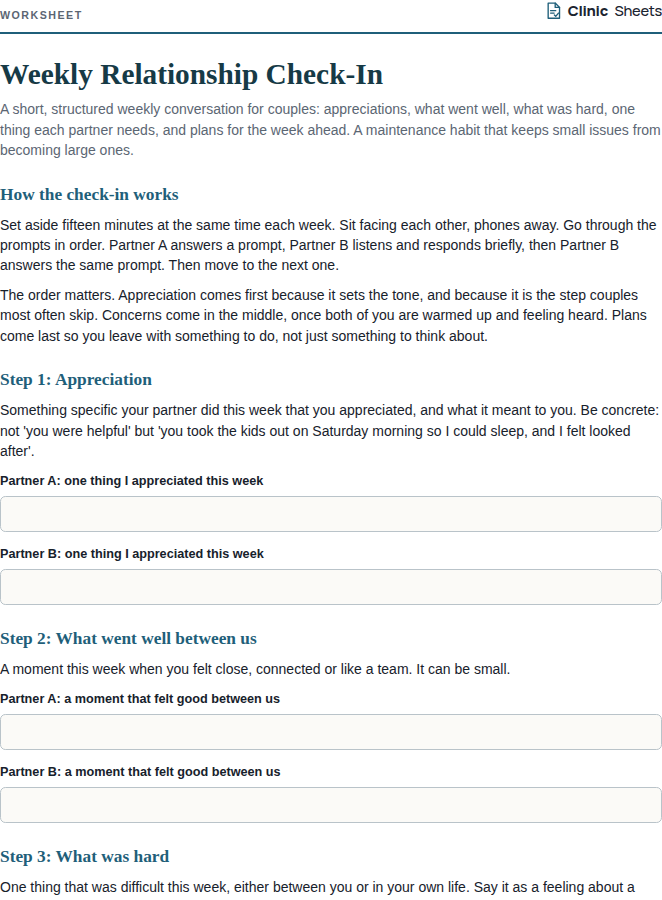
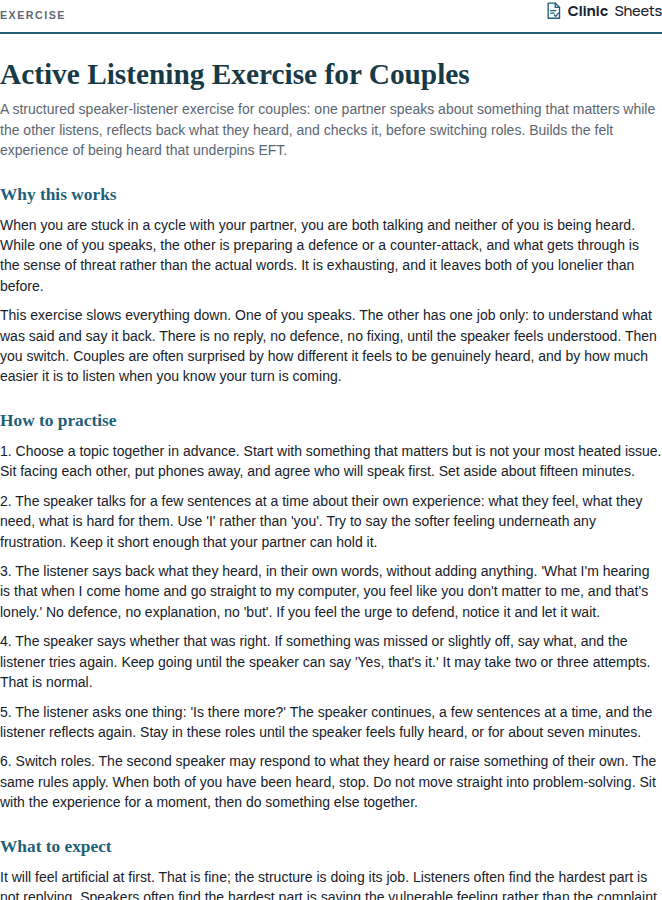
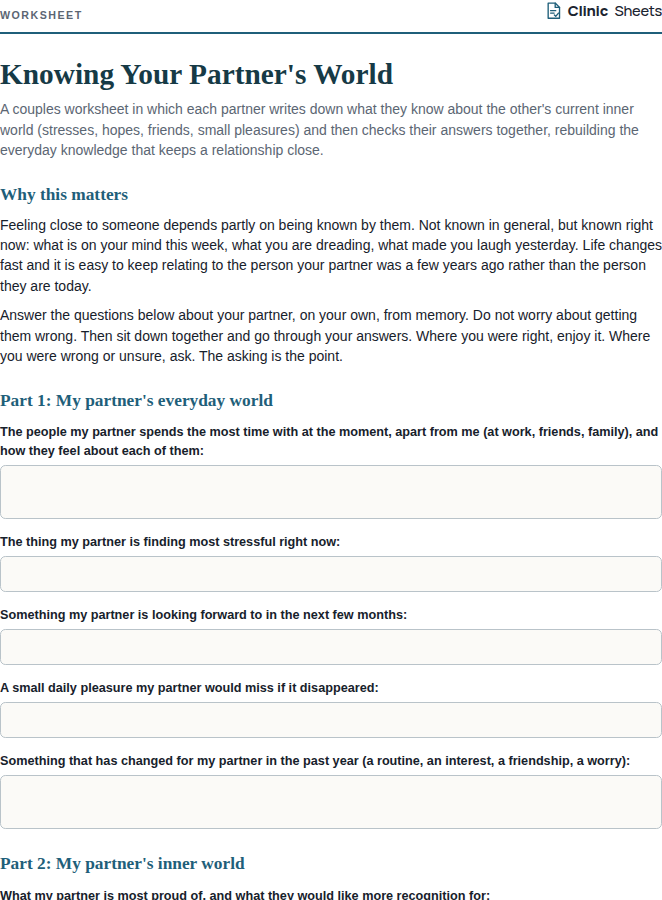
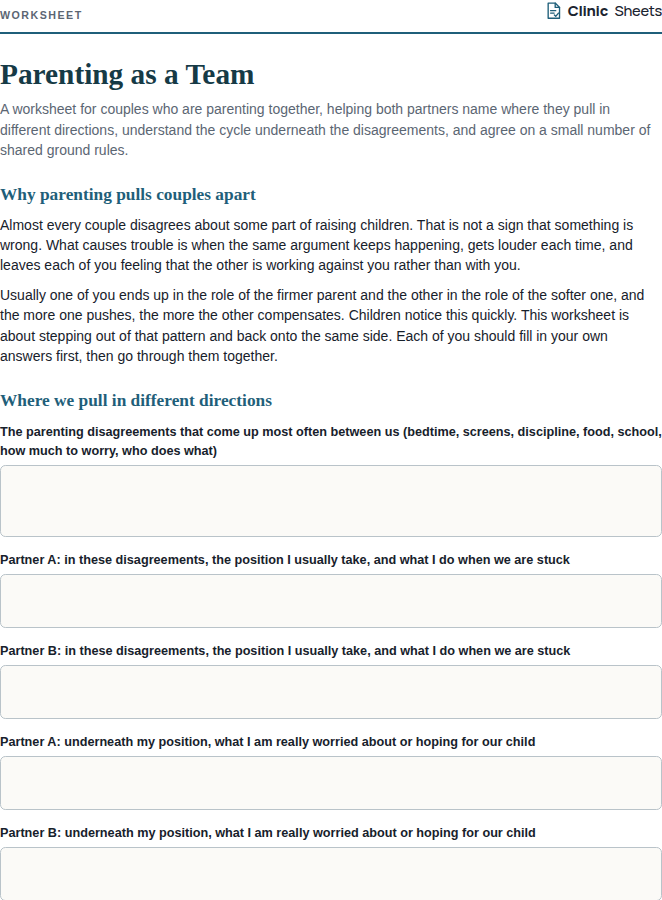
This worksheet gives couples a structure for an everyday repair conversation, not for a major attachment injury, which needs the clinician's guidance. It sets the conditions (both calm, both willing, no phones, a time limit), then walks each partner in turn through sharing their experience of what happened, naming the softer feeling beneath their reaction, listening to their partner and reflecting back what they heard, owning their own step in the cycle without defending it, and saying what would have helped and what would help now. It ends with each partner naming one thing they will do differently, and a short closing that returns the couple to connection.
The professional version adds guidance on introducing repair only after the cycle has been mapped and de-escalated, on managing the conversation in session before assigning it at home, on what to do when one partner cannot yet own their part, on the difference between an apology and a defence dressed as an apology, and on attachment injuries, which need a dedicated process.
How to use it
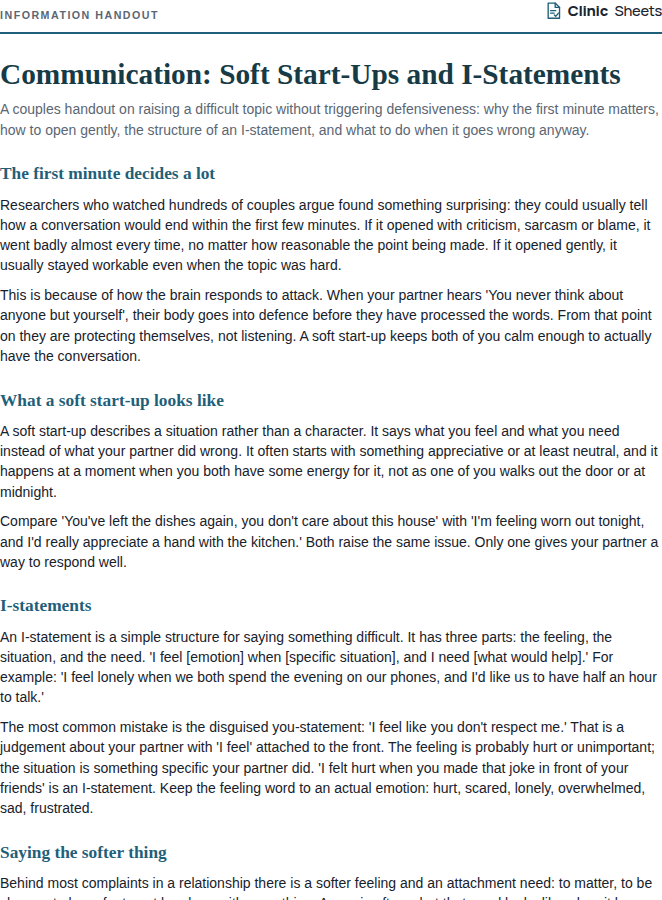
- Introduce this after the couple has mapped their cycle and can, at least sometimes, catch it in the moment. Repair attempted while the cycle is still fully active tends to become another round of it.
- Run the first repair conversation in session using a recent, moderate rupture. Enforce the structure firmly: one speaker at a time, the listener reflects before responding, no rebuttals.
- Coach each partner toward their own primary emotion and their own part. When an 'apology' contains a 'but', name it gently and invite a second attempt.
- Check whether the repair landed. Ask each partner what it was like to hear the other, and whether they feel closer, the same, or further away.
- Assign the worksheet for home use with clear conditions: only when both are calm, only for everyday hurts, and stop and bring it to session if it escalates.
References
- Johnson, S. M. (2020). The Practice of Emotionally Focused Couple Therapy: Creating Connection (3rd ed.). Routledge.
- Gottman, J. M., & Silver, N. (1999). The Seven Principles for Making Marriage Work. Crown.
- Makinen, J. A., & Johnson, S. M. (2006). Resolving attachment injuries in couples using emotionally focused therapy: Steps toward forgiveness and reconciliation. Journal of Consulting and Clinical Psychology, 74(6), 1055-1064.