Weekly Relationship Check-In
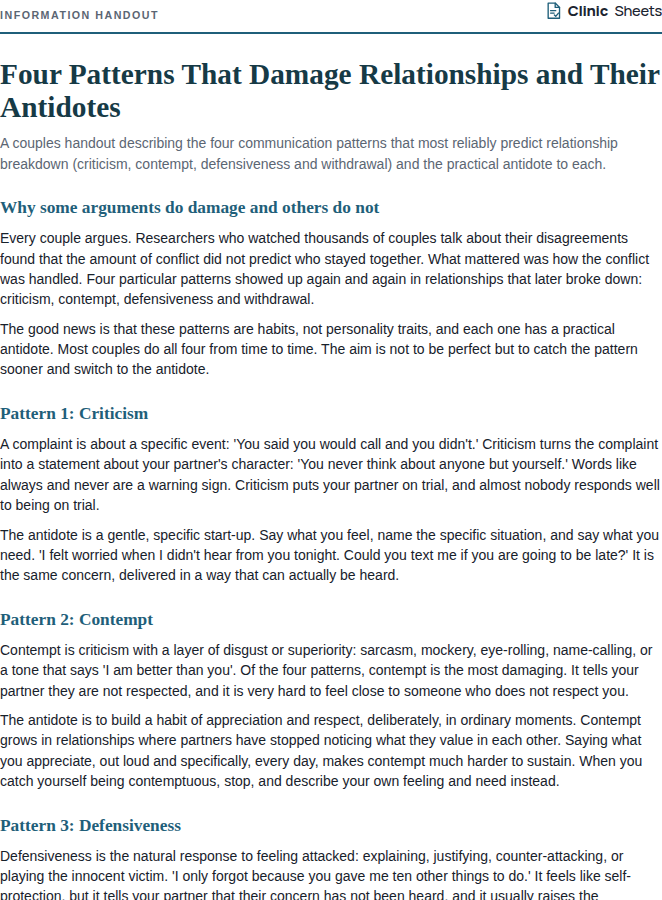
A short, structured weekly conversation for couples: appreciations, what went well, what was hard, one thing each partner needs, and plans for the week ahead. A maintenance habit that keeps small issues from becoming large ones.
About this resource
Distressed couples often report that they only talk about the relationship when something has gone wrong, which means every relationship conversation starts in a negative frame. A regular, brief, predictable check-in changes this. It gives both partners a reliable place to raise concerns while they are still small, ensures that appreciation is voiced rather than assumed, and builds the experience of turning toward each other on purpose. In emotionally focused terms it is a scheduled opportunity for accessibility and responsiveness; in cognitive behavioural terms it is a behavioural routine that increases positive exchanges and reduces the build-up of unexpressed resentment.
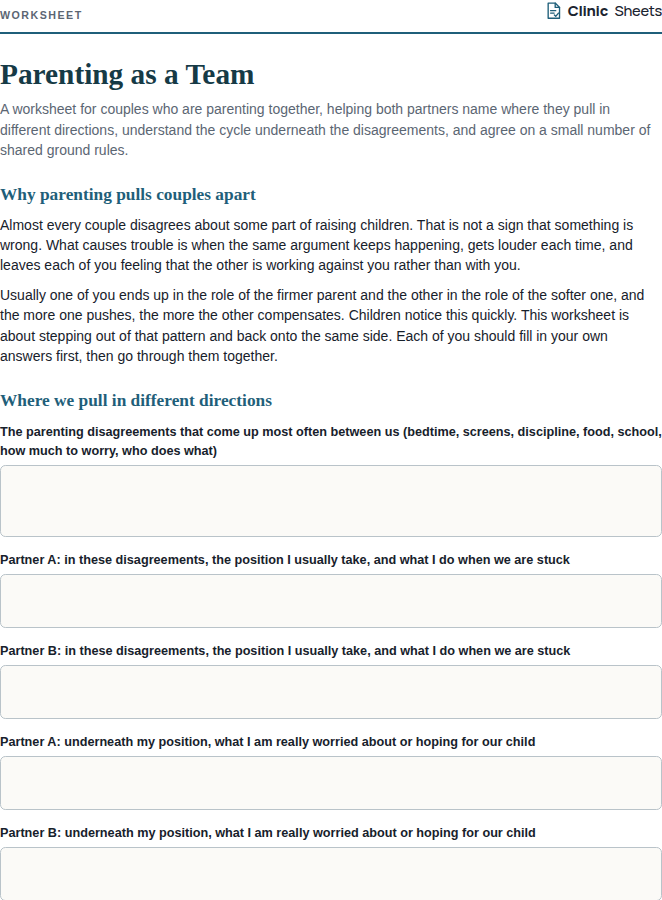
This worksheet provides the agenda. Each partner answers the same prompts, in turn, while the other listens without interrupting or problem-solving. The structure is deliberately simple so that it survives busy weeks. Ten to twenty minutes is enough. The final section commits both partners to one small action for the coming week, so that the check-in produces change rather than just talk.
The professional version adds guidance on rehearsing the format in session first, on the common failure modes (turning the check-in into a complaint session, one partner dominating, skipping the appreciation step), and on what to do when a check-in surfaces an issue that is too large for the format.
How to use it
- Run the first check-in in session so both partners experience the format with you coaching. Keep strictly to the order: appreciations before concerns.
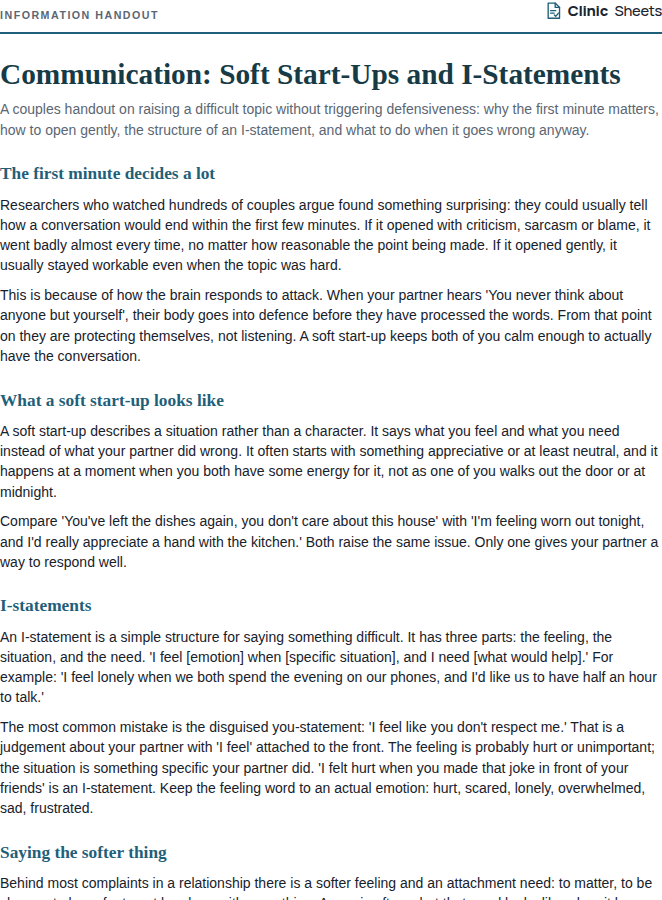
- Establish the listening rule: while one partner speaks, the other listens and may ask clarifying questions but does not defend, explain or fix. Each concern gets a brief acknowledgement before moving on.
- Help the couple choose a fixed time and place for the check-in each week. Predictability matters more than the exact slot. Suggest it is not done late at night or during a conflict.
- Agree a rule for large issues: if something comes up that cannot be handled in the check-in, it is noted and brought to the next therapy session, rather than derailing the check-in.
- Review the completed sheets at the start of each session. They give you a running record of the relationship's temperature and of whether the weekly commitments are being kept.
References
- Gottman, J. M., & Silver, N. (1999). The Seven Principles for Making Marriage Work. Crown.
- Johnson, S. M. (2008). Hold Me Tight: Seven Conversations for a Lifetime of Love. Little, Brown.
- Christensen, A., Doss, B. D., & Jacobson, N. S. (2014). Reconcilable Differences (2nd ed.). Guilford Press.