Giving Effective Instructions
A parent handout on how to give instructions that children, including children with ADHD, are most likely to follow: get attention first, say it once, make it specific, and follow through.
About this resource
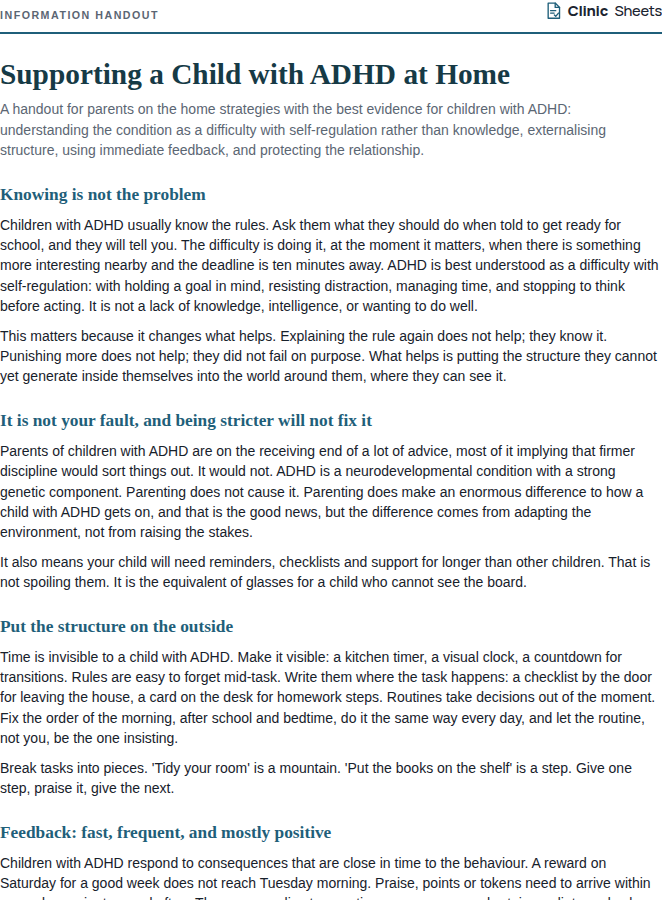
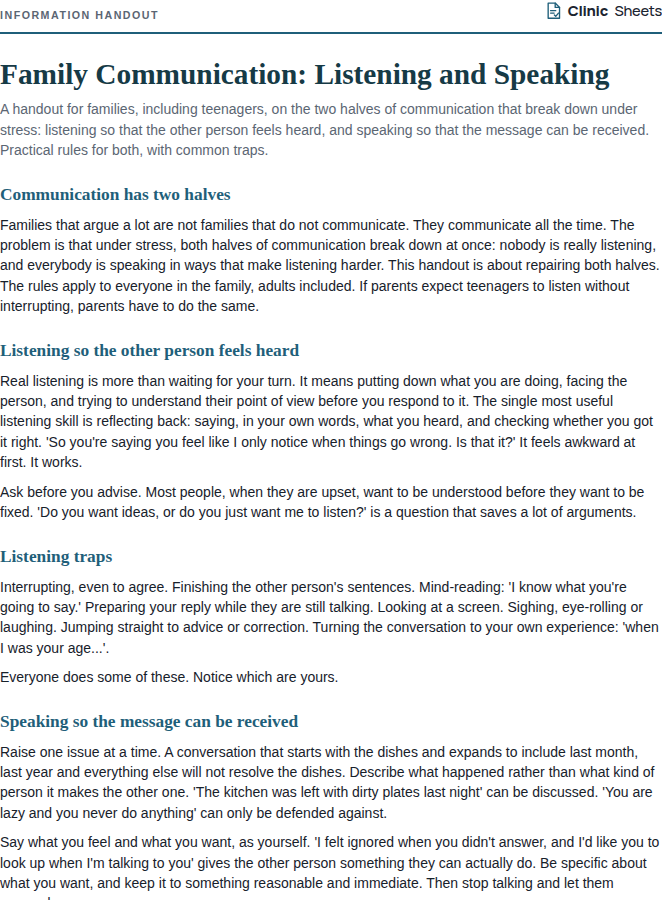
Much of the daily conflict in families with a child who has behavioural difficulties or ADHD begins at the moment an instruction is given. Parents commonly give instructions from another room, phrase them as questions, chain several together, repeat them many times with rising frustration, and then respond to the eventual refusal rather than to the earlier compliance. The child learns that instructions are optional until the parent's voice reaches a certain pitch. Behavioural parent training programmes address this directly by teaching a small set of habits for giving instructions well, and the improvement in compliance is often rapid.
This handout covers the core skills as taught in Barkley's Defiant Children programme and in Helping the Noncompliant Child: gaining the child's attention before speaking, using a calm and firm tone, giving one instruction at a time, stating what to do rather than what to stop, making it specific and short, giving a brief wait, and praising compliance immediately. It also distinguishes a genuine instruction from a request, and explains why 'Could you please tidy up now?' invites the answer 'no'.
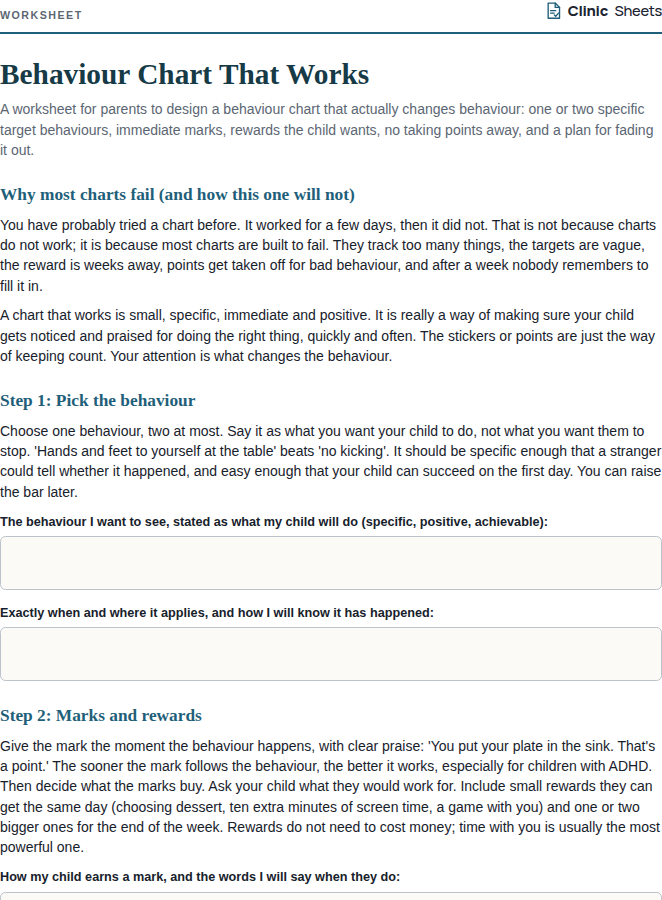
The professional version adds notes on children with ADHD, for whom working memory limits make multi-step and delayed instructions especially hard to hold, and on the value of reducing the total number of instructions given per day so that the ones that remain can be followed through consistently. It also covers the transition from an instruction to a consequence, so this handout links to the time-out and planned ignoring resources.
How to use it
- Ask the parent to describe, in detail, the last time an instruction turned into a battle. Identify where in the sequence it went wrong (usually attention was not gained, the instruction was vague, or it was repeated many times).
- Teach the steps in the handout and role-play them in session, with the clinician playing the child. Parents are often surprised by how different a clear, close-range, single instruction feels.
- Ask the parent to reduce the number of instructions they give for a week and to give the remaining ones properly. Fewer, better instructions is the goal.
- Pair with descriptive praise for compliance. If compliance improves and the parent does not comment on it, the improvement will not last.
- Review with the parent's record. Where instructions are still not followed, check whether the child understood, whether they were capable of the task, and whether follow-through was consistent, before adding consequences.
References
- Barkley, R. A. (2013). Defiant Children: A Clinician's Manual for Assessment and Parent Training (3rd ed.). Guilford Press.
- McMahon, R. J., & Forehand, R. L. (2003). Helping the Noncompliant Child: Family-Based Treatment for Oppositional Behavior (2nd ed.). Guilford Press.
- Barkley, R. A. (2020). Taking Charge of ADHD: The Complete, Authoritative Guide for Parents (4th ed.). Guilford Press.