Behaviour Chart That Works
A worksheet for parents to design a behaviour chart that actually changes behaviour: one or two specific target behaviours, immediate marks, rewards the child wants, no taking points away, and a plan for fading it out.
About this resource
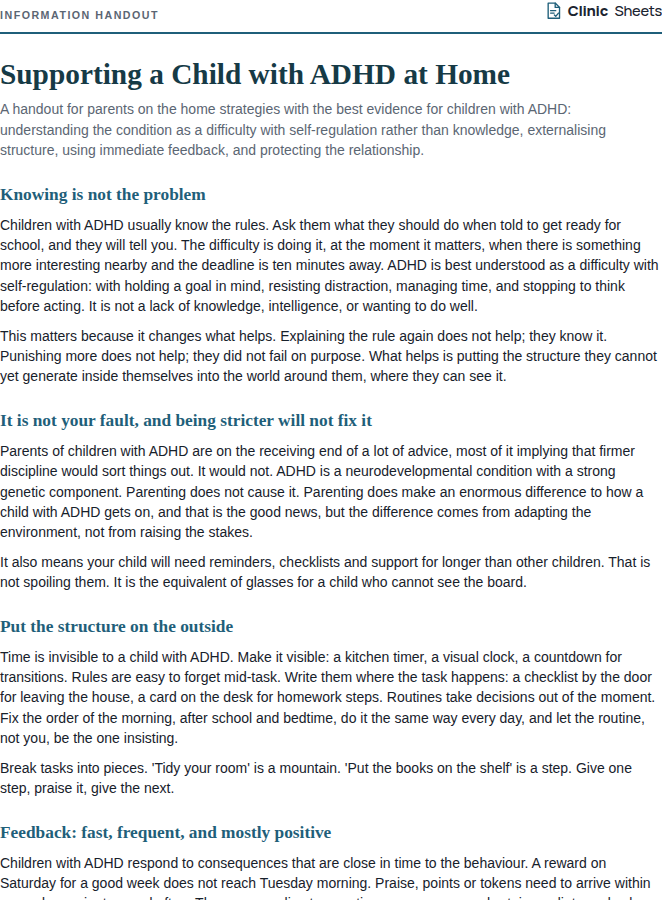
Behaviour charts are among the most widely used and most widely abandoned parenting tools. They fail for predictable reasons: too many targets, targets that are vague ('be good') or describe the absence of behaviour ('no hitting'), rewards that are too distant or too small, points removed as punishment, and inconsistent use. When they are designed according to the principles of parent management training, they work well, particularly for children with ADHD, whose difficulty with delayed consequences means they respond much better to immediate, frequent, concrete feedback than to reasoning or long-term promises.
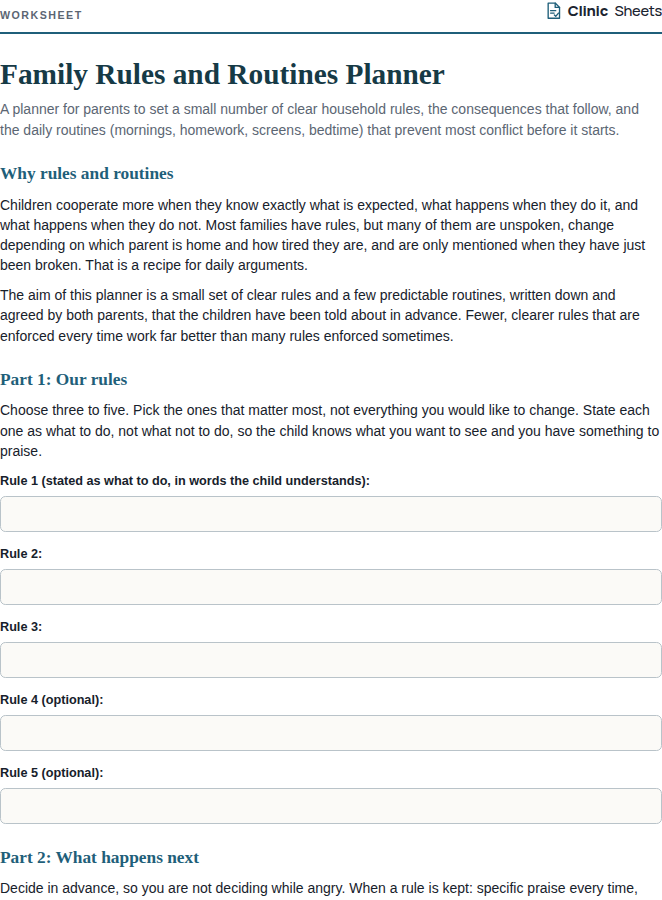
This worksheet walks a parent through the design decisions that matter, in order. Choose one or two behaviours, stated as what the child should do, specific enough that anyone could tell whether it happened. Decide the moment the mark is earned and give it straight away with praise. Build a small menu of rewards the child has helped choose, with some available the same day. Commit to never removing a mark once earned. Plan how the chart will be reviewed and, once the behaviour is established, how it will be faded so that praise and the behaviour's own rewards take over. Kazdin's work on parent management training and Barkley's ADHD parenting programme both describe these elements, and both stress that the parent's attention and praise, not the sticker, is the active ingredient.
The professional version notes that a chart is not a substitute for a good relationship or for addressing why the behaviour is happening, that older children (roughly nine and up) usually prefer points to stickers and can be involved in setting the terms, and that a chart which is not producing marks within the first few days has a target that is too hard and needs to be shrunk.
How to use it
- Use when a parent wants to build a specific positive behaviour (getting dressed by 7:30, putting homework in the bag, using words instead of hitting) and has tried charts before without success.
- Work through the worksheet with the parent in session. Spend most of the time on the target behaviour; a well-chosen, specific, achievable target does most of the work.
- Check the reward menu against what the child actually cares about, and make sure some rewards can be earned the same day. Involve the child in choosing where possible.
- Set the rule that marks are never taken away, and explain why: a chart that punishes stops motivating and becomes a source of conflict.
- Plan the review: how often the family will look at the chart together, and what 'established' will look like. Agree in advance how the chart will be faded. Review in session after one week and adjust the target if marks are not being earned.
References
- Kazdin, A. E. (2005). Parent Management Training: Treatment for Oppositional, Aggressive, and Antisocial Behavior in Children and Adolescents. Oxford University Press.
- Barkley, R. A. (2013). Taking Charge of ADHD: The Complete, Authoritative Guide for Parents (3rd ed.). Guilford Press.
- Webster-Stratton, C. (2005). The Incredible Years: A Trouble-Shooting Guide for Parents of Children Aged 2-8 Years. Incredible Years.