Supporting a Child with ADHD at Home
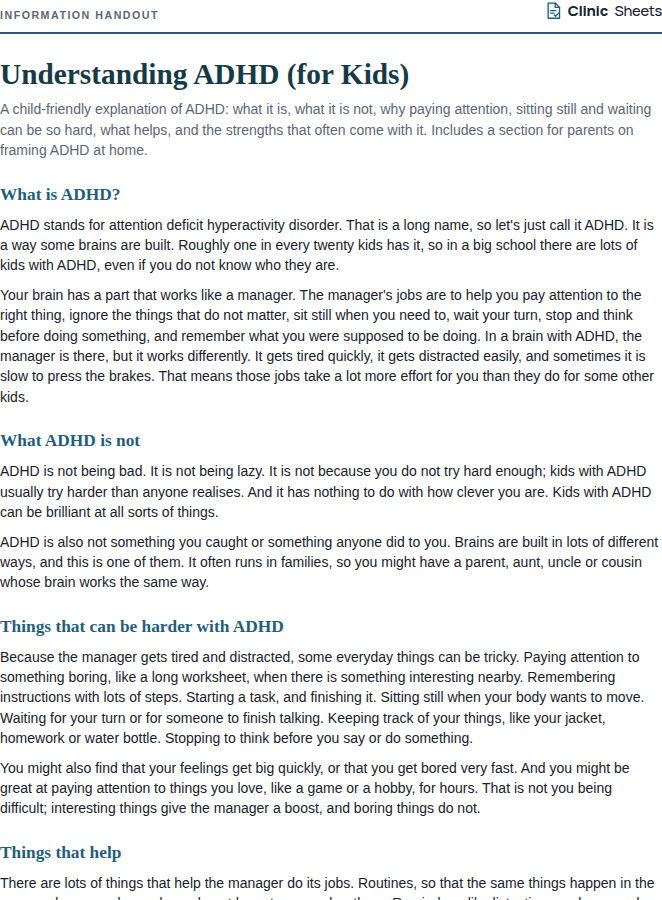
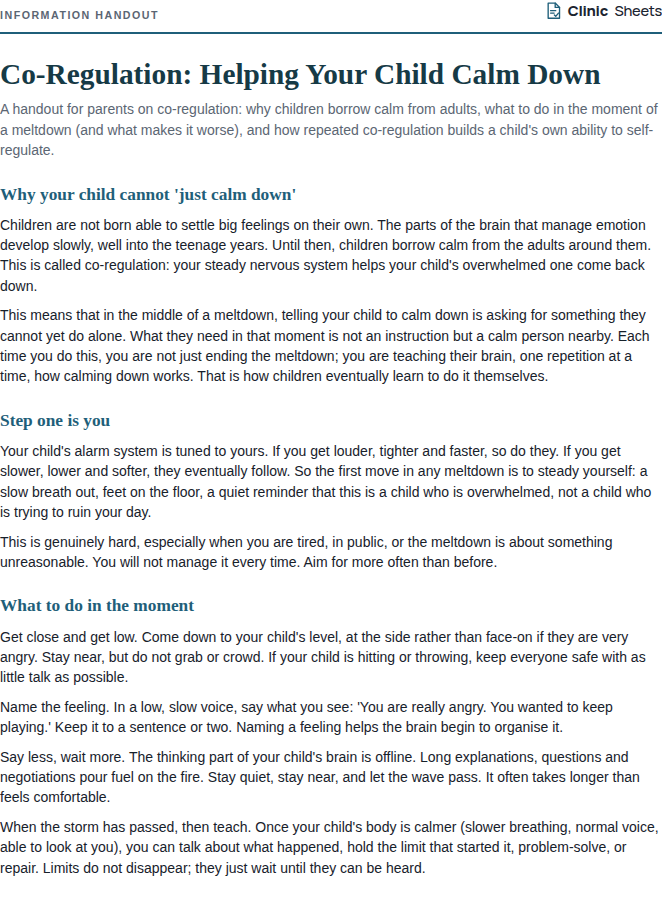
A handout for parents on the home strategies with the best evidence for children with ADHD: understanding the condition as a difficulty with self-regulation rather than knowledge, externalising structure, using immediate feedback, and protecting the relationship.
About this resource
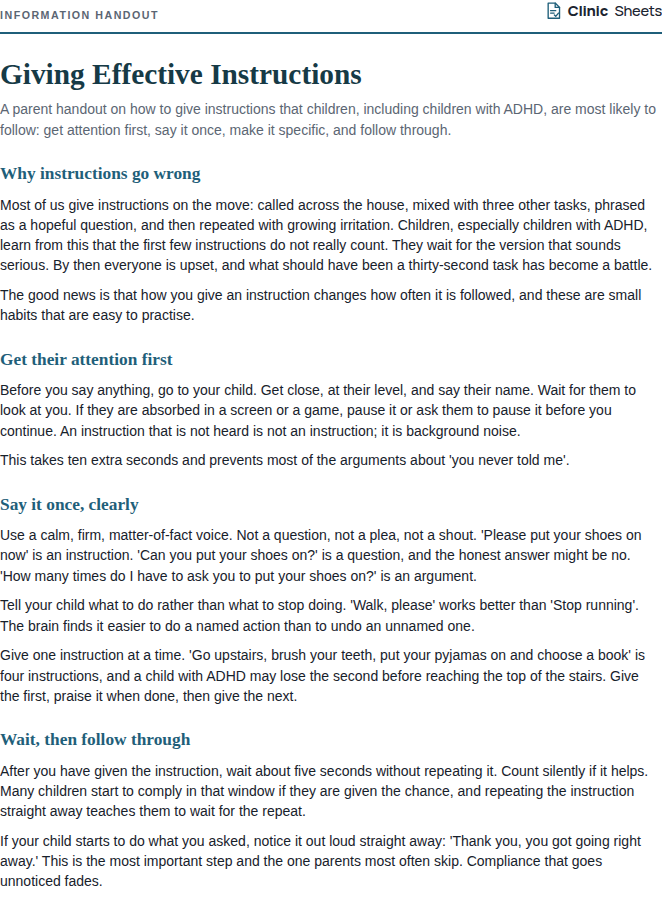
Behavioural parent training is a first-line psychosocial treatment for children with ADHD and is recommended alongside, or before, medication depending on age and severity. Its effectiveness rests on adapting the home environment to the child's neuropsychology rather than expecting the child to adapt to a typical environment. Barkley's account of ADHD as a disorder of self-regulation and executive function, rather than of knowledge or motivation, gives parents a useful frame: the child knows what to do and cannot reliably do it at the point of performance. The strategies that follow from this are consistent across the literature: externalise time, rules and reminders; give feedback that is immediate, frequent and specific; use rewards before punishments; keep instructions short; build routines; and protect the parent-child relationship from the erosion of constant correction.
This handout explains ADHD to parents in these terms, then works through the main home strategies with practical detail. It addresses the guilt and blame parents often carry, the myth that consistent discipline alone would resolve the difficulties, and the reality that reminders and structure will be needed for longer than for other children, which is a feature of the condition rather than a failure of parenting.
The professional version adds notes on the interaction between ADHD and oppositional behaviour, on the value of collaboration with school, on sleep, on the evidence base for behavioural interventions (which shows stronger effects on parenting and on conduct problems than on core ADHD symptoms), and on when to refer for medication assessment or reassessment. It is intended for use alongside the practice's instruction-giving, special time and consequence resources.
How to use it
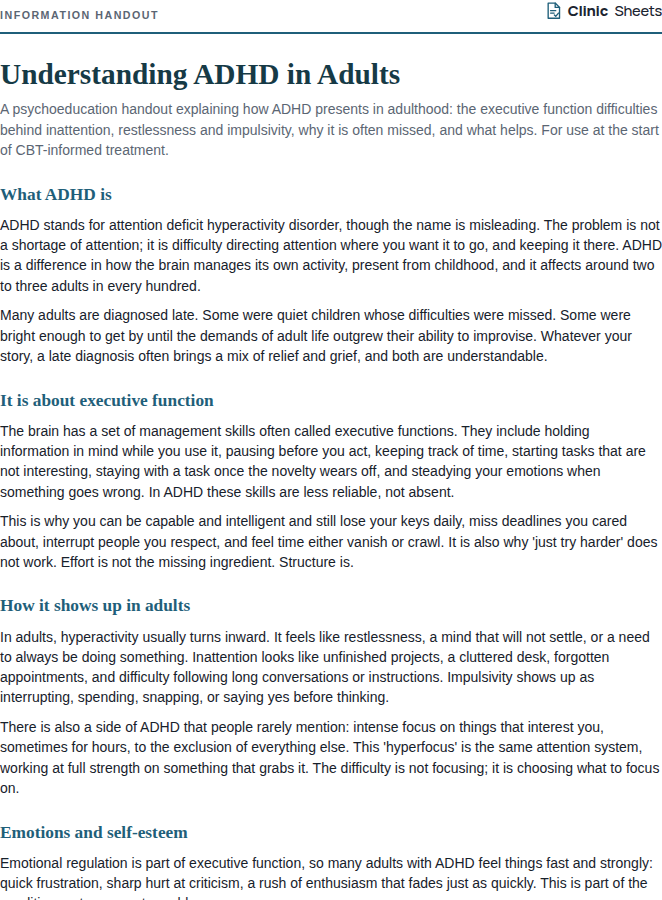
- Begin by asking the parent what they understand ADHD to be. Correct the common misconceptions gently: it is not a knowledge or motivation problem, it is not caused by parenting, and it will not be fixed by being stricter.
- Introduce the idea of the point of performance: the child knows the rule and cannot apply it in the moment without external support. This reframes reminders and structure as accommodations rather than indulgence.
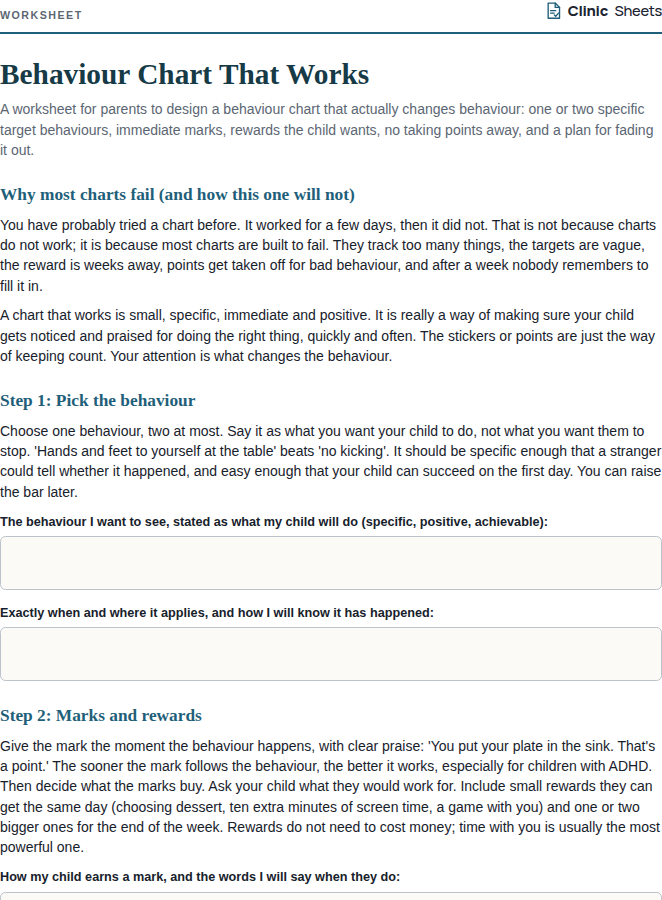
- Work through the strategies in the handout and help the parent choose two to start with. Routines and immediate specific praise are usually the highest-yield starting points.
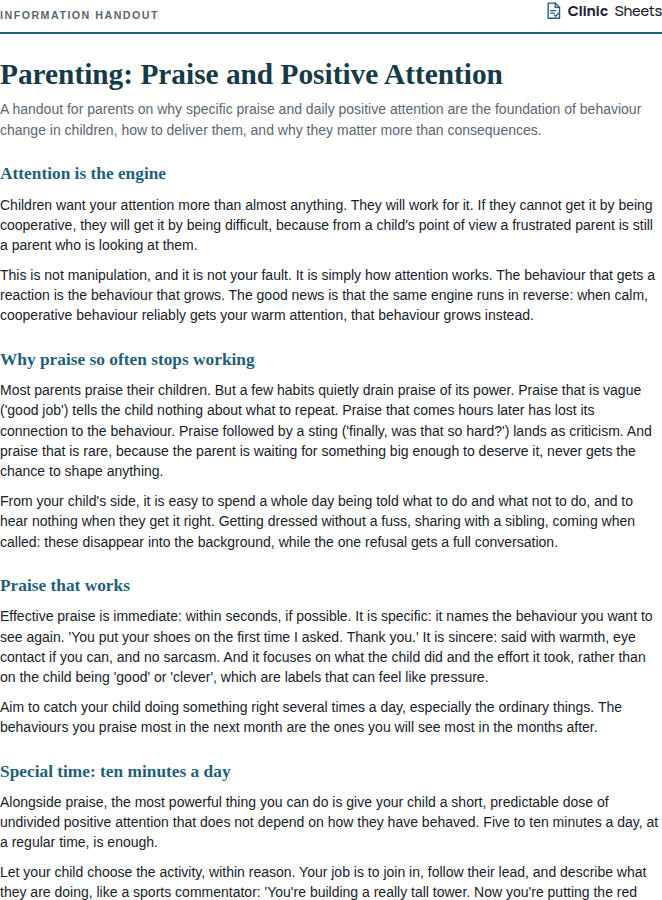
- Ensure special time is in place. Children with ADHD receive far more negative than positive feedback across a day, and the relationship needs active protection.
- Coordinate with school where possible, and review the need for medical assessment. Behavioural strategies and medication are complementary.
References
- Barkley, R. A. (2020). Taking Charge of ADHD: The Complete, Authoritative Guide for Parents (4th ed.). Guilford Press.
- Barkley, R. A. (2013). Defiant Children: A Clinician's Manual for Assessment and Parent Training (3rd ed.). Guilford Press.
- Daley, D., van der Oord, S., Ferrin, M., Danckaerts, M., Doepfner, M., Cortese, S., & Sonuga-Barke, E. J. S. (2014). Behavioral interventions in attention-deficit/hyperactivity disorder: A meta-analysis of randomized controlled trials across multiple outcome domains. Journal of the American Academy of Child & Adolescent Psychiatry, 53(8), 835-847.
- DuPaul, G. J., & Stoner, G. (2014). ADHD in the Schools: Assessment and Intervention Strategies (3rd ed.). Guilford Press.