Group Session Plan: 8-Week Mindfulness Course Outline
A facilitator's outline of the standard eight-week mindfulness-based course, following the structure of Kabat-Zinn's MBSR with notes on the MBCT adaptation for recurrent depression: purpose, format, materials, week-by-week themes, practices and home practice, and common challenges.
About this resource
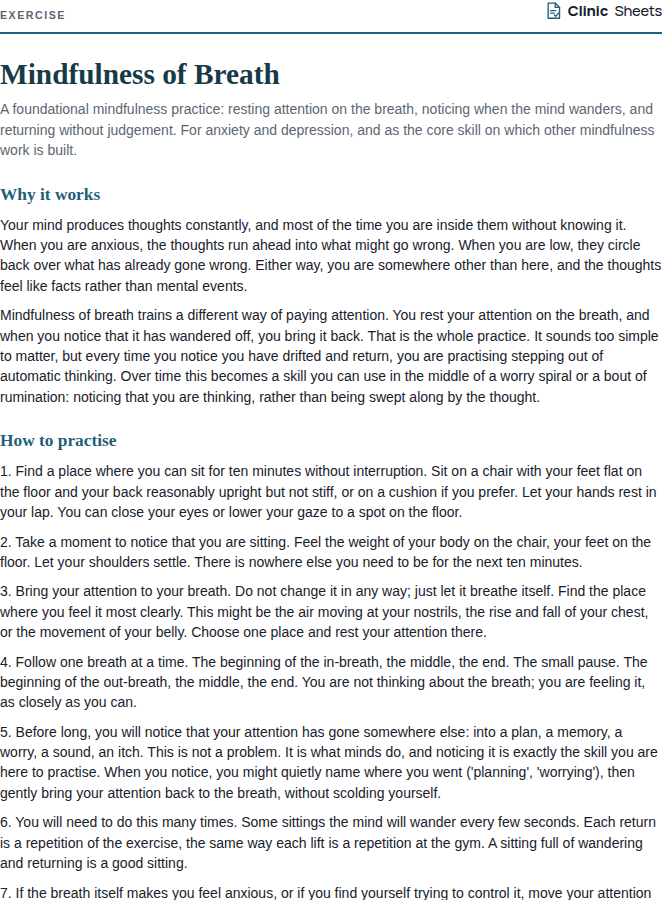
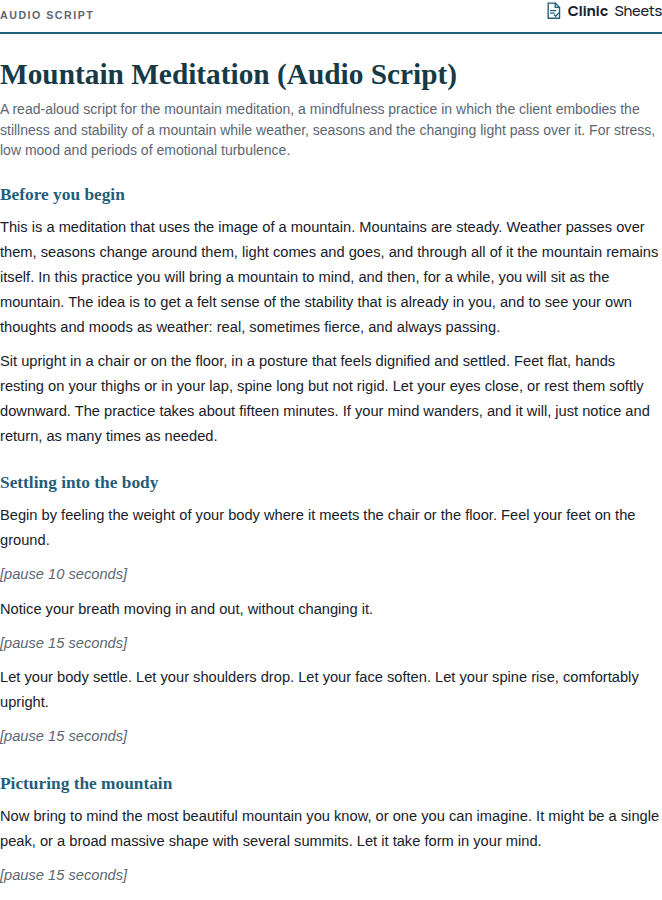
The eight-week mindfulness course developed by Kabat-Zinn as Mindfulness-Based Stress Reduction has become the template for a family of group programmes, of which Mindfulness-Based Cognitive Therapy by Segal, Williams and Teasdale is the most thoroughly evaluated for a clinical population. Both share the same architecture: weekly sessions of two to two and a half hours or longer, a full day of practice in the later weeks, and substantial daily home practice using guided recordings. Both move from formal attention training (the body scan, sitting meditation, mindful movement) toward the application of mindfulness to stress, difficult experience and daily life. MBCT adds cognitive therapy elements aimed at the specific patterns that lead to depressive relapse, and has evidence, summarised in an individual-patient meta-analysis, for reducing relapse in people with recurrent depression.
This outline gives the course week by week, naming the theme, the core practices taught, the inquiry focus and the home practice, and indicating where MBCT departs from MBSR. It is written for a clinician planning to run a mindfulness-based course, or joining one as co-facilitator, and assumes the facilitator has completed the appropriate teacher training and holds a personal practice. Mindfulness-based programmes are taught from the inside, and the good-practice guidelines of the field make personal practice and supervised teaching a requirement, not a preference.
The professional version includes the format and materials in full, the week-by-week outline, a note on the all-day session, and a section on the challenges that arise most often, including participants who do not practise at home, participants for whom formal practice is distressing, and the tendency of clinically trained facilitators to slide into problem solving instead of inquiry.
How to use it
- Confirm your own readiness. Facilitators should have completed a recognised teacher training pathway for MBSR or MBCT, maintain a daily personal practice, and have access to supervision from an experienced mindfulness teacher.
- Hold an individual orientation interview with each prospective participant. Explain the commitment (eight weekly sessions, the all-day session, and forty-five minutes of daily home practice), explore the person's expectations, and screen for current acute depression, active suicidality, psychosis, unprocessed trauma or substance dependence, which usually make this the wrong time for an intensive course.
- Decide which programme you are delivering and keep to it. MBSR is for stress in the broadest sense and is open to a general population; MBCT is a clinical programme, usually for people with a history of recurrent depression who are currently in remission or partial remission, and follows a specific session-by-session curriculum from the published manual.
- Provide guided practice recordings, a participant handbook with each week's practices and home practice sheets, and a practice log. Review home practice at every session and take it seriously; the course is the home practice.
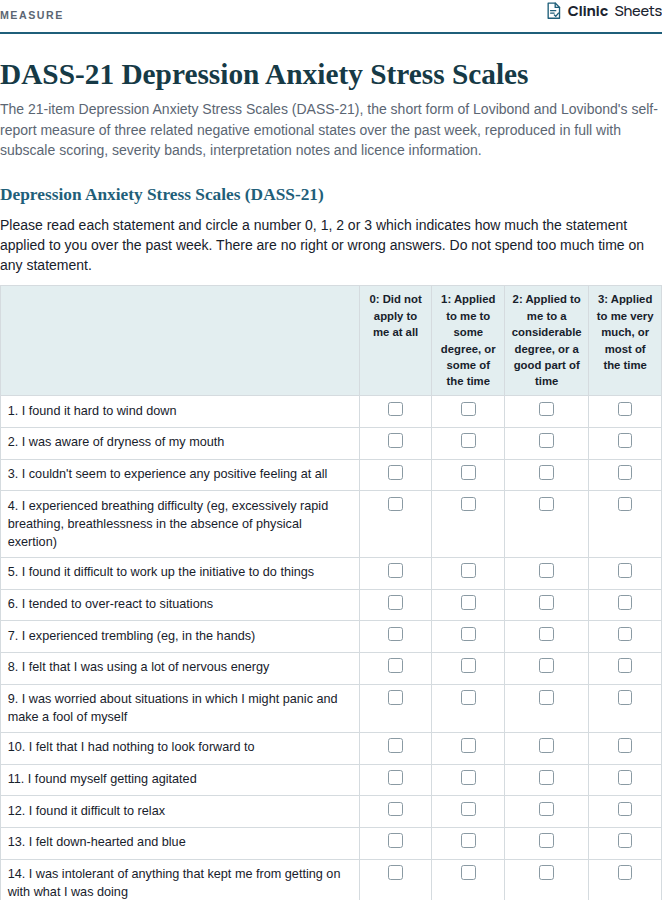
- Administer a mood measure such as the PHQ-9 at orientation and at week 8, and a mindfulness or stress measure if the service wishes to track process. For MBCT, review the relapse action plan from week 7 with each participant before they leave the course.
- Teach through practice and inquiry, not lecture. Each session leads a practice, then invites participants to describe what they noticed, with the facilitator's questions drawing out direct experience rather than interpretation.
References
- Kabat-Zinn, J. (2013). Full Catastrophe Living: Using the Wisdom of Your Body and Mind to Face Stress, Pain, and Illness (Revised ed.). Bantam Books.
- Segal, Z. V., Williams, J. M. G., & Teasdale, J. D. (2013). Mindfulness-Based Cognitive Therapy for Depression (2nd ed.). Guilford Press.
- Crane, R. S. (2017). Mindfulness-Based Cognitive Therapy: Distinctive Features (2nd ed.). Routledge.
- Kuyken, W., Warren, F. C., Taylor, R. S., Whalley, B., Crane, C., Bondolfi, G., Hayes, R., Huijbers, M., Ma, H., Schweizer, S., Segal, Z., Speckens, A., Teasdale, J. D., Van Heeringen, K., Williams, M., Byford, S., Byng, R., & Dalgleish, T. (2016). Efficacy of mindfulness-based cognitive therapy in prevention of depressive relapse: An individual patient data meta-analysis from randomized trials. JAMA Psychiatry, 73(6), 565-574.