Mindfulness of Breath
A foundational mindfulness practice: resting attention on the breath, noticing when the mind wanders, and returning without judgement. For anxiety and depression, and as the core skill on which other mindfulness work is built.
About this resource
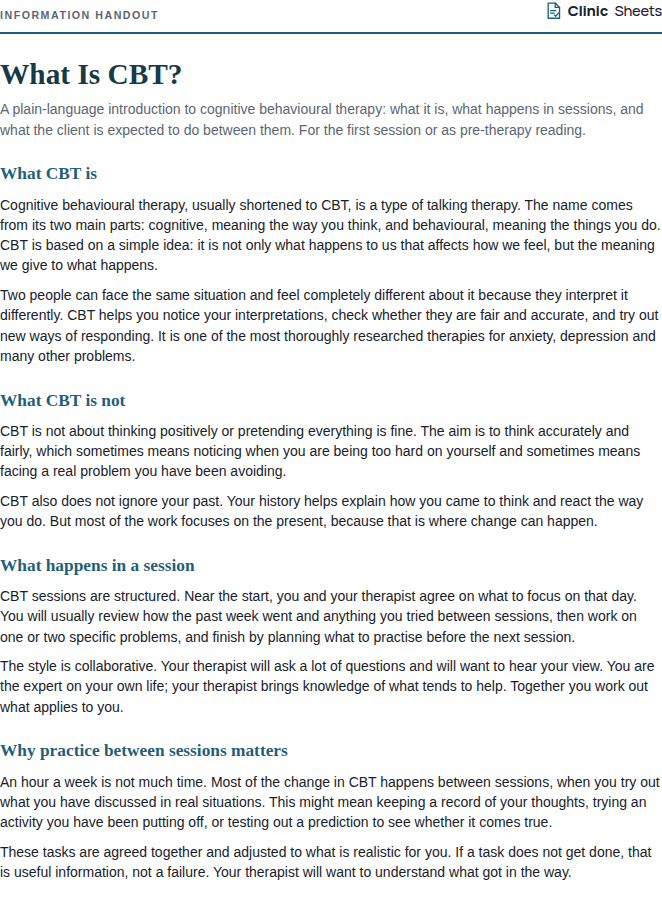
Mindfulness of breath is the most basic formal practice in mindfulness-based cognitive therapy (MBCT) and mindfulness-based stress reduction (MBSR). The instruction is deceptively simple: attend to the sensations of breathing, notice when attention has moved elsewhere, and bring it back. Its clinical value lies not in the moments of steady attention but in the repeated act of noticing and returning. Each return is a small rehearsal of stepping out of automatic mental activity, and it is this capacity, sometimes called decentering or metacognitive awareness, that MBCT identifies as protective against depressive relapse.
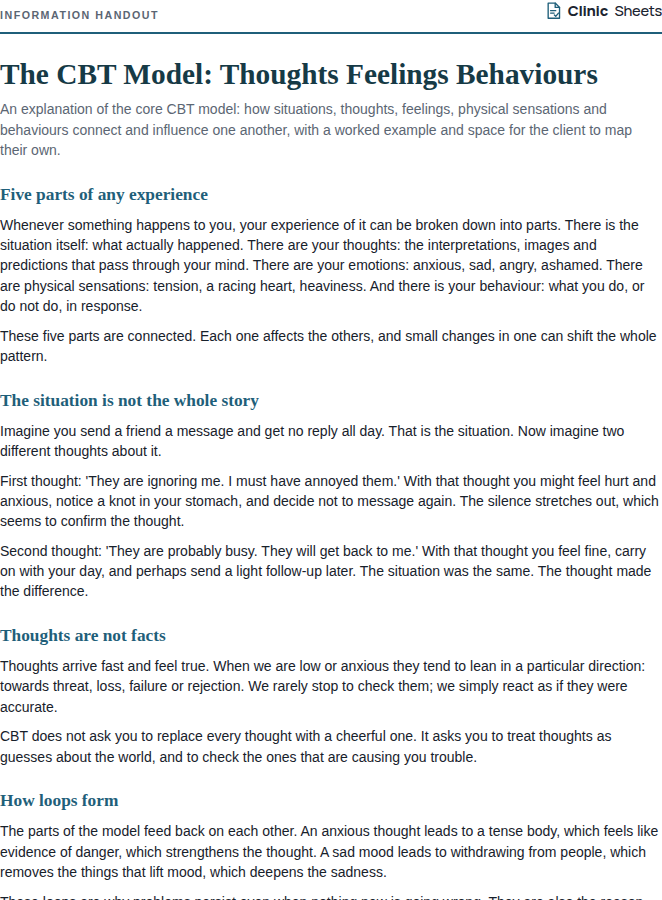
For anxiety, the practice trains the ability to notice worry as mental activity rather than being carried along by it, and it provides an anchor in present-moment sensation when the mind is racing toward the future. For depression, it counters rumination by offering a different mode of attention: noticing rather than analysing. The breath is used as the object of attention because it is always available, always in the present, and rhythmically varied enough to hold interest. It is not a breathing exercise; the client is not asked to change the breath at all.
The professional version includes a full script for guiding the practice in session, a discussion of the common misunderstanding that the goal is to empty the mind or feel calm, guidance for clients who find the breath itself anxiety-provoking (offering the feet, hands or sounds as alternative anchors), and notes on progressing from ten minutes to longer sittings and to informal practice during the day.
How to use it
- Explain that the practice is about noticing where attention is and returning it, not about achieving calm or stopping thoughts. Set this expectation clearly before the first sitting.
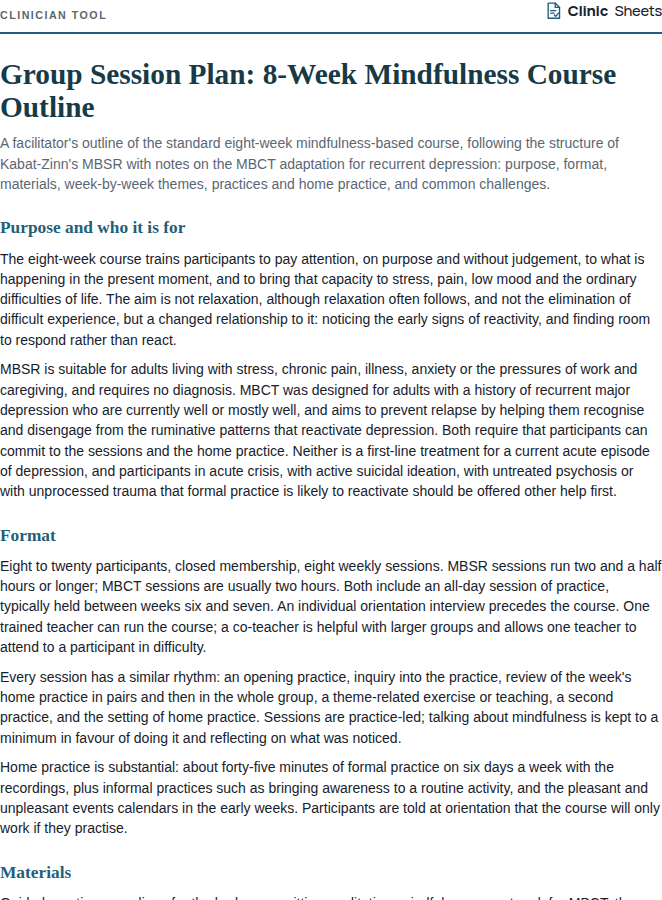
- Guide a short practice in session (five to ten minutes) using the steps in the resource. Leave silences; the client needs to experience the mind wandering and the return.
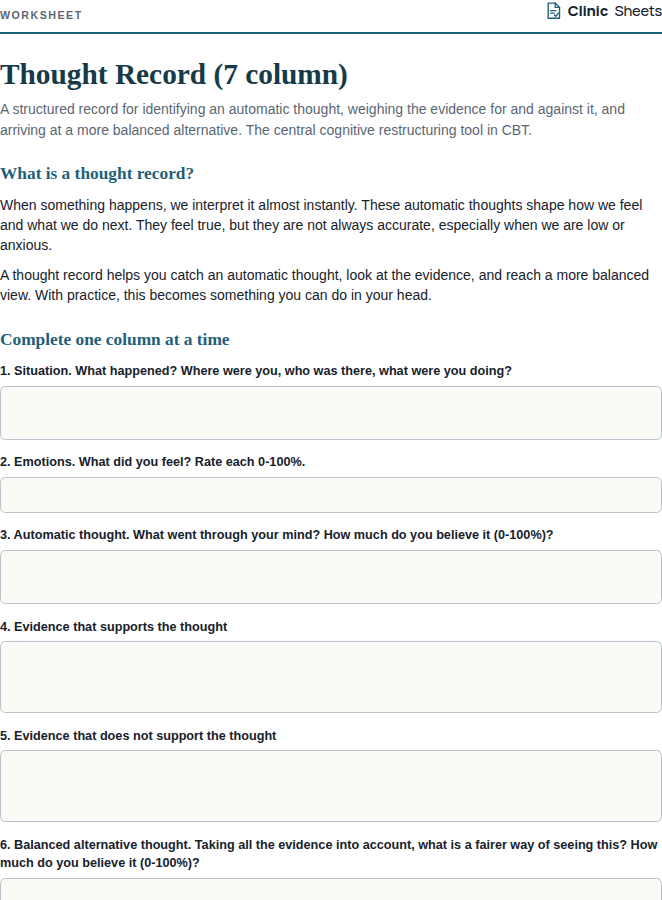
- Enquire afterwards with curiosity: what did you notice, where did your mind go, what was it like to come back? Reflect any self-criticism about wandering and reframe it as the practice working.
- Prescribe daily practice of ten minutes, increasing to fifteen or twenty over a few weeks. A recording helps at first; encourage some unguided practice too.
- If focusing on the breath increases anxiety (common in panic and health anxiety), offer an alternative anchor such as the sensations in the feet or hands, or the sounds in the room.
- Connect the practice to daily life: suggest three-breath pauses at transition points during the day, and link the noticing skill to catching worry or rumination when it starts.
References
- Segal, Z. V., Williams, J. M. G., & Teasdale, J. D. (2013). Mindfulness-Based Cognitive Therapy for Depression (2nd ed.). Guilford Press.
- Kabat-Zinn, J. (2013). Full Catastrophe Living: Using the Wisdom of Your Body and Mind to Face Stress, Pain, and Illness (rev. ed.). Bantam.
- Kuyken, W., Warren, F. C., Taylor, R. S., et al. (2016). Efficacy of mindfulness-based cognitive therapy in prevention of depressive relapse: An individual patient data meta-analysis from randomized trials. JAMA Psychiatry, 73(6), 565-574.
- Hofmann, S. G., Sawyer, A. T., Witt, A. A., & Oh, D. (2010). The effect of mindfulness-based therapy on anxiety and depression: A meta-analytic review. Journal of Consulting and Clinical Psychology, 78(2), 169-183.