Interoceptive Exposure Exercises
A set of exercises that deliberately bring on the physical sensations of panic (dizziness, breathlessness, racing heart, unreality) so that the client can learn they are uncomfortable but harmless. With a practice log.
About this resource
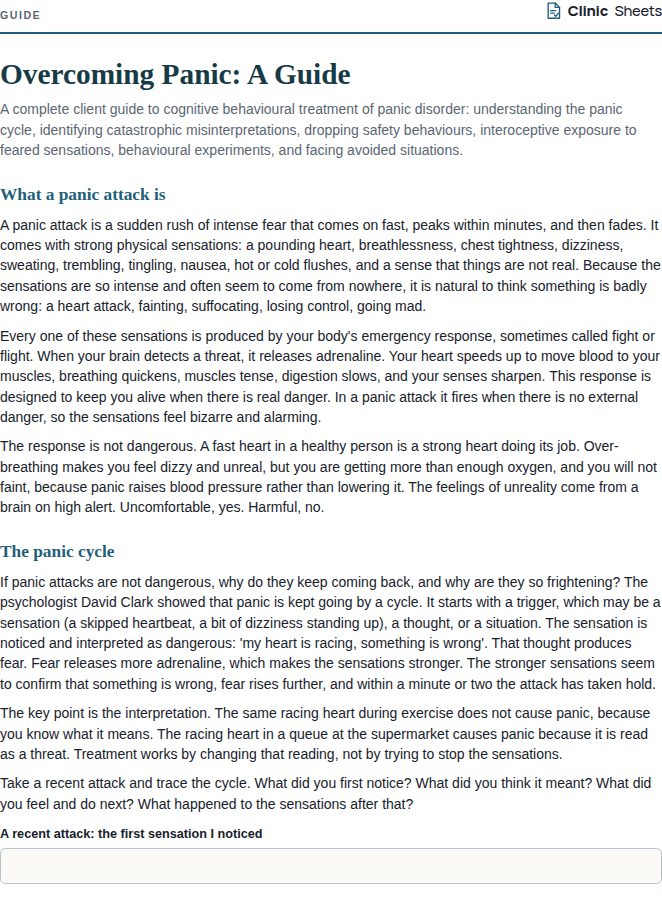
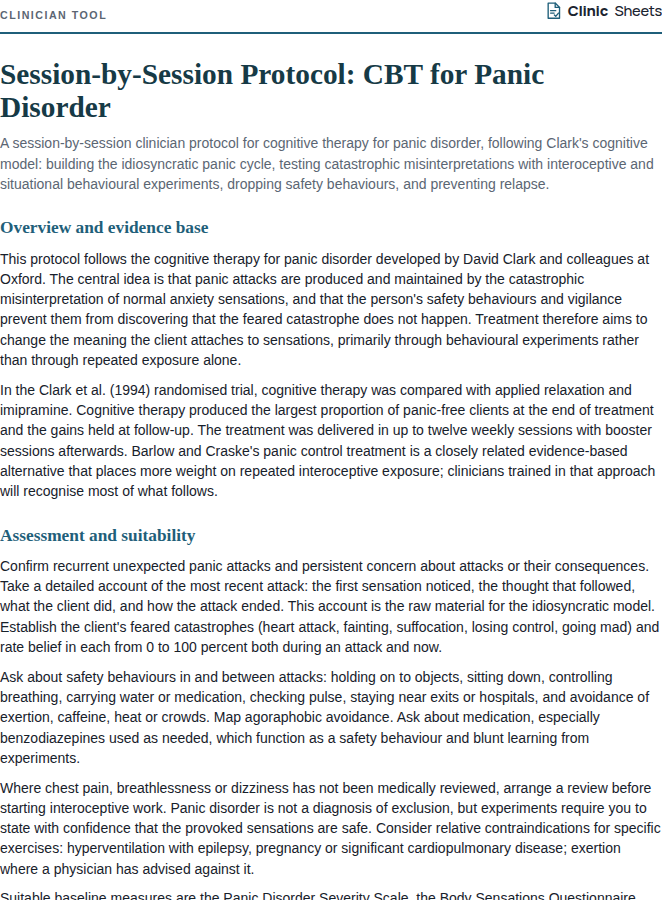
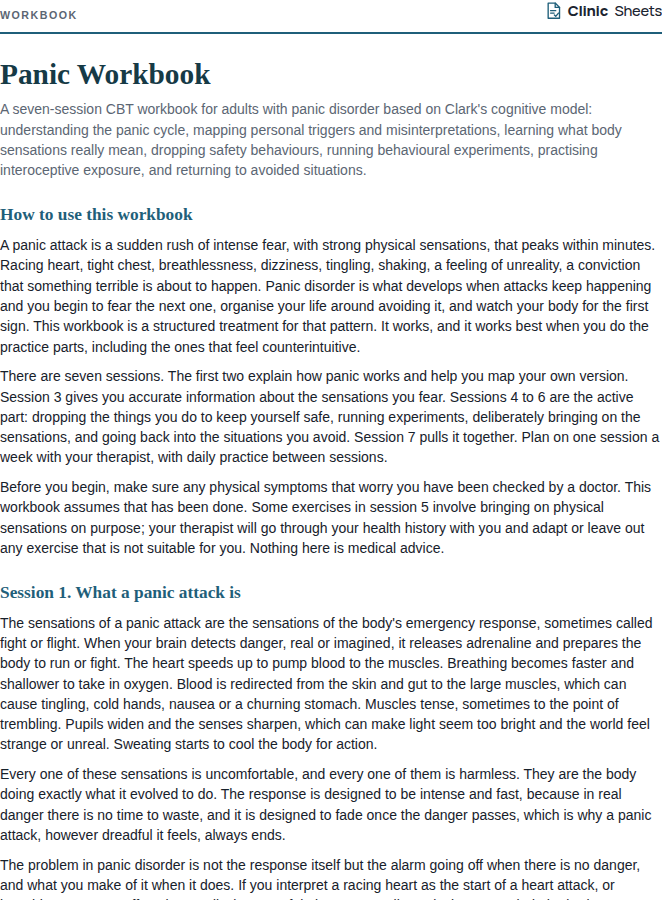
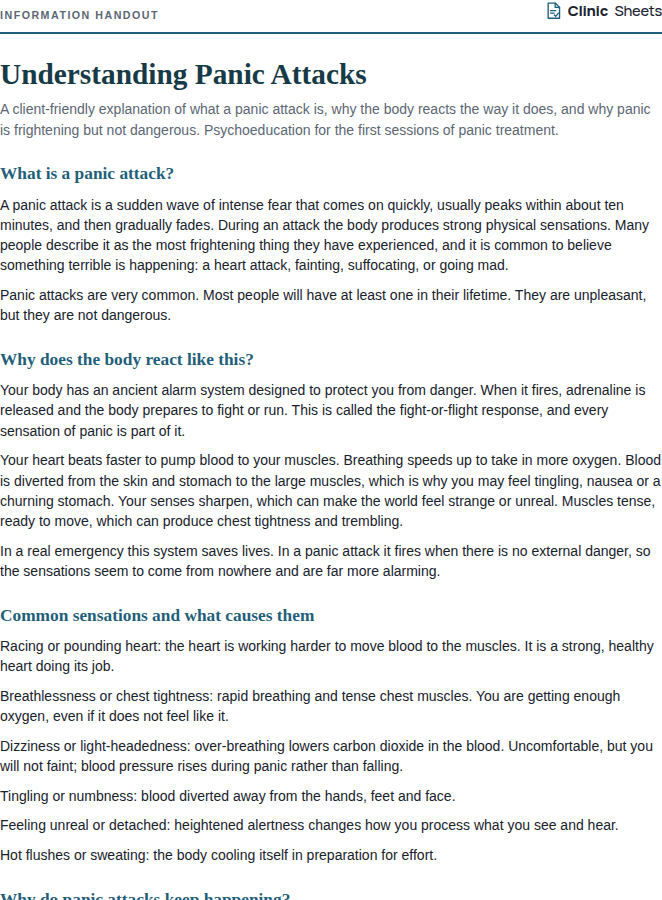
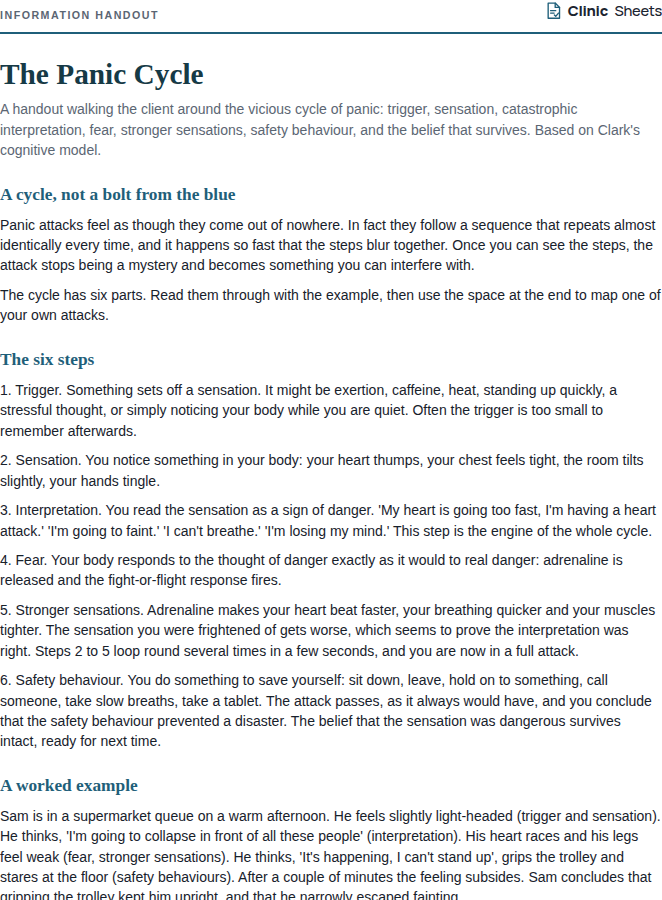
Interoceptive exposure is the systematic, repeated provocation of feared bodily sensations. It targets the core of panic disorder: the fear of the sensations themselves. Where situational exposure teaches that supermarkets or motorways are safe, interoceptive exposure teaches that a pounding heart, a spinning head or a tight chest are survivable and pass on their own. It is a central component of the Barlow and Craske panic protocols and of Clark's cognitive therapy, where the exercises function as behavioural experiments that test catastrophic predictions.
This resource explains the rationale in client language, then gives step-by-step instructions for six standard exercises: spinning, hyperventilation, breathing through a straw, running on the spot, staring at a point, and tensing the whole body. Each is matched to the sensations it usually produces. The client is asked to rate how similar the sensations are to their panic and how much distress they cause, so that the most relevant exercises can be selected for repeated practice. A 'What to expect' section pre-empts the common concern that the exercises will trigger a real attack, and the practice log records belief in the feared catastrophe before and after.
The professional version adds contraindications and medical screening prompts (cardiac and respiratory conditions, pregnancy, epilepsy, recent injury), a fuller exercise menu, and guidance on combining interoceptive exposure with situational exposure once the client is ready. Never proceed with an exercise where a medical condition makes it unsafe; when in doubt, ask the client to check with their physician first.
How to use it
- Screen for medical conditions before the first session of interoceptive exposure. Ask about heart, lung, blood pressure, seizure and pregnancy-related issues, and adapt or omit exercises accordingly.
- Demonstrate each exercise yourself first, then do it alongside the client. Ask them to rate sensation intensity, similarity to their panic (0-10) and distress (0-100) after each.
- Choose the two or three exercises that most closely reproduce the client's feared sensations. These become the homework.
- Before each repetition, elicit the specific prediction ('my heart will not slow down', 'I will faint') and the belief rating. Afterwards, compare the outcome with the prediction.
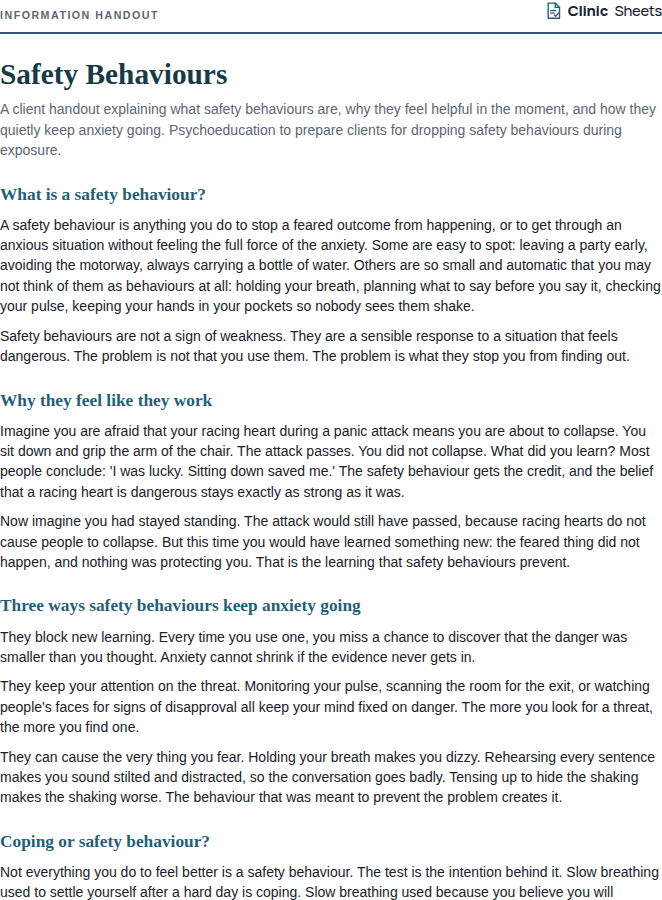
- Prescribe daily practice: each chosen exercise repeated three to five times in a row, with a short pause between, until the distress rating has fallen. Ask the client not to use safety behaviours such as sitting down or slowing their breathing during the exercise.
- Progress to doing the exercises in feared situations (in a shop, while driving as a passenger, in a meeting) once they are tolerated at home.
References
- Craske, M. G., & Barlow, D. H. (2007). Mastery of Your Anxiety and Panic: Therapist Guide (4th ed.). Oxford University Press.
- Boettcher, H., Brake, C. A., & Barlow, D. H. (2016). Origins and outlook of interoceptive exposure. Journal of Behavior Therapy and Experimental Psychiatry, 53, 41-51.
- Clark, D. M. (1986). A cognitive approach to panic. Behaviour Research and Therapy, 24(4), 461-470.