Session-by-Session Protocol: CBT for Panic Disorder
A session-by-session clinician protocol for cognitive therapy for panic disorder, following Clark's cognitive model: building the idiosyncratic panic cycle, testing catastrophic misinterpretations with interoceptive and situational behavioural experiments, dropping safety behaviours, and preventing relapse.
About this resource
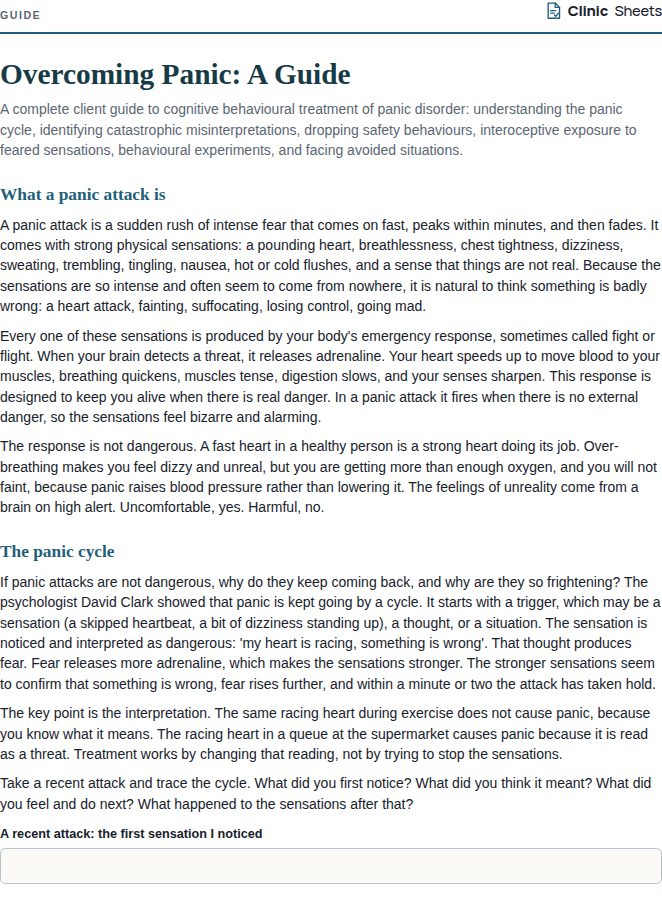
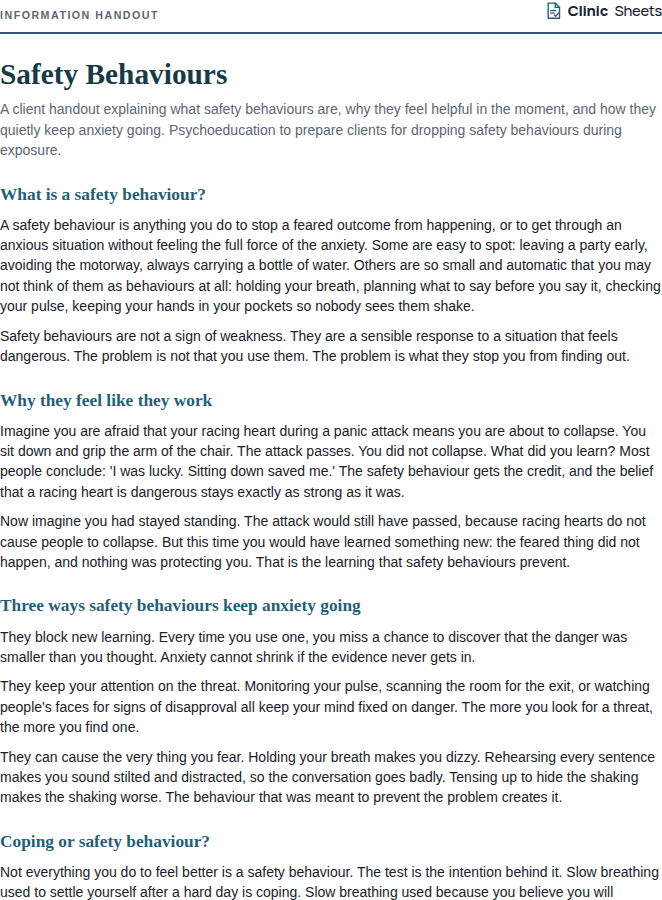
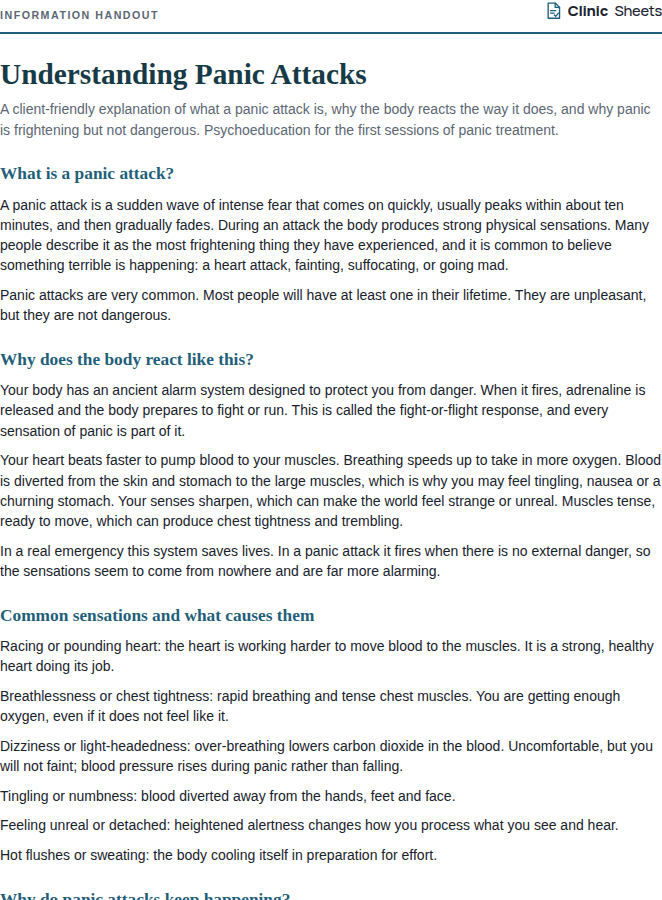
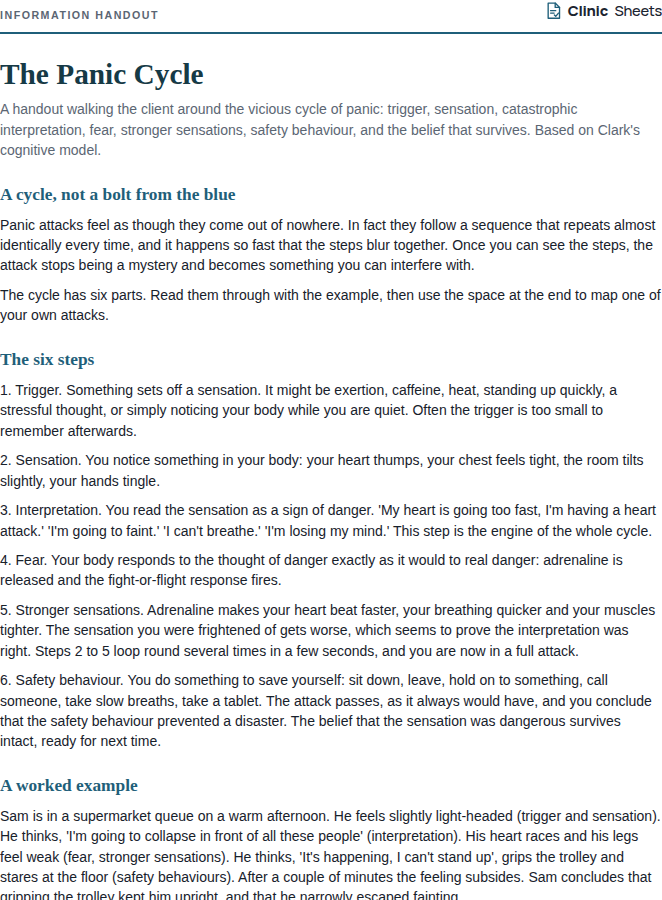
Clark's cognitive model proposes that panic attacks result from the catastrophic misinterpretation of bodily sensations: a racing heart is read as a heart attack, breathlessness as suffocation, dizziness as imminent collapse. The misinterpretation raises anxiety, which intensifies the sensations, which strengthens the belief. Between attacks the person remains vigilant for sensations and relies on safety behaviours (sitting down, carrying medication, avoiding exertion) that prevent disconfirmation of the feared catastrophe. Cognitive therapy targets this cycle directly, and in the Clark et al. (1994) trial it produced high rates of panic-free status that were maintained at follow-up.
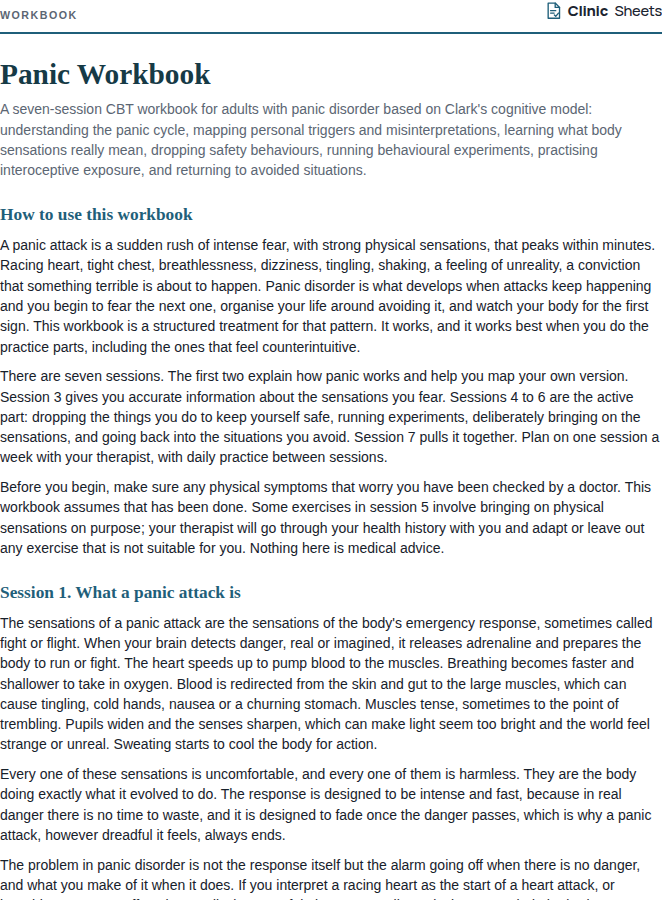
This protocol lays out a course of roughly twelve weekly sessions, the length used in the original trials, followed by booster sessions. The sequence is: assessment and socialisation to the model, education about the physiology of anxiety, identification of the client's specific catastrophic beliefs, verbal reattribution, interoceptive behavioural experiments that provoke the feared sensations in session, dropping of safety behaviours, situational experiments for agoraphobic avoidance, and a written relapse prevention blueprint. Many clients need fewer sessions; some with extensive agoraphobia need the situational work extended.
The professional version notes where this protocol converges with and differs from Barlow and Craske's panic control treatment, which shares the interoceptive exposure component but frames it more as habituation and inhibitory learning than as belief testing. It also gives guidance on the medical screening question, on clients taking benzodiazepines, and on the most common reason the treatment stalls: experiments conducted while a subtle safety behaviour remains in place.
How to use it
- Confirm the diagnosis and suitability first: recurrent unexpected panic attacks with at least one month of worry about attacks or their consequences, or behaviour change because of them. Screen for medical contributors where indicated and establish whether agoraphobic avoidance is present and how extensive it is.
- Follow the sessions in order but at the client's pace. The model must be understood and agreed before any experiment is attempted. If the client does not yet believe that misinterpretation plays a role, spend another session on the idiosyncratic model rather than moving on.
- Administer a panic-specific measure at every session and record attack frequency, intensity and belief ratings in the feared catastrophe. Belief ratings, not just attack frequency, are the best guide to whether the cognitive work is landing.
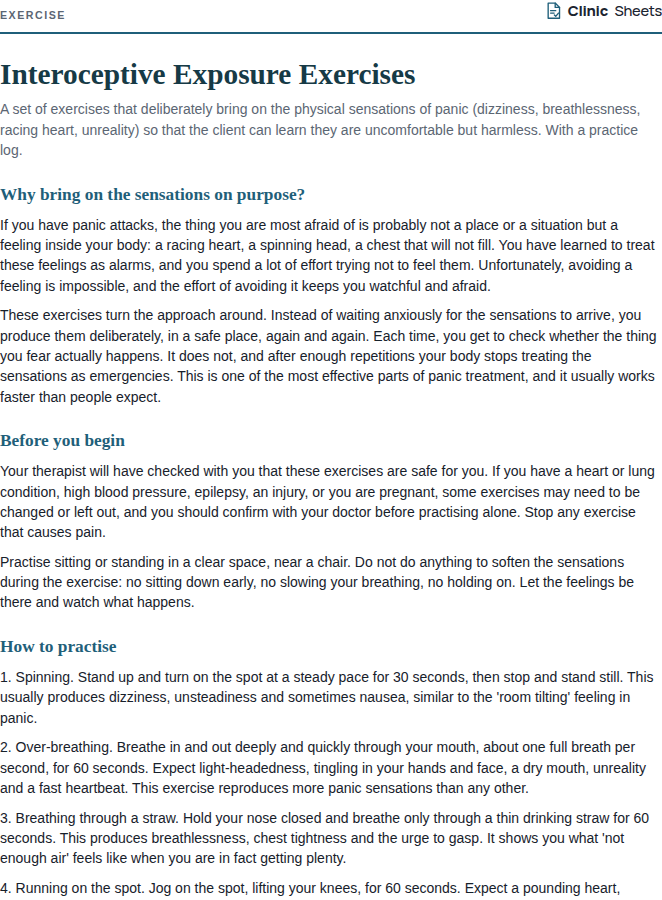
- Conduct every interoceptive experiment in session before asking the client to repeat it at home. Model each procedure yourself first. Check for safety behaviours before, during and after each experiment.
- Reserve the last two sessions for the written blueprint and relapse prevention, and book at least one booster session one to three months after the final session.
References
- Clark, D. M. (1986). A cognitive approach to panic. Behaviour Research and Therapy, 24(4), 461-470.
- Clark, D. M., Salkovskis, P. M., Hackmann, A., Middleton, H., Anastasiades, P., & Gelder, M. (1994). A comparison of cognitive therapy, applied relaxation and imipramine in the treatment of panic disorder. British Journal of Psychiatry, 164(6), 759-769.
- Craske, M. G., & Barlow, D. H. (2007). Mastery of Your Anxiety and Panic: Therapist Guide (4th ed.). Oxford University Press.
- Salkovskis, P. M., Clark, D. M., & Gelder, M. G. (1996). Cognition-behaviour links in the persistence of panic. Behaviour Research and Therapy, 34(5-6), 453-458.