Irritable Bowel Syndrome and Anxiety
A handout explaining the two-way link between irritable bowel syndrome and anxiety: how the gut and brain talk to each other, how catastrophic thoughts and avoidance amplify symptoms, and what CBT can change.
About this resource
Irritable bowel syndrome (IBS) is a disorder of gut-brain interaction characterised by abdominal pain and altered bowel habit in the absence of structural disease. It is common, and it is strongly associated with anxiety and depression, with the relationship running in both directions: stress and anxiety alter gut motility and sensitivity, and unpredictable, embarrassing symptoms generate anxiety. The Rome IV framework describes IBS explicitly in terms of disordered communication between the gut and the central nervous system, which gives clinicians a non-dismissive way to explain why psychological treatment helps a physical condition.
The cognitive behavioural model of IBS, developed by Toner and colleagues and others, focuses on catastrophic interpretations of gut sensations ('I'm going to lose control', 'everyone will notice', 'something is seriously wrong'), hypervigilance to bodily signals, and avoidance and safety behaviours (not eating before going out, mapping toilets, refusing invitations, restricting the diet excessively). These responses increase arousal, which increases gut sensitivity and symptoms, and prevent the person from learning that feared outcomes rarely occur. CBT for IBS has a substantial evidence base; Lackner and colleagues' large trial found that both clinic-based and largely self-administered CBT produced clinically meaningful improvement in symptoms compared with education alone.
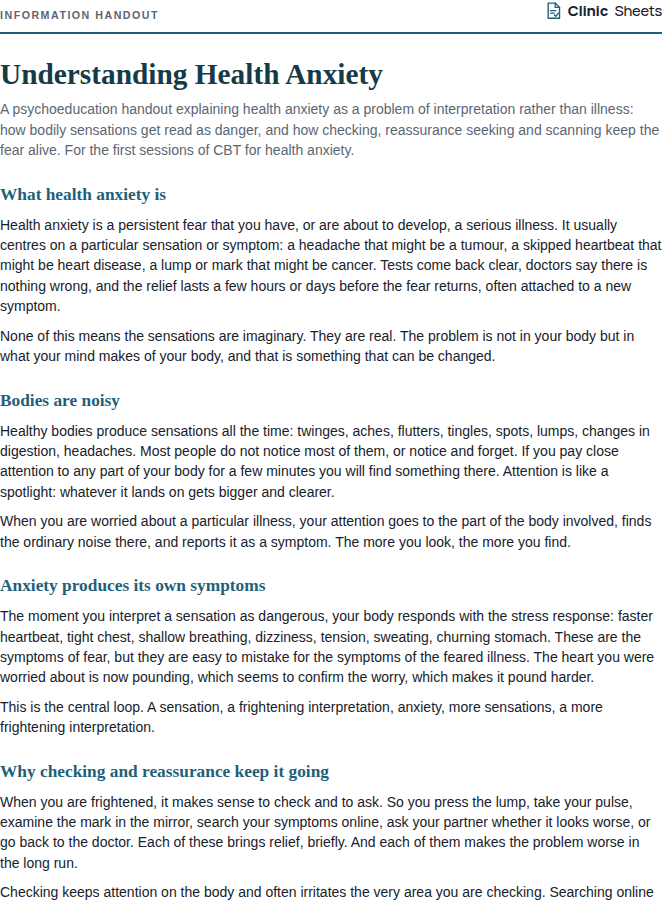
This handout explains the gut-brain connection, describes the anxiety-symptom cycle and the role of catastrophising and avoidance, and introduces first steps. It is not medical advice; the client should have a diagnosis from a physician, and red-flag symptoms need medical review. The professional version notes the importance of not treating IBS as 'just anxiety', the overlap with health anxiety, and the need to work alongside rather than instead of the client's medical and dietary care.
How to use it
- Confirm the client has a medical diagnosis of IBS and that red-flag symptoms have been excluded. This handout is not a substitute for medical assessment.
- Introduce the gut-brain model with care. Many clients have been told their symptoms are 'all in their head' and are sensitised to dismissal. Emphasise that the symptoms are real and physical and that the brain is one of the levers for changing them.
- Map the client's own cycle: the sensation, the catastrophic thought, the anxiety, the behaviour, and the effect on symptoms. Use a recent specific episode.
- Target catastrophic beliefs with thought records and behavioural experiments, and plan graded reduction of avoidance and safety behaviours (eating before an outing, going somewhere without first locating every toilet).
- Where health anxiety is prominent, address it directly. Where dietary restriction has become extreme, involve a dietitian or physician.
References
- Toner, B. B., Segal, Z. V., Shelagh, D. E., & Myran, D. (2000). Cognitive-Behavioral Treatment of Irritable Bowel Syndrome: The Brain-Gut Connection. Guilford Press.
- Lackner, J. M., Jaccard, J., Keefer, L., Brenner, D. M., Firth, R. S., Gudleski, G. D., Hamilton, F. A., Katz, L. A., Krasner, S. S., Ma, C.-X., Radziwon, C. D., & Sitrin, M. D. (2018). Improvement in gastrointestinal symptoms after cognitive behavior therapy for refractory irritable bowel syndrome. Gastroenterology, 155(1), 47-57.
- Drossman, D. A. (2016). Functional gastrointestinal disorders: History, pathophysiology, clinical features, and Rome IV. Gastroenterology, 150(6), 1262-1279.