PHQ-15 Somatic Symptom Scale
The PHQ-15, the 15-item somatic symptom module of the Patient Health Questionnaire, reproduced in full with its severity bands, interpretation notes for health anxiety, chronic pain and unexplained physical symptoms, and licence information.
About this resource
The PHQ-15 is the somatic symptom scale of the Patient Health Questionnaire, developed by Kroenke, Spitzer and Williams and published in 2002. It asks how much the person has been bothered over the past four weeks by 15 common physical symptoms, each rated 0 (not bothered at all), 1 (bothered a little) or 2 (bothered a lot), for a total of 0 to 30. The symptoms were chosen because they account for a large proportion of physical complaints in primary care and because they are the symptoms most often reported by people with somatic symptom presentations. One item asks about menstrual problems and is answered only by those to whom it applies.
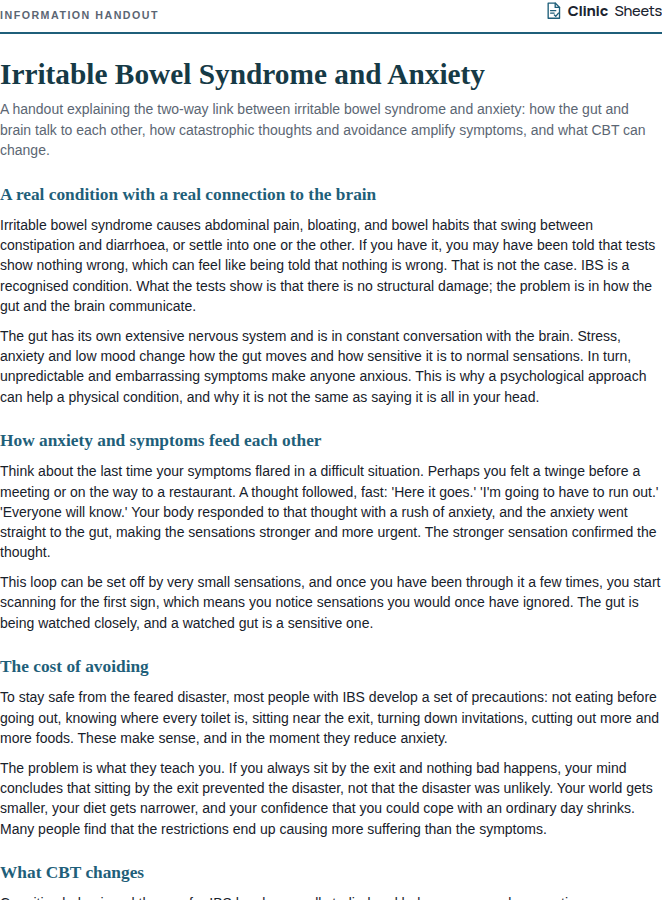
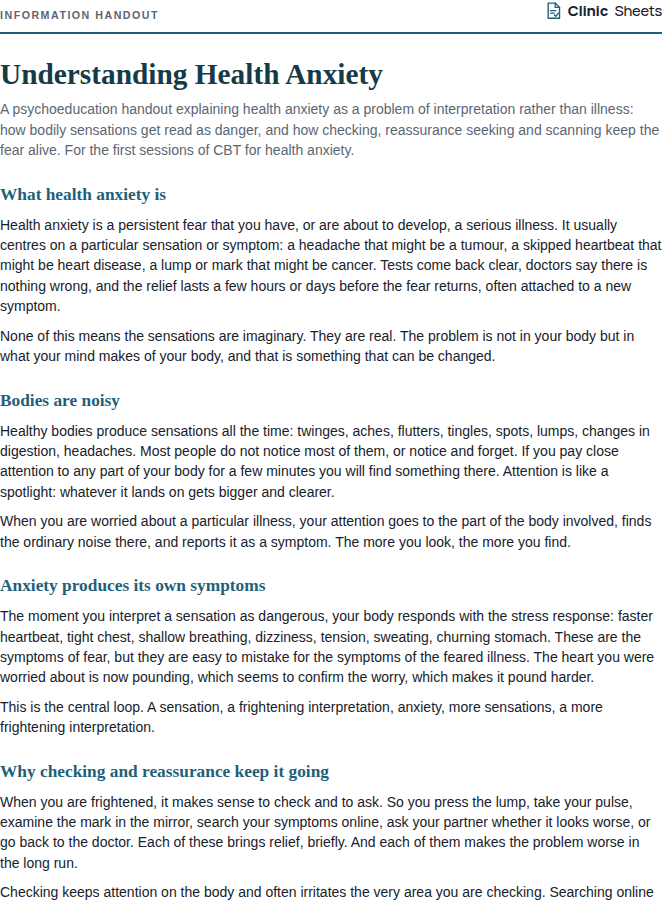
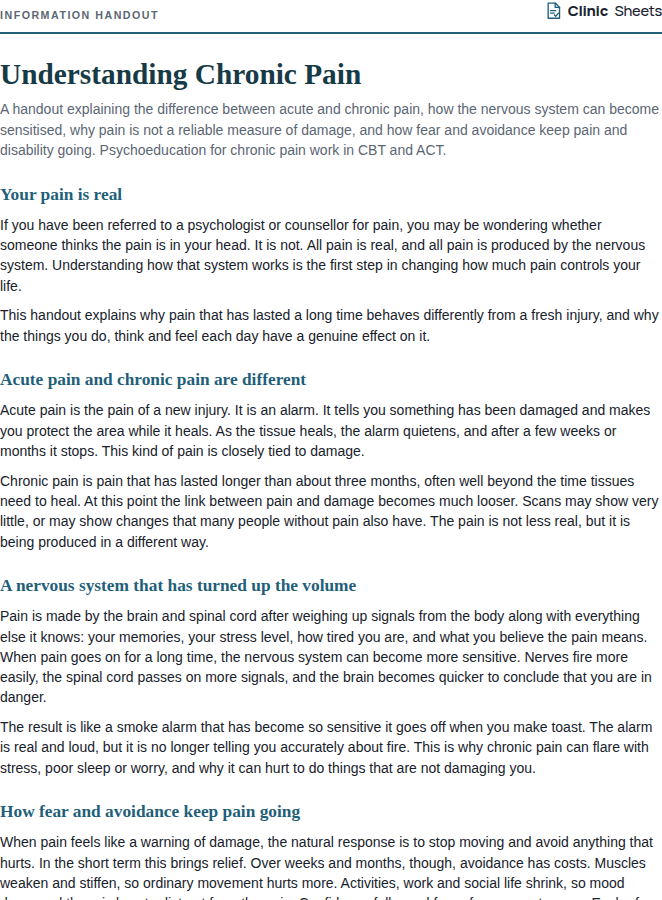
The scale measures somatic symptom burden regardless of cause; it does not distinguish medically explained from unexplained symptoms. It is useful in therapy for health anxiety, chronic pain and illness adjustment as a way of quantifying symptom load, tracking change, and opening a conversation about how symptoms and distress interact. Kroenke and colleagues proposed cut-offs of 5, 10 and 15 for low, medium and high somatic symptom severity, and found that higher scores were associated with more functional impairment, more health care use and more depressive and anxiety symptoms.
The professional version adds the scoring table, interpretation guidance for psychological practice, and limitations, including the reminder that a high score is not evidence that symptoms are psychological in origin and that the scale does not replace medical assessment.
The instrument is reproduced here because Pfizer, the copyright holder, permits reproduction, translation, display and distribution of the PHQ family without permission. Item wording follows the published instrument.
How to use it
- Administer at assessment and at intervals during treatment for health anxiety, chronic pain, illness adjustment or persistent physical symptoms. The four-week time frame suits monthly monitoring.
- Sum the 15 items for a total between 0 and 30. If the menstrual item is not applicable, the total is based on 14 items; note this so that repeated scores are comparable.
- Use the severity bands (5, 10 and 15) to describe symptom burden and track change. Read individual items to see which symptoms are most troubling and to guide formulation.
- Do not treat a high score as evidence that symptoms are unexplained or psychological. Confirm that appropriate medical assessment has taken place, and coordinate with the client's physician where needed.
- Pair the PHQ-15 with a depression measure (PHQ-9) and an anxiety measure (GAD-7), since the three often rise and fall together and the combination gives a fuller picture.
References
- Kroenke, K., Spitzer, R. L., & Williams, J. B. W. (2002). The PHQ-15: Validity of a new measure for evaluating the severity of somatic symptoms. Psychosomatic Medicine, 64(2), 258-266.
- Kroenke, K., Spitzer, R. L., Williams, J. B. W., & Löwe, B. (2010). The Patient Health Questionnaire somatic, anxiety, and depressive symptom scales: A systematic review. General Hospital Psychiatry, 32(4), 345-359.