Understanding Health Anxiety
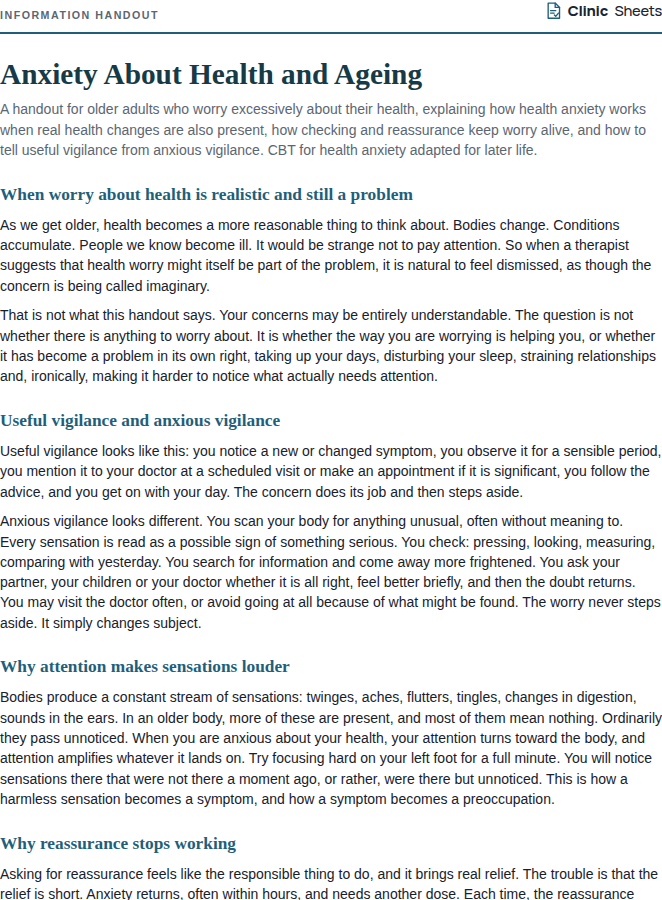
A psychoeducation handout explaining health anxiety as a problem of interpretation rather than illness: how bodily sensations get read as danger, and how checking, reassurance seeking and scanning keep the fear alive. For the first sessions of CBT for health anxiety.
About this resource
Health anxiety (illness anxiety disorder, or what was previously called hypochondriasis) is characterised by a persistent fear of having or developing a serious illness, based on the misinterpretation of bodily sensations or minor symptoms, that continues despite medical reassurance. Clients often feel dismissed by the label and by repeated negative tests, and many have had years of investigations. Engagement depends on a formulation that takes the sensations seriously while relocating the problem from the body to the interpretation.
This handout is based on the cognitive behavioural model of health anxiety developed by Salkovskis and Warwick. It explains how attention amplifies normal sensations, how catastrophic interpretation produces anxiety and its own physical symptoms, and how the behaviours that follow (body checking, seeking reassurance from doctors, family and the internet, and avoidance of illness-related cues) provide short-term relief but prevent disconfirmation and keep attention locked on the body. It also introduces the idea that the client may have two problems to choose between: a possible physical illness, or a definite anxiety problem about illness, and that treatment tests the second.
Suitable for adults. The professional version includes guidance on the 'two theories' engagement strategy, notes on liaising with the client's physician to agree limits on further investigation, and a short list of the sensations most often misinterpreted, with their benign explanations.
How to use it
- Use after assessment, once the client has described their feared illness, the sensations that trigger the fear, and what they do in response. Read it together.
- Ask the client to map their own experience onto each section: what they notice, what they think it means, what they do about it, and what happens to the fear afterwards.
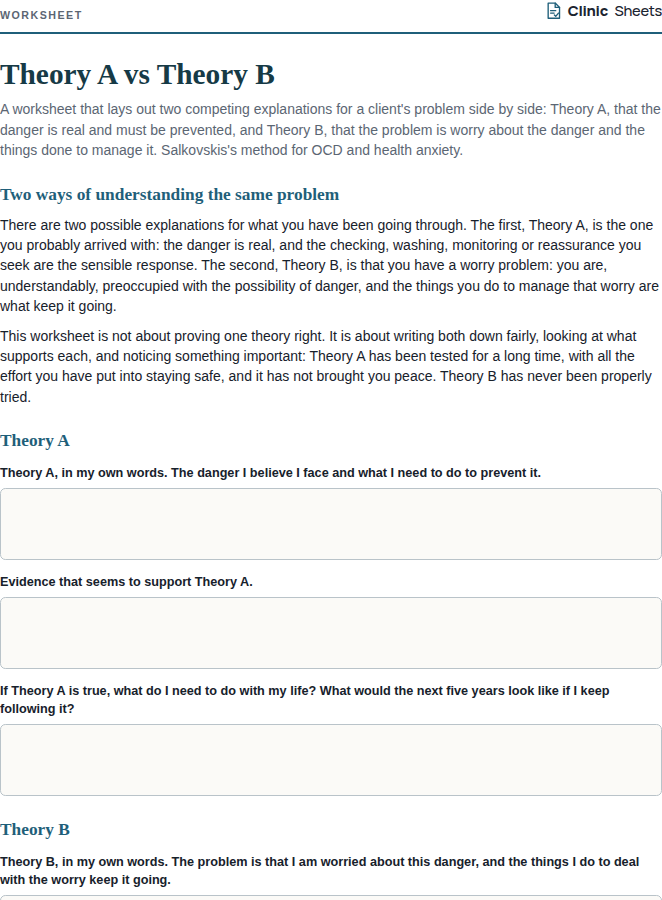
- Present the two theories explicitly: theory A, that they have a serious illness that has been missed; theory B, that they have a problem of worry about illness. Ask which theory they have been living by, and propose spending the treatment testing theory B.
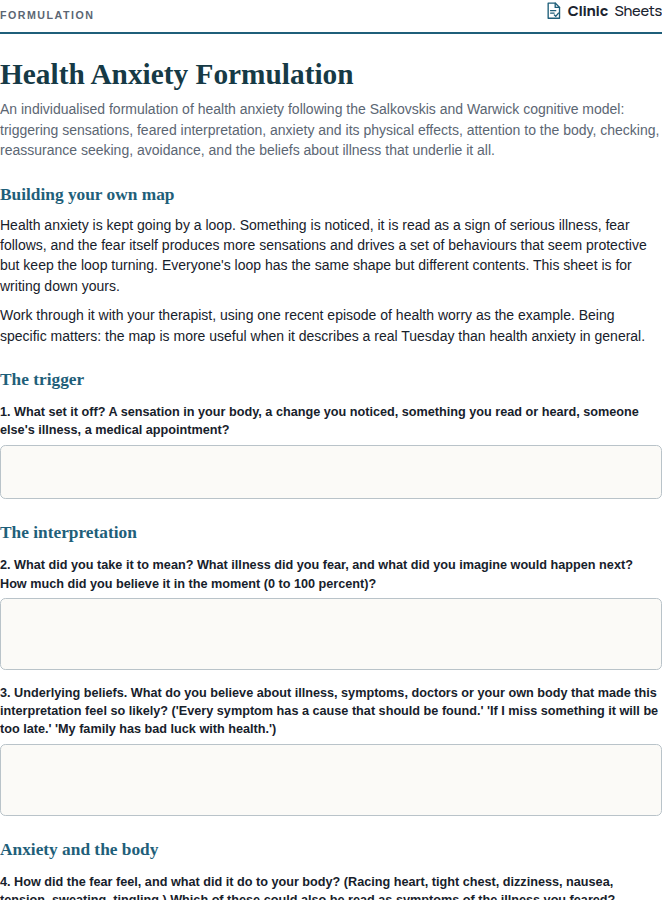
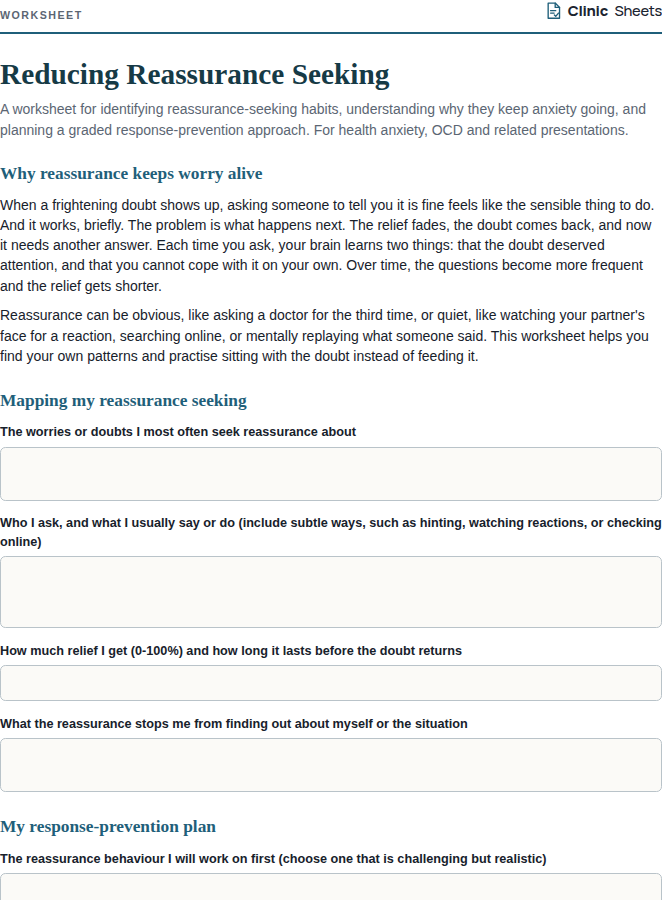
- Follow with the Health Anxiety Formulation to build an individualised model, then move to behavioural experiments that reduce checking and reassurance seeking.
- Where appropriate and with consent, agree with the client's physician on a plan for routine review rather than symptom-driven appointments.
References
- Salkovskis, P. M., & Warwick, H. M. C. (1986). Morbid preoccupations, health anxiety and reassurance: A cognitive-behavioural approach to hypochondriasis. Behaviour Research and Therapy, 24(5), 597-602.
- Warwick, H. M. C., & Salkovskis, P. M. (1990). Hypochondriasis. Behaviour Research and Therapy, 28(2), 105-117.
- Furer, P., Walker, J. R., & Stein, M. B. (2007). Treating Health Anxiety and Fear of Death: A Practitioner's Guide. Springer.
- Tyrer, P., Cooper, S., Salkovskis, P., et al. (2014). Clinical and cost-effectiveness of cognitive behaviour therapy for health anxiety in medical patients: A multicentre randomised controlled trial. The Lancet, 383(9913), 219-225.