Anxiety About Health and Ageing
A handout for older adults who worry excessively about their health, explaining how health anxiety works when real health changes are also present, how checking and reassurance keep worry alive, and how to tell useful vigilance from anxious vigilance. CBT for health anxiety adapted for later life.
About this resource
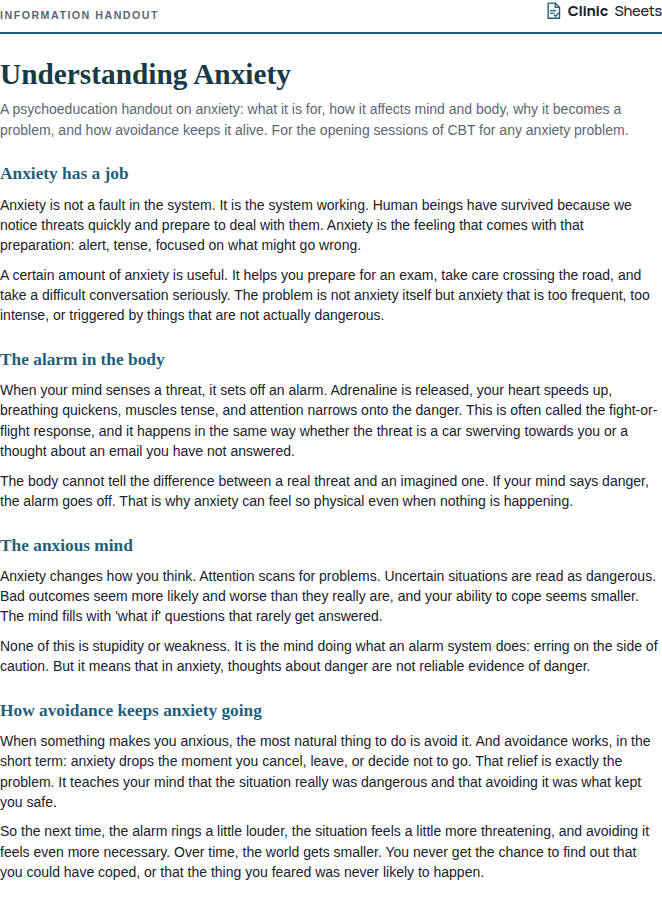
Health anxiety in older adults presents a particular challenge: the feared outcomes are not implausible. Bodies change, illnesses become more common, friends and contemporaries become ill and die, and many older adults are managing at least one chronic condition. Clinicians can therefore be reluctant to treat health worry as anxiety, and clients often feel that their worry is simply realism. Yet the cognitive-behavioural model of health anxiety (Salkovskis and Warwick, 1986; Warwick and Salkovskis, 1990) applies regardless of whether some risk is present. The problem is not the presence of concern but the process: selective attention to bodily sensations, catastrophic interpretation of them, and behaviours such as checking, reassurance seeking, repeated medical consultation, and avoidance that provide short-term relief and long-term maintenance.
This handout takes the reader's health concerns seriously while distinguishing between useful vigilance (noticing a new symptom and reporting it to a doctor once) and anxious vigilance (scanning constantly, interpreting each sensation as evidence of disease, checking, searching, and asking repeatedly for reassurance that does not last). It explains why reassurance stops working, why attention amplifies sensations, and how to conduct an experiment with reducing checking. It is written to respect the reader's experience and their legitimate wish to look after their health.
The professional version adds guidance on coordinating with the family physician so that medical review is planned rather than driven by anxiety, on working with family members who provide reassurance, and on adapting the model where a serious diagnosis is present.
How to use it
- Use after a medical review has established the current state of the client's health, so that the work can proceed on agreed facts.
- Read the section on useful and anxious vigilance together and ask the client to sort their own behaviours. Do not argue about whether a concern is realistic; focus on whether the behaviour is helping.
- Elicit the client's reassurance and checking behaviours in detail, including family members' role, and ask what happens to the worry in the hours after each.
- Introduce the attention experiment in session: focus on one body part for two minutes and note what is noticed. Use this to explain amplification.
- Agree one checking or reassurance behaviour to reduce for a week, and a plan for how genuine new symptoms will be handled (for example, a scheduled appointment rather than a same-day call).
- Involve the family physician in agreeing a review schedule so that medical contact is regular and predictable rather than anxiety-driven.
References
- Salkovskis, P. M., & Warwick, H. M. C. (1986). Morbid preoccupations, health anxiety and reassurance: A cognitive-behavioural approach to hypochondriasis. Behaviour Research and Therapy, 24(5), 597-602.
- Warwick, H. M. C., & Salkovskis, P. M. (1990). Hypochondriasis. Behaviour Research and Therapy, 28(2), 105-117.
- Laidlaw, K., Thompson, L. W., Dick-Siskin, L., & Gallagher-Thompson, D. (2003). Cognitive Behaviour Therapy with Older People. Wiley.