Body Image: Checking and Avoidance
A handout explaining how body checking and body avoidance keep shape and weight concern alive, why both feel helpful but backfire, and how to begin reducing them. For clients with eating disorders or body image distress.
About this resource
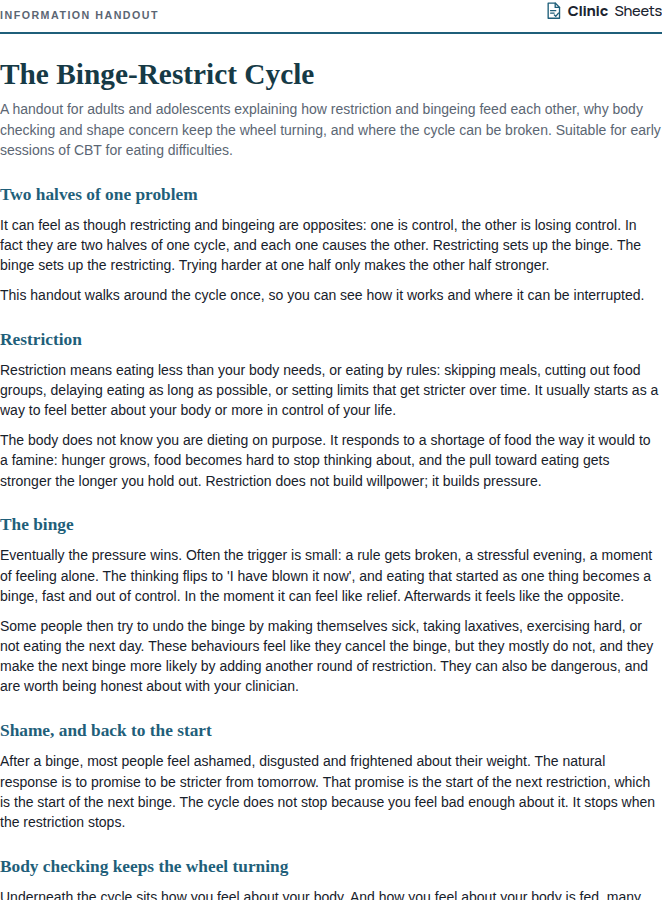
Body checking and body avoidance are two sides of the same maintaining process in the transdiagnostic model of eating disorders, and they are equally common in body image distress without a full eating disorder. Checking includes repeated weighing, mirror scrutiny, pinching or measuring body parts, comparing with others, and seeking reassurance. Avoidance includes refusing to look in mirrors, wearing concealing clothes, avoiding being seen or photographed, and not touching one's body. Both are attempts to manage anxiety about shape and weight, and both keep that anxiety at the centre of attention.
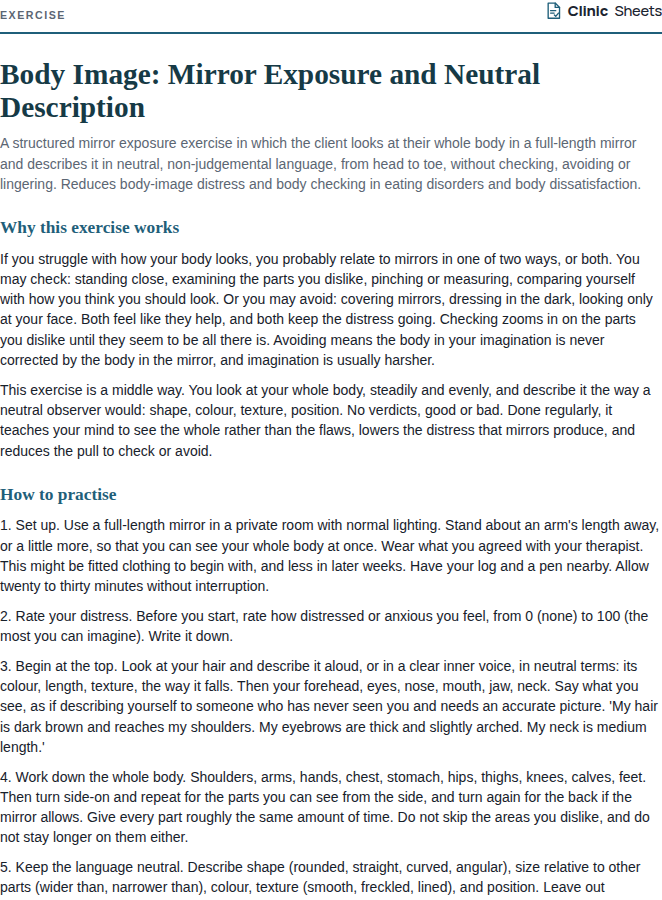
Checking is problematic for specific reasons. Scrutiny magnifies what is looked at: staring at any part of the body for long enough makes it look wrong. Checking provides information that is unreliable (weight fluctuates daily for reasons unrelated to fat) and is interpreted in a biased way (only the unwelcome readings are believed). Comparison is selectively directed at people who appear thinner. Avoidance, meanwhile, prevents the person from ever discovering that their body is tolerable to see, so the feared image persists unchallenged. This handout explains these mechanisms and introduces the treatment strategy: monitoring checking, reducing its frequency, changing how mirrors are used, and gradually approaching what is avoided.
The professional version adds guidance on eliciting checking behaviours the client may not recognise as such, on the sequence of intervention (address checking before avoidance, and in-session weekly weighing as a controlled replacement for frequent self-weighing where appropriate), and on the role of body checking in maintaining the over-evaluation of shape and weight.
How to use it
- Introduce once the client has grasped the maintaining model and self-monitoring is established.
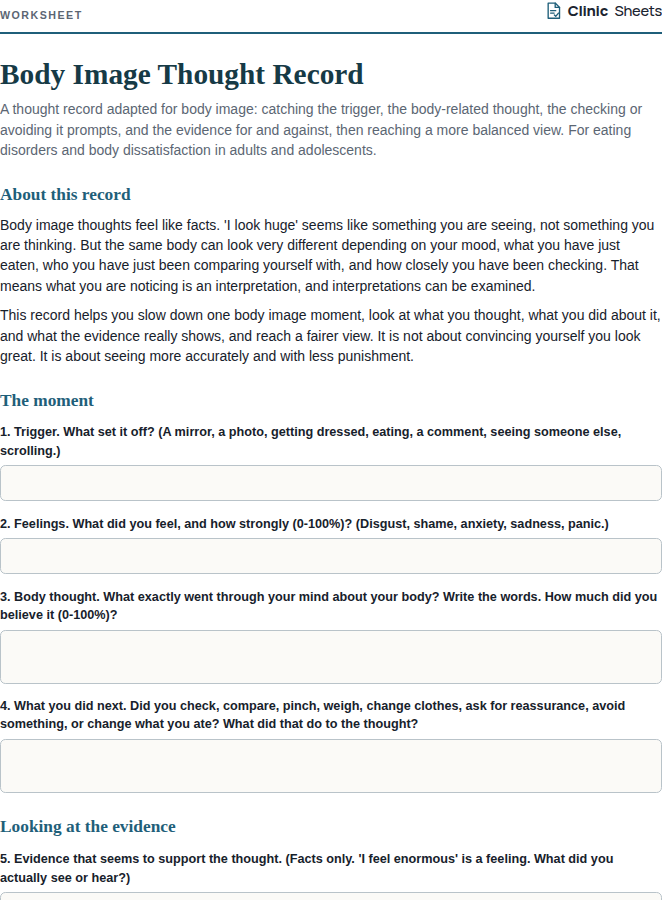
- Ask the client to list their own checking and avoidance behaviours using the handout as a prompt. Many are habitual and go unnoticed, so a day or two of monitoring may be needed first.
- Explain why each behaviour backfires, using the client's own examples. Focus on the effect of scrutiny and the unreliability of the information gathered.
- Agree a plan to reduce the most frequent checking behaviour and to begin approaching one avoided situation. Move gradually.
- Review at each session. Expect anxiety to rise briefly when checking is reduced and to settle over one to two weeks.
References
- Fairburn, C. G. (2008). Cognitive Behavior Therapy and Eating Disorders. Guilford Press.
- Shafran, R., Fairburn, C. G., Robinson, P., & Lask, B. (2004). Body checking and its avoidance in eating disorders. International Journal of Eating Disorders, 35(1), 93-101.
- Walker, D. C., White, E. K., & Srinivasan, V. J. (2018). A meta-analysis of the relationships between body checking, body image avoidance, body image dissatisfaction, mood, and disordered eating. International Journal of Eating Disorders, 51(8), 745-770.