Discharge Summary and Relapse Plan
A clinician template for ending a course of CBT well: a discharge summary recording the formulation, the work done and the outcome, and a relapse prevention plan written with the client that they take with them.
About this resource
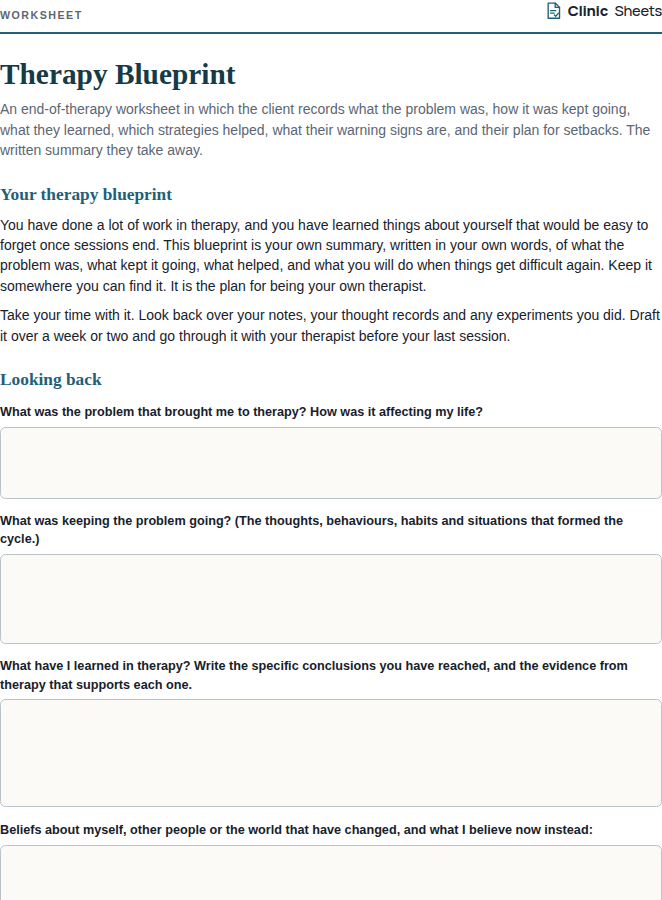
The final sessions of CBT have two jobs. One is administrative and clinical: recording what was done, what changed, and what remains, so that the client's other providers and any future therapist have an accurate account. The other is therapeutic: consolidating the client's learning into a plan they can use when difficulties return. Relapse prevention work of this kind, sometimes called a therapy blueprint, is associated with better maintenance of gains, and it is the part of ending that clients most often say they valued.
This template holds both. The discharge summary section is written by you and follows the elements most referrers expect: presenting problem, formulation, interventions, outcome measures at start and end, risk, and recommendations. The relapse plan section is written with the client, in their words, and covers what they learned, which strategies helped, their early warning signs, what they will do when they notice them, and when to seek help again. The plan is copied for the client and, with consent, can be shared with their family physician.
The professional version adds guidance on planning the ending from the first session, spacing the final sessions, handling endings that come earlier than planned, and offering booster sessions.
How to use it
- Begin discussing the ending several sessions before it happens, and consider spacing the last two or three sessions further apart so the client can test coping without weekly support.
- Complete the relapse plan section collaboratively over one or two sessions. Ask the client to draft parts of it between sessions; the plan is theirs.
- Administer the primary outcome measure at the final session and record start and end scores in the summary. Note the direction and size of change in plain language.
- Write the discharge summary within a week of the final session. Keep it factual and proportionate, and write it knowing the client may read it.
- Give the client a copy of their relapse plan. With their consent, send the discharge summary to the referrer or family physician.
- If booster sessions are offered, agree the number and timing and record them in the plan.
References
- Beck, J. S. (2020). Cognitive Behavior Therapy: Basics and Beyond (3rd ed.). Guilford Press.
- Kennerley, H., Kirk, J., & Westbrook, D. (2016). An Introduction to Cognitive Behaviour Therapy (3rd ed.). SAGE.
- Marlatt, G. A., & Donovan, D. M. (Eds.). (2005). Relapse Prevention: Maintenance Strategies in the Treatment of Addictive Behaviors (2nd ed.). Guilford Press.