Therapy Blueprint
An end-of-therapy worksheet in which the client records what the problem was, how it was kept going, what they learned, which strategies helped, what their warning signs are, and their plan for setbacks. The written summary they take away.
About this resource
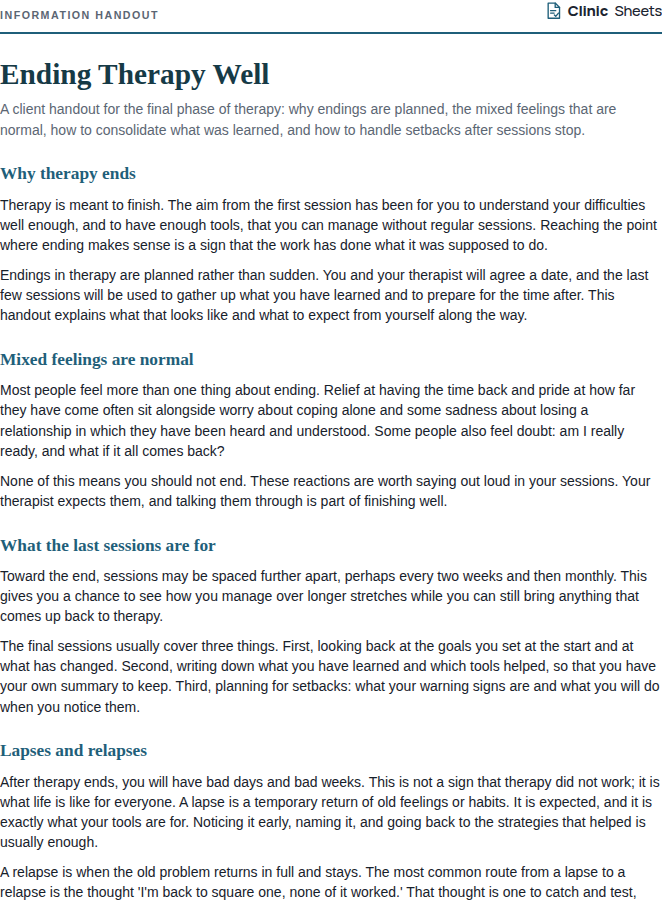
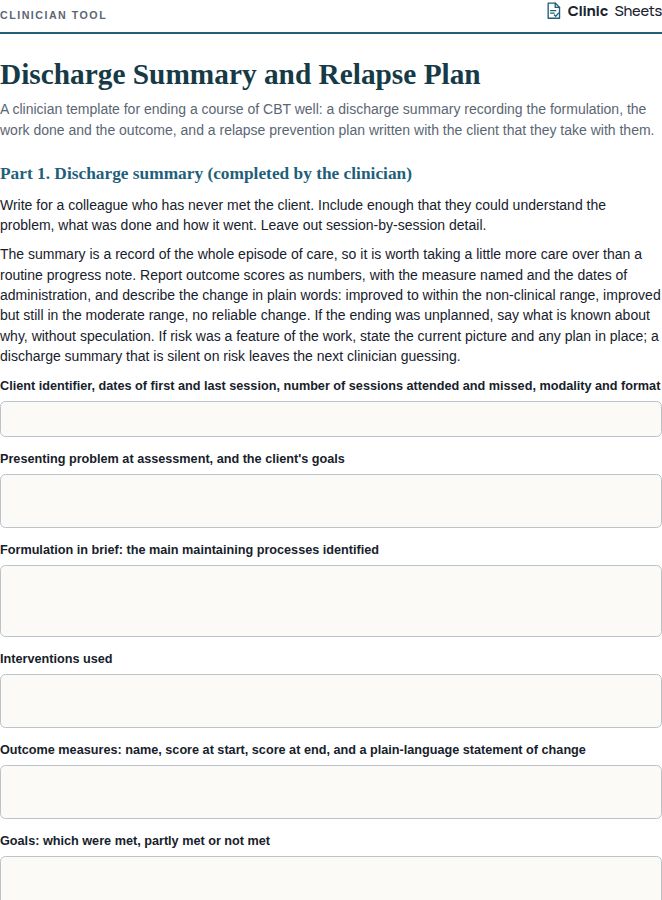
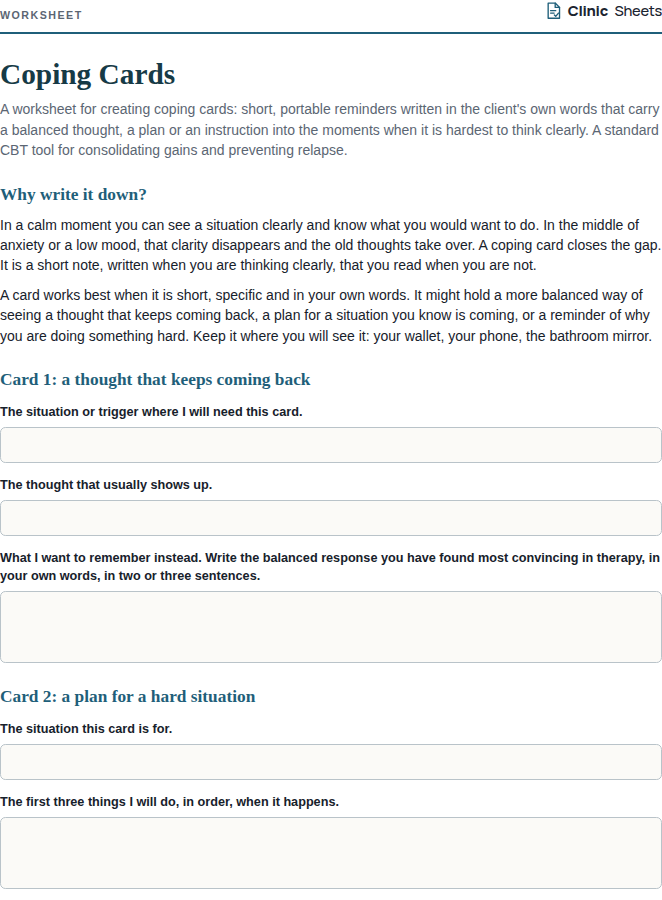
The therapy blueprint is a standard part of ending CBT well. Over a course of treatment the client learns a great deal, but much of it is held in the memory of sessions rather than in a form they can consult later. The blueprint gathers it onto one or two pages in the client's own words: the understanding of the problem, the strategies that worked, the beliefs that shifted and what replaced them, and a concrete plan for the setbacks that will inevitably come. Its purpose is to make the client their own therapist.
The structure follows the format described in the Oxford CBT texts and in Judith Beck's work on relapse prevention: a brief statement of the original problem and the maintaining cycle, a summary of the key learning, a list of the tools that helped and when to use them, early warning signs, a setback plan, and goals for the period after therapy. It should be completed over the final two or three sessions rather than in the last ten minutes, with the client drafting between sessions and refining in the room.
The professional version includes guidance on drawing out learning from clients who attribute change to the therapist or to circumstances, on distinguishing a lapse from a relapse, and on using the blueprint as the agenda for follow-up or booster sessions.
How to use it
- Introduce the blueprint three or four sessions before the planned ending, and explain that it will be the client's own summary of the therapy to keep.
- Ask the client to draft the first sections between sessions, looking back over their notes, thought records and experiments. Review the draft together and add what they have missed.
- Pay particular attention to the 'what I learned' section. Push for specific conclusions in the client's own words, and for evidence from the therapy that supports each one. General statements such as 'I learned to think differently' are less useful than 'I learned that my panic sensations peak and pass within minutes if I do nothing about them.'
- For the setback plan, distinguish a lapse (a bad day or week, expected) from a relapse (a return to the full problem), and make sure the plan starts with the tools the client already has before it reaches asking for help.
- Give the client a clean copy at the final session and keep one on file. If booster sessions are planned, use the blueprint as their starting point.
References
- Beck, J. S. (2020). Cognitive Behavior Therapy: Basics and Beyond (3rd ed.). Guilford Press.
- Kennerley, H., Kirk, J., & Westbrook, D. (2016). An Introduction to Cognitive Behaviour Therapy: Skills and Applications (3rd ed.). SAGE.
- Butler, G., Fennell, M., & Hackmann, A. (2008). Cognitive-Behavioral Therapy for Anxiety Disorders: Mastering Clinical Challenges. Guilford Press.