Supporting a Family Member with OCD
A handout for the family of someone with OCD: how obsessions and compulsions work, why reassurance and other forms of accommodation keep the disorder going, and how to step back from accommodation in a planned, caring way.
About this resource
Families of people with OCD are almost always drawn into the disorder. They answer the same question for the tenth time, wait while rituals are completed, avoid the objects or words that trigger distress, and rearrange household routines around the compulsions. Research since the mid-1990s has consistently found that this family accommodation is common, that it is associated with more severe symptoms and poorer treatment outcome, and that reducing it improves results.
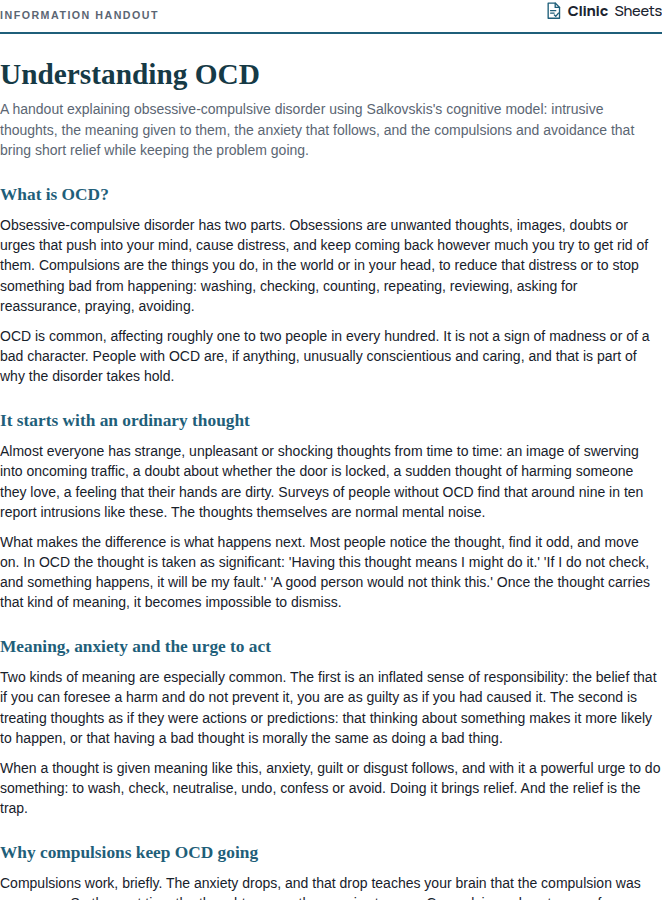
This handout explains OCD using the cognitive behavioural model: an intrusive thought is interpreted as meaningful and dangerous, anxiety follows, and a compulsion or a request for reassurance brings brief relief, which teaches the brain that the ritual was necessary. Family accommodation is a compulsion carried out by someone else, and it maintains OCD in exactly the same way. The handout then gives families a way to reduce accommodation that is gradual, agreed in advance, and framed as support for the person rather than a withdrawal of care.
The professional version includes guidance on assessing accommodation at intake, on preparing the family before any change is made, on scripting the responses families can use in place of reassurance, and on managing the temporary increase in distress and conflict that often follows.
How to use it
- Assess accommodation early. Ask the client and, with consent, family members what the family does differently because of OCD: answering questions, providing supplies, waiting, avoiding, participating in rituals, or taking over tasks.
- Share the handout after the client understands the OCD cycle and has agreed that exposure and response prevention is the plan. Family change should support the client's treatment, not run ahead of it.
- Agree with the client which accommodations will be reduced first. Start with ones the client rates as least distressing to lose. The client's consent makes the difference between support and a power struggle.
- Give the family a short, kind script to use in place of reassurance and rehearse it in session. The wording should acknowledge the distress, restate the plan, and express confidence.
- Warn the family that distress and irritability usually increase for a period before they fall. Plan how they will hold steady, and make sure they can contact you if things escalate.
- Review accommodation at each session. Families frequently slip back under pressure; treat this as information rather than failure and problem-solve the specific situation.
References
- Calvocoressi, L., Lewis, B., Harris, M., Trufan, S. J., Goodman, W. K., McDougle, C. J., & Price, L. H. (1995). Family accommodation in obsessive-compulsive disorder. American Journal of Psychiatry, 152(3), 441-443.
- Salkovskis, P. M. (1985). Obsessional-compulsive problems: A cognitive-behavioural analysis. Behaviour Research and Therapy, 23(5), 571-583.
- Lebowitz, E. R. (2019). Addressing Parental Accommodation When Treating Anxiety in Children. Oxford University Press.
- Abramowitz, J. S., Deacon, B. J., & Whiteside, S. P. H. (2019). Exposure Therapy for Anxiety: Principles and Practice (2nd ed.). Guilford Press.