Session-by-Session Protocol: Trauma-Focused CBT for PTSD
A session-by-session clinician protocol for trauma-focused CBT for PTSD, following Ehlers and Clark's cognitive therapy: reclaiming life, identifying hotspots through imaginal reliving, updating the trauma memory, discriminating triggers, dropping safety behaviours and rumination, a site visit, and a blueprint for the future.
About this resource
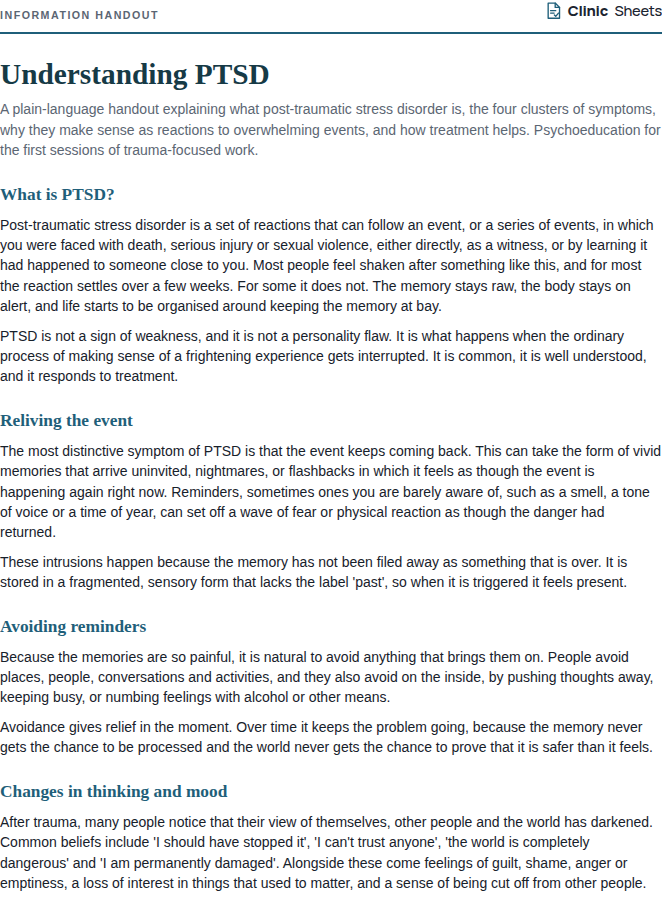
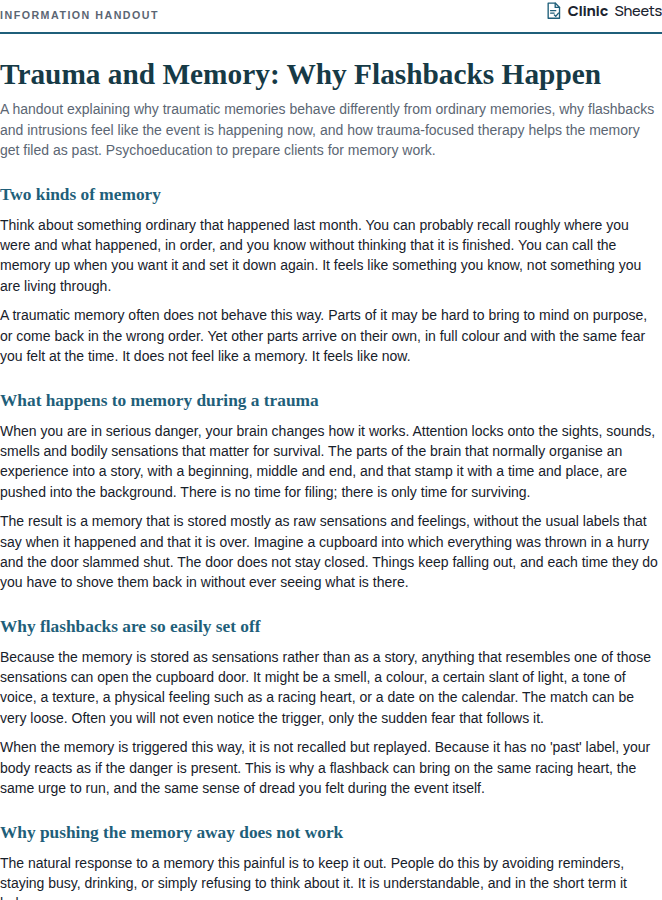
Ehlers and Clark's cognitive model proposes that PTSD persists when the trauma is processed in a way that leaves a sense of serious current threat. Two processes produce this: excessively negative appraisals of the trauma and its aftermath ('I am going mad', 'it was my fault', 'nowhere is safe'), and a trauma memory that is poorly elaborated and poorly integrated in time and context, so that it is triggered by sensory cues and re-experienced as if happening now. The person's strategies for coping, including thought suppression, rumination, avoidance and safety behaviours, prevent change in both. Cognitive therapy for PTSD (CT-PTSD) targets all three: it modifies appraisals, elaborates and updates the memory, and drops the maintaining strategies.
This protocol follows the treatment described in Ehlers et al. (2005), delivered in up to twelve weekly sessions of sixty to ninety minutes with up to three booster sessions. The core memory work uses imaginal reliving to identify the worst moments ('hotspots') and their meanings, cognitive work on those meanings, and then updating: bringing the new information into the hotspot while reliving it. Foa's prolonged exposure, which relies on repeated imaginal exposure and in vivo exposure to trauma reminders, is a closely related evidence-based alternative; the two approaches share the imaginal component and differ in how much explicit cognitive work is done inside the memory.
The professional version explains how to run a first reliving safely, how to work with hotspots when there are several traumas, what to do when the client dissociates, why 'reclaiming your life' comes first, and how to conduct a site visit. It also covers the most common reasons treatment stalls: memory work started before the client is stabilised enough to sleep and attend, and updating attempted before the meaning of the hotspot has actually shifted.
How to use it
- Confirm PTSD and identify the index trauma or traumas. Administer the PCL-5 at baseline and weekly, and the Posttraumatic Cognitions Inventory at baseline and at the end. Screen for risk, dissociation, substance use and current threat.
- Follow the phase order: assessment and rationale, reclaiming life, memory work with updating, trigger discrimination, work on appraisals and safety behaviours, site visit, blueprint. Reliving is usually introduced by session three or four.
- Before the first reliving, agree the ground rules with the client: present tense, first person, eyes closed if tolerable, the therapist will ask for ratings of distress and vividness and will keep the client in the room if needed. After every reliving, allow time to return fully to the present before ending the session.
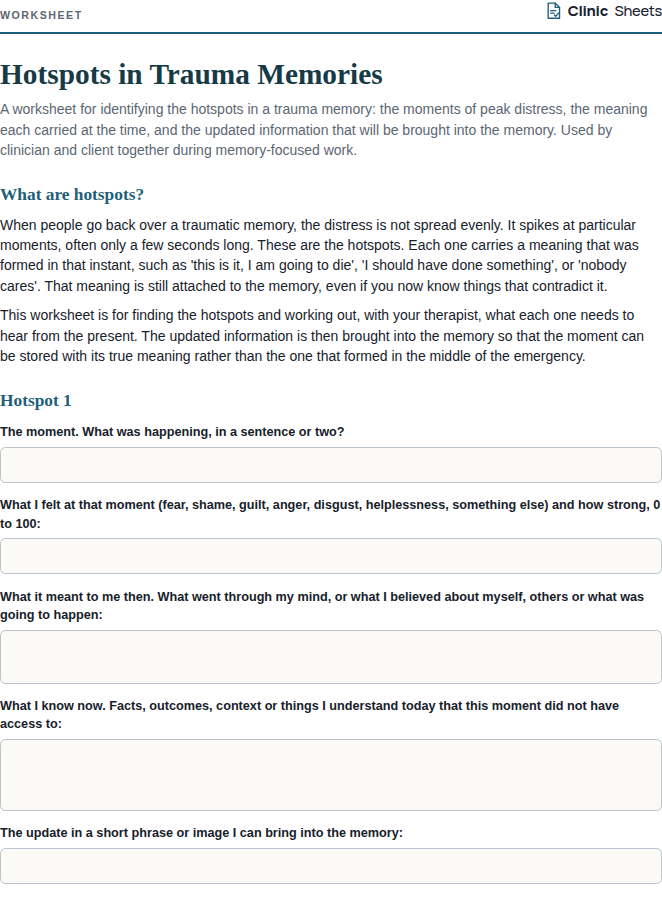
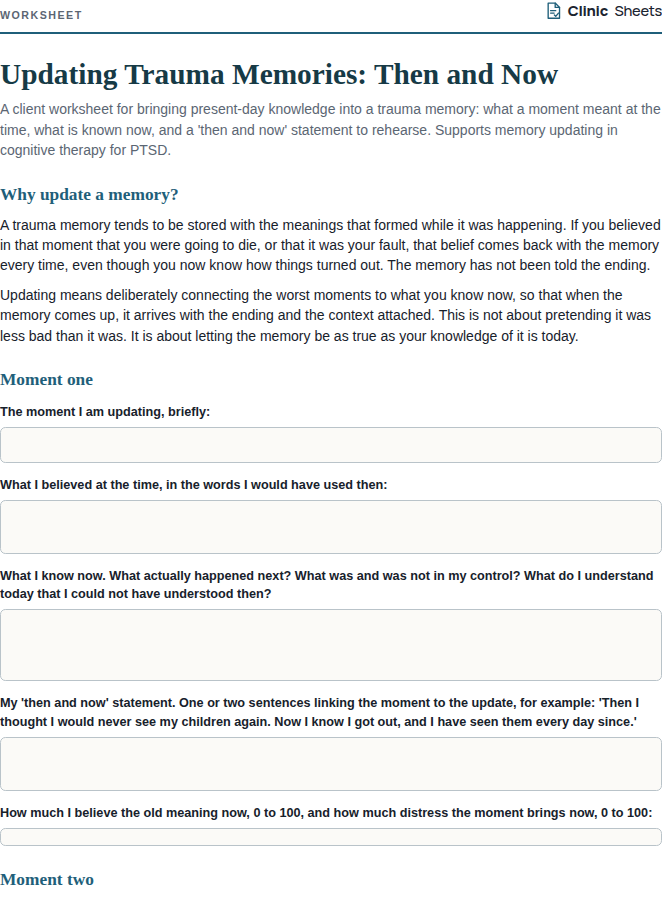
- Identify hotspots and their meanings after the first reliving, do cognitive work on each meaning outside the memory, then update the memory by reliving the hotspot and bringing in the new information.
- Assign between-session tasks every week: listening to recorded relivings where used, trigger discrimination practice, activities from the reclaiming-life plan, and behavioural experiments. Reserve the last two sessions for the blueprint.
References
- Ehlers, A., & Clark, D. M. (2000). A cognitive model of posttraumatic stress disorder. Behaviour Research and Therapy, 38(4), 319-345.
- Ehlers, A., Clark, D. M., Hackmann, A., McManus, F., & Fennell, M. (2005). Cognitive therapy for post-traumatic stress disorder: Development and evaluation. Behaviour Research and Therapy, 43(4), 413-431.
- Foa, E. B., Hembree, E. A., Rothbaum, B. O., & Rauch, S. A. M. (2019). Prolonged Exposure Therapy for PTSD: Emotional Processing of Traumatic Experiences, Therapist Guide (2nd ed.). Oxford University Press.
- Grey, N., Young, K., & Holmes, E. (2002). Cognitive restructuring within reliving: A treatment for peritraumatic emotional 'hotspots' in posttraumatic stress disorder. Behavioural and Cognitive Psychotherapy, 30(1), 37-56.