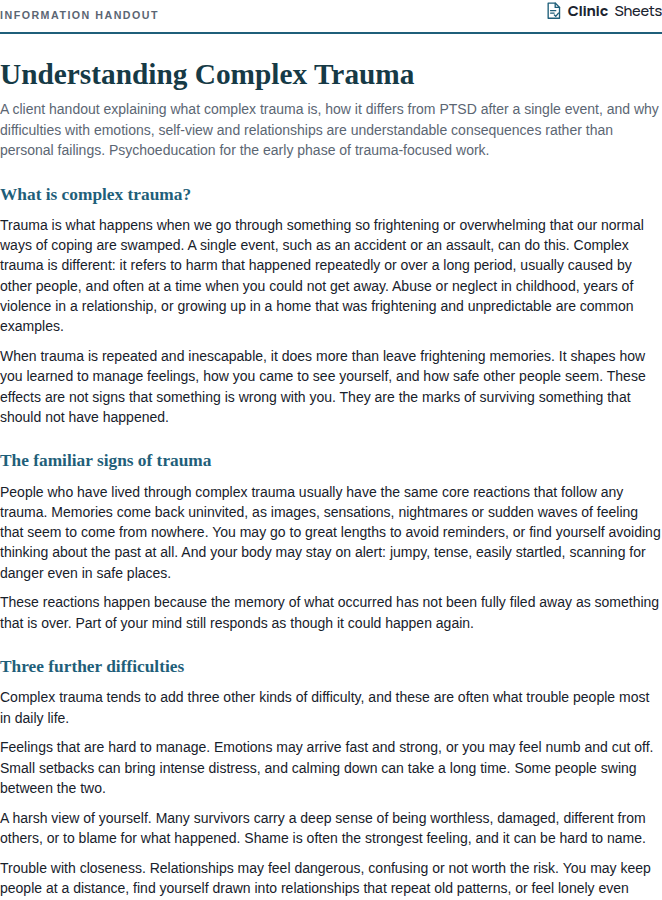
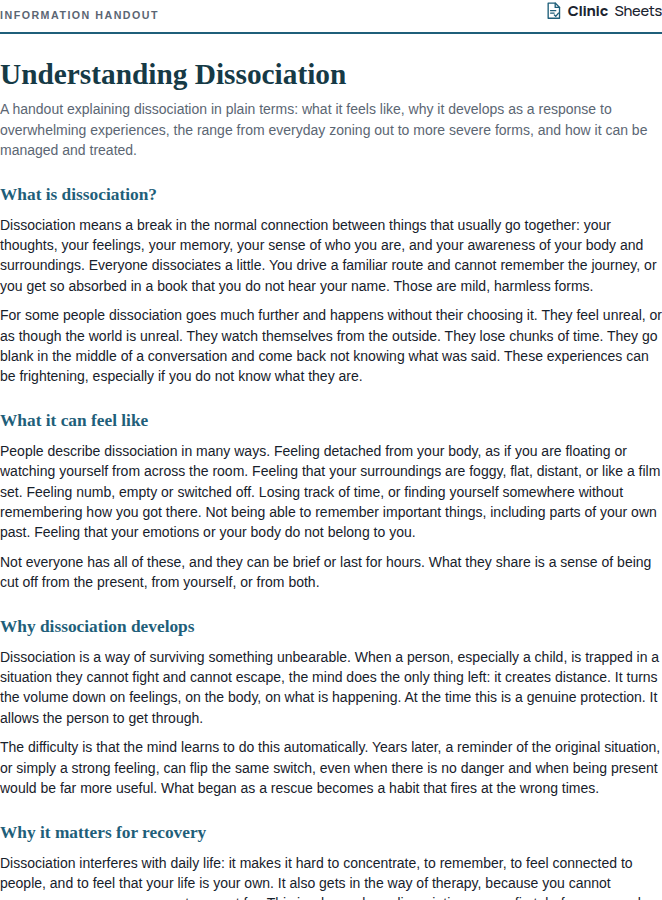
Trauma and Memory: Why Flashbacks Happen
A handout explaining why traumatic memories behave differently from ordinary memories, why flashbacks and intrusions feel like the event is happening now, and how trauma-focused therapy helps the memory get filed as past. Psychoeducation to prepare clients for memory work.
About this resource
Clients with PTSD are often bewildered and frightened by the behaviour of their own memory. They cannot recall parts of the event in order, yet a fragment of it can burst in with full sensory force at an unrelated moment. They may conclude that they are going mad, that the memory is dangerous, or that the only sensible course is to keep it locked away. This handout offers an alternative account that makes the symptoms intelligible and that points directly toward treatment.
The explanation draws on Ehlers and Clark's cognitive model and on Brewin's dual representation theory. Under extreme threat, attention narrows to sensory detail and the systems that ordinarily place an experience in context, sequence and time are disrupted. The result is a memory that is rich in sensations but poorly integrated with the rest of autobiographical memory: it is not tagged as 'over', it is easily triggered by superficial cues, and when triggered it is re-experienced rather than recalled. The handout uses the everyday image of a cupboard into which things have been thrown in a hurry, which keeps falling open until the contents are taken out and put away properly.
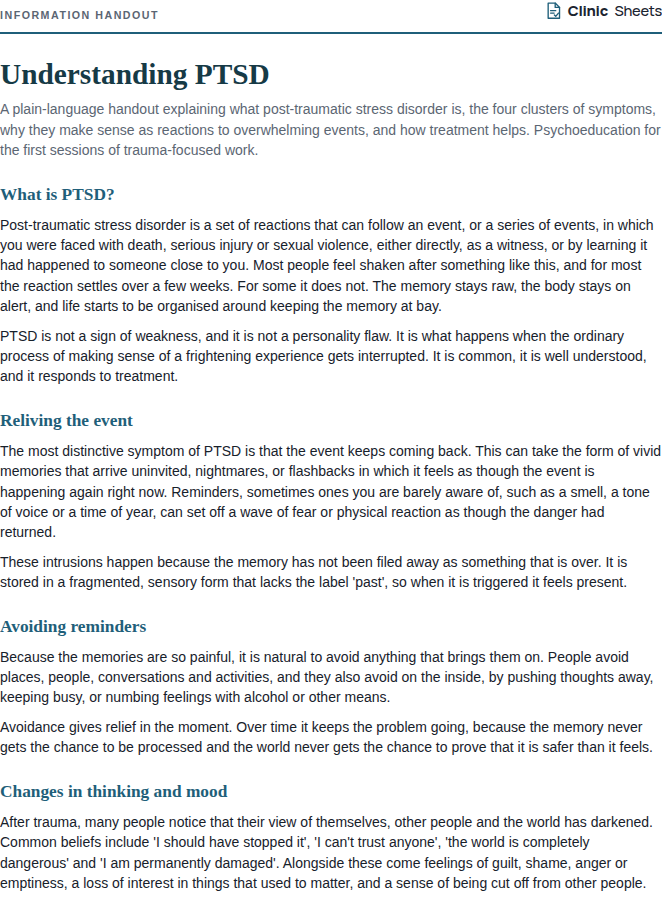
Use this after Understanding PTSD and before beginning reliving, narrative work, or EMDR processing. It gives the client a rationale for deliberately approaching the memory, which most have spent months or years avoiding. The professional version includes a discussion of how to present the model to clients with fragmented or absent recall, and suggested responses to the common objection that talking about the event will make things worse.
How to use it
- Introduce this in the session before memory work is due to start, once the client has a basic understanding of PTSD and is oriented to the treatment plan.
- Read the handout together. Pause after the section on ordinary versus traumatic memory and ask the client to give an example of each from their own life, without going into detail about the trauma itself.
- Ask the client to identify their own triggers, including sensory ones they may not have connected to the event before. Use these to illustrate why the memory is set off so easily.
- Link the explanation directly to the technique you will use: the cupboard needs to be unpacked so that each item can be labelled and put away, which is what reliving, writing the narrative, or EMDR processing does.
- Invite the client's doubts about approaching the memory and address them explicitly. Agree how pacing and grounding will be used to keep the work manageable.
References
- Ehlers, A., & Clark, D. M. (2000). A cognitive model of posttraumatic stress disorder. Behaviour Research and Therapy, 38(4), 319-345.
- Brewin, C. R., Dalgleish, T., & Joseph, S. (1996). A dual representation theory of posttraumatic stress disorder. Psychological Review, 103(4), 670-686.
- Brewin, C. R. (2014). Episodic memory, perceptual memory, and their interaction: Foundations for a theory of posttraumatic stress disorder. Psychological Bulletin, 140(1), 69-97.