Understanding PTSD
A plain-language handout explaining what post-traumatic stress disorder is, the four clusters of symptoms, why they make sense as reactions to overwhelming events, and how treatment helps. Psychoeducation for the first sessions of trauma-focused work.
About this resource
Many people who develop PTSD believe their symptoms mean they are weak, damaged or losing their mind. Early psychoeducation counters this by presenting the symptoms as understandable consequences of how the brain and body respond to overwhelming threat. Normalising the reaction reduces shame, builds a shared language for the work ahead, and often produces a measurable drop in distress before any trauma-focused technique is introduced.
This handout covers the four symptom clusters described in DSM-5 (re-experiencing, avoidance, negative changes in thoughts and mood, and hyperarousal), briefly explains the role of the threat system and of memory processing, and introduces the idea, drawn from Ehlers and Clark's cognitive model, that the sense of current threat is maintained by the way the memory is stored, the meaning the person has taken from the event, and the strategies they use to cope. It closes with what recovery looks like and what treatment involves, so that the client can make an informed choice about proceeding.
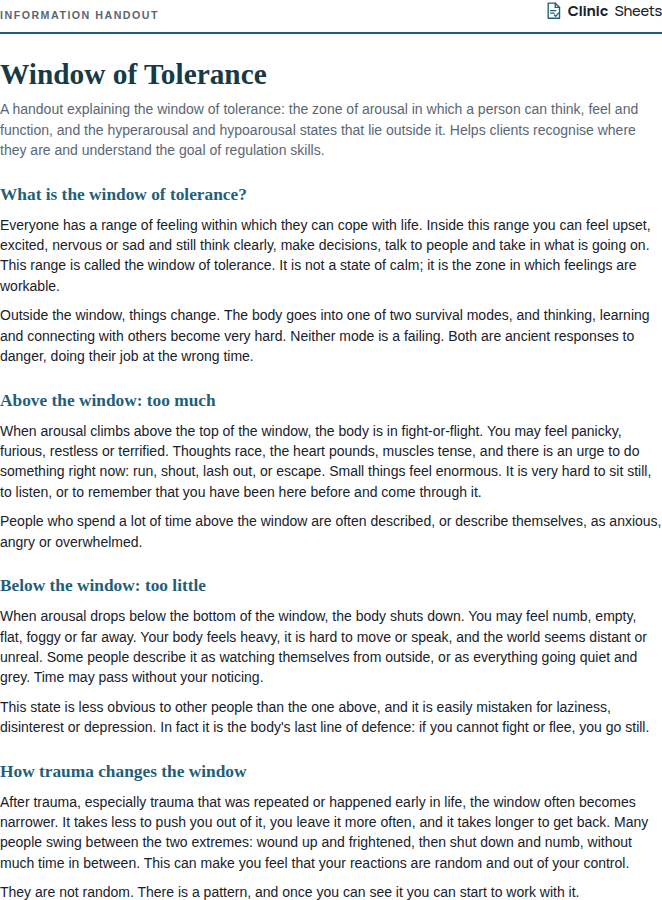
It is suitable for adults after a single traumatic event or repeated trauma. For clients with complex presentations, dissociation or ongoing danger, use it alongside the Window of Tolerance and Grounding Techniques resources and pace the discussion of the trauma itself accordingly. The professional version includes notes on adapting the language for clients who do not identify with the word 'trauma', on discussing symptoms without eliciting a full account of the event, and on which points to emphasise when the client's main fear is of losing control.
How to use it
- Use in the first or second session once the client has given a brief outline of what happened and what they are struggling with. A full trauma narrative is not needed at this stage.
- Read the symptom sections together and ask the client to mark those they recognise. Ask what they had made of each symptom before today.
- Draw out the client's own theory of why the symptoms have not faded. Use their answer to introduce the idea of an unprocessed memory and the coping strategies that keep it stuck.
- Explain the treatment plan in terms of the model: reducing the sense of current threat by updating the memory and its meaning, and dropping the strategies that maintain it.
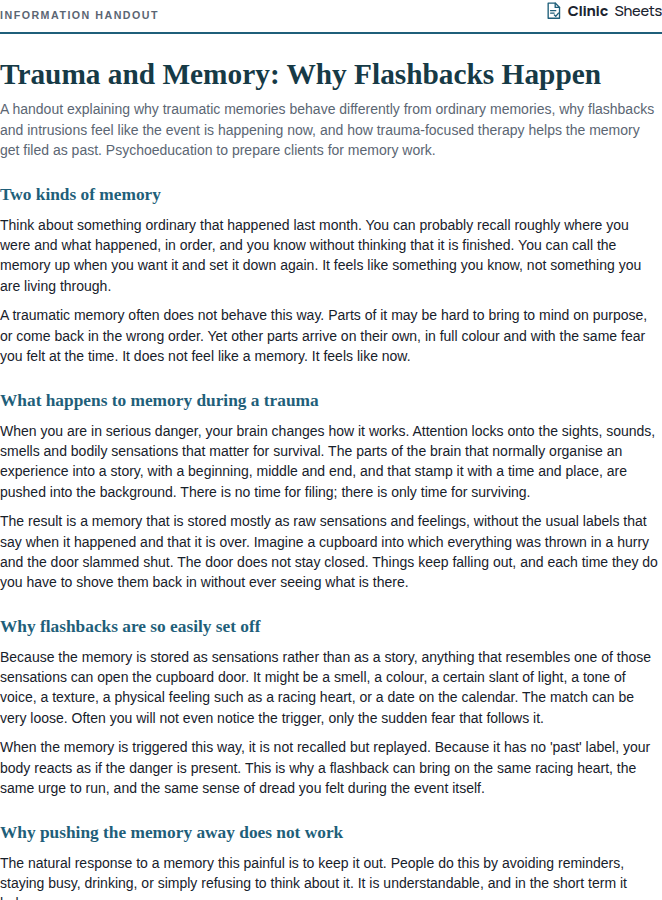
- Send the handout home and ask the client to note any questions or disagreements for the next session. Follow with Trauma and Memory: Why Flashbacks Happen.
References
- Ehlers, A., & Clark, D. M. (2000). A cognitive model of posttraumatic stress disorder. Behaviour Research and Therapy, 38(4), 319-345.
- American Psychiatric Association. (2013). Diagnostic and Statistical Manual of Mental Disorders (5th ed.). American Psychiatric Publishing.
- Foa, E. B., Hembree, E. A., Rothbaum, B. O., & Rauch, S. A. M. (2019). Prolonged Exposure Therapy for PTSD: Emotional Processing of Traumatic Experiences, Therapist Guide (2nd ed.). Oxford University Press.
- Brewin, C. R., Gregory, J. D., Lipton, M., & Burgess, N. (2010). Intrusive images in psychological disorders: Characteristics, neural mechanisms, and treatment implications. Psychological Review, 117(1), 210-232.