Hotspots in Trauma Memories
A worksheet for identifying the hotspots in a trauma memory: the moments of peak distress, the meaning each carried at the time, and the updated information that will be brought into the memory. Used by clinician and client together during memory-focused work.
About this resource
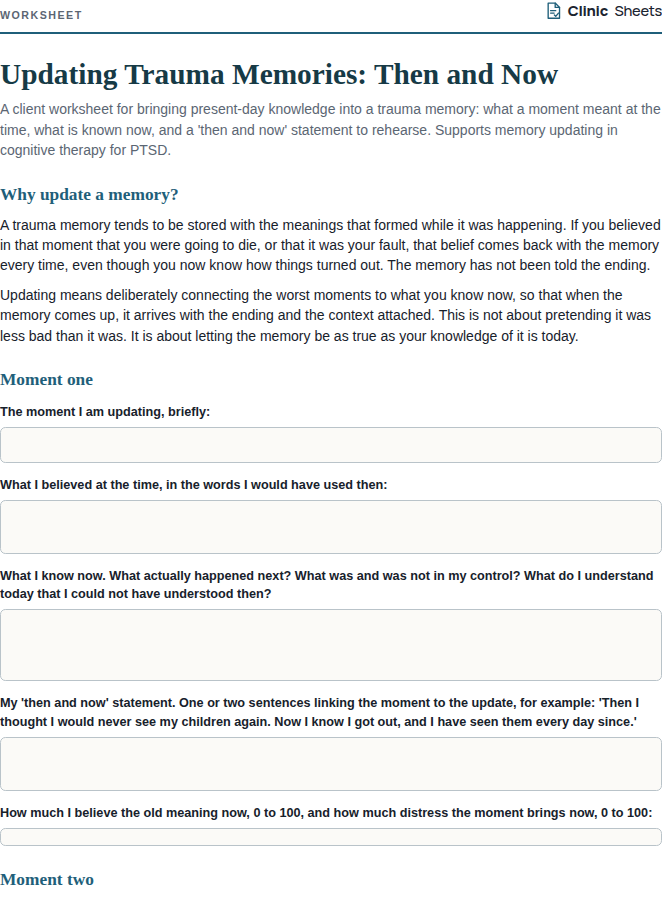
In cognitive therapy for PTSD, the moments within a trauma memory that carry the greatest distress are called hotspots. They are typically brief, often only a few seconds of the event, and each is linked to a specific meaning that was formed at the time: 'I am going to die', 'it is my fault', 'no one is coming', 'I am disgusting'. These peritraumatic appraisals are what make the memory intolerable, and they are frequently at odds with what the person now knows (they did not die; the outcome was outside their control; help did arrive). Because the memory was encoded during high arousal, the new knowledge has not been linked to it, and the hotspot continues to be re-experienced with its original meaning intact.
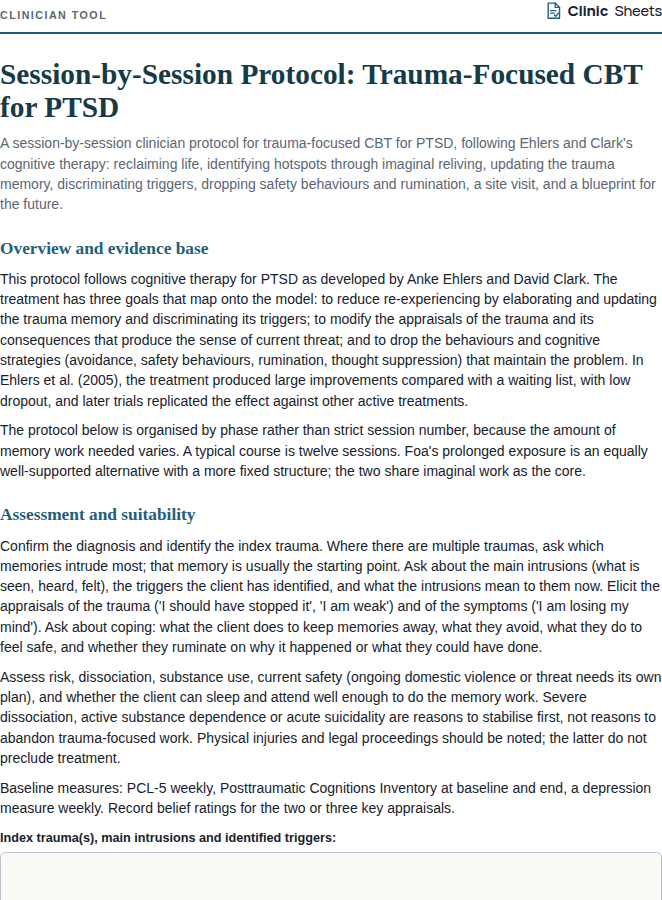
Grey, Young and Holmes described a method of cognitive restructuring within reliving, in which hotspots are identified through imaginal reliving, the meaning of each is drawn out, and updating information is brought into the memory at the relevant moment. Ehlers and Clark's cognitive therapy for PTSD uses the same principle. This worksheet gives that process a structure: a table of hotspots with the associated emotion, the meaning then, the evidence or information that updates it, and the phrase or image that will be used to insert the update.
The professional version notes that hotspots are found by asking the client where distress rises during reliving, not by inference; that emotions other than fear (shame, guilt, anger, disgust) are common and require different updates; and that updates may be factual, imaginal or drawn from the client's own values. It also flags the need to complete identification and updating within the same or closely spaced sessions to avoid leaving the client with hotspots opened but unresolved.
How to use it
- Use after the client has completed an initial account of the trauma, through reliving or written narrative, and you have noticed where distress peaks.
- Identify each hotspot with the client: ask where the worst moments were, what they were feeling at that instant, and what was going through their mind. Record the meaning in their words.
- For each hotspot, work out the updating information together. This may be a fact ('the paramedics arrived within minutes'), a reappraisal ('I froze because freezing is what bodies do'), or a reflection from the present ('I have lived twelve years since then').
- Agree on a short phrase or image that captures the update and can be brought into the memory. Then return to the hotspot in reliving and have the client hold the moment while stating or imagining the update.
- Re-rate distress and belief in the original meaning after updating. Repeat for the remaining hotspots over one or more sessions, and keep the completed worksheet as a reference for the client between sessions.
References
- Grey, N., Young, K., & Holmes, E. (2002). Cognitive restructuring within reliving: A treatment for peritraumatic emotional 'hotspots' in posttraumatic stress disorder. Behavioural and Cognitive Psychotherapy, 30(1), 37-56.
- Ehlers, A., & Clark, D. M. (2000). A cognitive model of posttraumatic stress disorder. Behaviour Research and Therapy, 38(4), 319-345.
- Ehlers, A., Clark, D. M., Hackmann, A., McManus, F., & Fennell, M. (2005). Cognitive therapy for post-traumatic stress disorder: Development and evaluation. Behaviour Research and Therapy, 43(4), 413-431.